The force sent to save Haiti is now the target
A foreign security mission meant to break the gangs took its first hard blow this week, and the vote that was supposed to follow it has been shelved with no new date. Haiti is being asked to trust a plan whose two halves are both slipping.
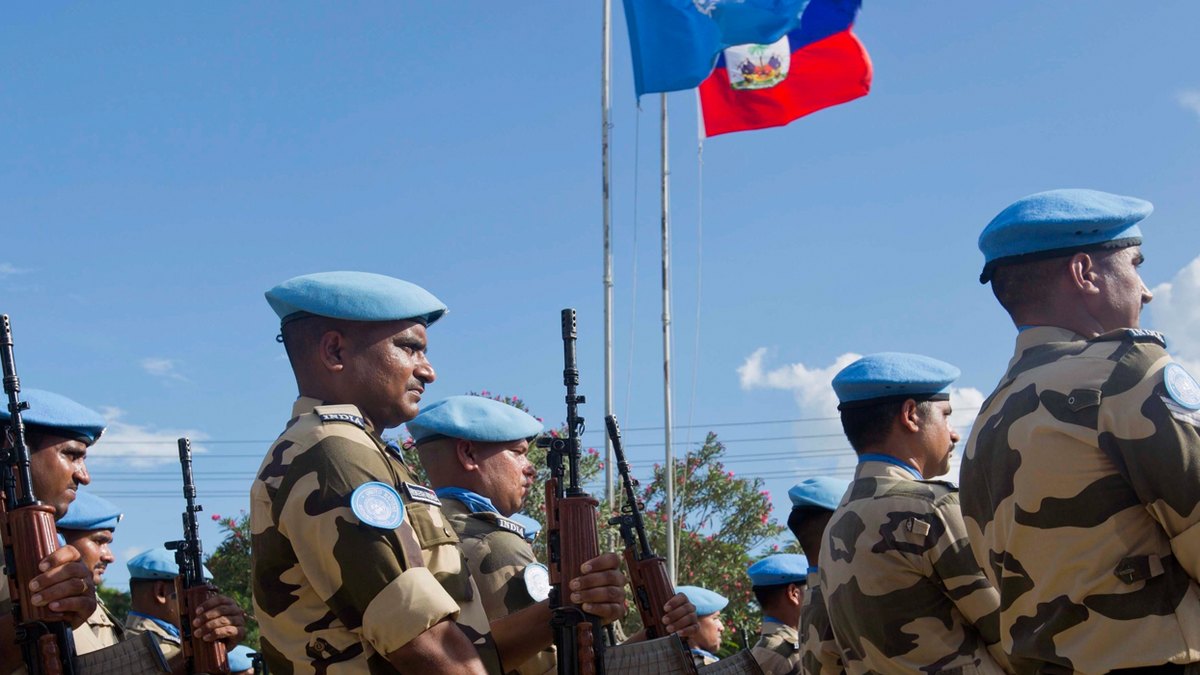
There is a particular kind of danger in a rescue that arrives slowly. For most of this year the people of Port-au-Prince have been told that help was coming in uniform, that a multinational Gang Suppression Force would do what the Haitian National Police could not, and that once the streets were quieter the country could finally vote. This week both halves of that promise cracked in public, on the same few days, in front of the United Nations Security Council and on a burning road in Croix-des-Bouquets.
On Sunday, October 18, 2026, gangs opened fire on an armored vehicle of the Gang Suppression Force in Croix-des-Bouquets, on the edge of the capital. Four Salvadoran soldiers went missing after fleeing the burning vehicle, and helicopters sent to recover them came under fire, according to Africanews, which reported the episode on October 20, 2026. As of Monday, October 19, their location was still unknown. El Salvador's military said, in remarks carried by Africanews and corroborated by CBC, that multiple attempts to reach the men by land and air had been made but were held back by the fighting. It was the first major attack on the force since it began operating roughly six months ago.
The symbolism was not lost on anyone. This was not the police being ambushed, nor a convoy of aid trucks. This was the force itself, the thing Haitians have been asked to pin their safety to, being hunted and, for a few hours at least, outmatched. Jack Christofides, the special representative attached to the mission, told the Security Council on Monday, October 19, 2026 that hostile incidents against the force had risen from 2 to 15 in a single month. His phrasing, reported by UN News on October 19, was blunt: the gangs are testing the force.
A mandate on paper, a fraction on the ground
The testing is happening against a force that is still mostly an idea. The Security Council authorized up to 5,550 uniformed personnel for the Gang Suppression Force. As of October 12, 2026, it had 1,563 of them, according to the UN briefing reported by UN News on October 19, and it had only recently established a base in the Artibonite region. That is a little more than one in four of the troops the plan calls for, asked to contest a capital where gangs control close to 70% of the territory, a figure cited by Africanews in its October 20 report.

Numbers like these are easy to read past, so it is worth sitting with the arithmetic. A force at 28% of its authorized strength is not a smaller version of the force that was promised. It is a different thing entirely, one that can hold a base and run operations in places but cannot yet blanket a city, cannot yet make the kind of permanent presence that changes how a neighborhood breathes. The gap between 1,563 and 5,550 is where this week's ambush lived.
The human ledger that the UN laid before the Council was grim and specific. Between July and early October 2026, gang violence killed 1,123 people and injured 440, according to figures presented at the October 19 briefing and reported by UN News. Some 689 women and girls were reported raped by gangs in July and August alone. Attacks on Kenscoff over August 23 and 24 killed 47 people, wounded 22, and took 52 hostage, of whom 13 were later freed. In the West and Artibonite departments, 241 people were killed for allegedly resisting the gangs. And in a detail that should trouble anyone who believes a security surge is cost-free, the same briefing reported that security-force operations caused 808 Haitians killed or wounded since early July, of whom 148, or 52%, were not associated with any gang.
The vote that will not come
If the force was the first half of the plan, the election was the second, and it is now gone from the calendar. The first-round presidential and legislative vote had been set for December 13, 2026. About two weeks before the Security Council met, it was shelved, with no replacement date announced. Carlos Ruiz Massieu, the senior UN official in Haiti, warned the Council against setting new dates without what he called a realistic assessment of their feasibility, according to UN News on October 19, 2026.
Haiti has not held national elections since 2016. The scale of what was being attempted, and the distance still to travel, shows in the registration figures Ruiz Massieu cited. More than 35 parties and groups and some 3,500 candidates had registered. But as of October 5, 2026, only 759,257 voters were on the lists, out of an estimated electorate of 6.5 million. A vote built on roughly one in nine eligible voters would have carried its own legitimacy problem even if the security picture had been calm, and it is not calm.
So the honest reading is that the postponement was not a failure of will so much as an admission of fact. You cannot register voters in neighborhoods you do not control, and you cannot ask people to queue at polling stations in a city where 15 hostile incidents a month are now aimed at the very force meant to protect them. The postponement is defensible. What is not yet visible is the thing that is supposed to replace a date, which is a credible path to the conditions under which a date would mean something.
Words from far away
Into that vacuum came the familiar sound of distant resolve. Mike Waltz, the United States ambassador to the United Nations, addressed the gang bosses directly, saying that their days of operating with impunity were numbered, in remarks reported around the October 19 briefing. It is the kind of line that reads well in a headline and lands softly in Cite Soleil. Haitians have heard many numbered days. What changes a gang leader's calculation is not a sentence in New York but a soldier on the corner who does not leave, and this week the supply of those soldiers was shown to be both thin and, for the first time, mortal in the eyes of the gangs.
There is a regional dimension here that the Ledger's readers should not miss. The Gang Suppression Force is a Caribbean and hemispheric project in all but name. Salvadoran troops are the ones now missing. Kenyan police led the earlier mission. Caribbean governments have supplied personnel and political cover through CARICOM, which has spent two years trying to broker Haiti's transition. Every one of those contributors is watching Croix-des-Bouquets and asking a quiet question about exposure. A mission that loses soldiers without recovering them, and without visibly degrading the gangs that took them, becomes harder to staff, not easier. The ambush was aimed at four men. Its intended audience was every capital still deciding whether to send a fifth.
What the plan needs now
The architecture of Haiti's transition rested on a sequence: secure, then register, then vote, then govern. This week the sequence was interrupted at the first step and abandoned at the third. That does not mean the plan is wrong. It means the plan has been honest, finally, about how far behind schedule it is, and the people who designed it owe Haitians more than a new slogan in place of a new date.
Three things would signal that the correction is real rather than rhetorical. The first is force generation, the unglamorous work of getting from 1,563 toward 5,550 with troops who are equipped and sustained, because a mission that stalls at a quarter strength will keep being tested until it breaks. The second is the recovery, accounting, and protection of the personnel already deployed, because contributor governments read casualty reports more closely than communiques, and a force seen as a trap will not grow. The third is a registration and security benchmark, stated plainly, that would have to be met before an election date is set again, so that the next date is a destination rather than a hope.
Haiti's economy is heading into what the UN described on October 19 as a seventh consecutive year of contraction, with roughly 1.5 million people displaced, including more than 740,000 children, and the 2026 humanitarian plan only about half funded. Those are not separate facts from the security story. They are what the security story is for. A quieter Port-au-Prince is the precondition for every other thing Haitians need, which is why the stakes of a 1,563-strong force being tested are so much larger than the force itself.
The grim truth of this week is that Haiti was asked to trust a plan whose two moving parts both slipped at once. The force meant to clear the way took its first hard blow and held, barely, with men still unaccounted for. The vote meant to follow it was taken off the calendar with nothing firm to put in its place. A rescue that arrives slowly is still, in principle, a rescue. But the slower it arrives, the more it starts to look to the people waiting like something they are expected to survive rather than something that will save them. The gangs understand that calculation perfectly. This week they made the force understand it too.
Read more at The Caribbean Ledger ›