Guyana signs its security to Washington, and asks the region to follow its logic
A defence declaration at the Pentagon binds a small, suddenly rich country to the United States at the exact moment the Caribbean is split over how close is too close.
GEORGETOWN. There is a particular kind of handshake that changes a country's weight in the world, and Guyana had one this week. On Wednesday, October 21, 2026, President Irfaan Ali stood in the Pentagon beside the United States Secretary of War, Pete Hegseth, and signed a Joint Declaration for an Enhanced Defence Partnership.
The language of the document is the careful language of alliances. The meaning underneath it is simpler. A nation of roughly 800,000 people, sitting on one of the largest oil discoveries of the century and claimed in part by its far larger neighbor, has decided that its insurance policy is written in Washington.
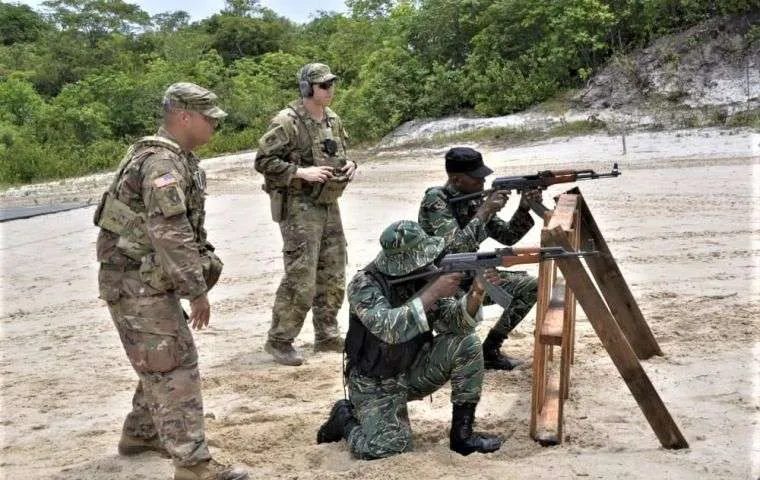
The declaration, reported by Kaieteur News on October 22 and confirmed the same day by the Guyana Chronicle and by News Source Guyana, commits the United States Department of War to what the American side called sustained defence expertise, multidomain training and combined exercises with the Guyana Defence Force. It promises to strengthen Guyana's awareness of its own airspace, its ability to monitor, deter and respond to threats in and around its territory. It aligns the two governments against what both describe as narcoterrorist organizations, building on the Americas Counter Cartel Coalition and the initiative Washington has branded Shield of the Americas. News Source Guyana reported that it sits alongside a separate memorandum on critical minerals, tying the two countries' resources to what the Americans called a shared defence industrial base.

Read the official quotes and you hear two men selling the same idea to different audiences. For his domestic audience, President Ali reached for history and momentum. "This landmark declaration builds on our multi-decade partnership with the United States," he said, before adding the line his government will repeat for weeks: "This is the era of action; this is the era of leadership." For his, Secretary Hegseth reached for flattery with a purpose. "Your leadership across the region with key Caribbean partners has been indispensable," he told Ali, and, "When we work together, we can advance our shared interests in this hemisphere."
What the paper does not say
It is worth being precise about what the declaration contains, because the temptation to read everything into it will be strong. None of the three Guyanese outlets that confirmed the signing recorded the word Venezuela in it. None recorded the word Essequibo. The confirming reports refer only to Guyana's sovereignty and territorial integrity, and to the shared goal of limiting military influence from outside the Western Hemisphere.
There were no troop numbers, no ship names, no dollar figures. A reader looking for a mutual defence treaty, the kind that commits American soldiers to a border, will not find one here. This is a framework for training, exercises and intelligence sharing, not a tripwire.
And yet the context does the work the text declines to do. Guyana's western two-thirds, the region it calls Essequibo, is the subject of a claim Venezuela has pressed with renewed energy for three years, and the case sits before the International Court of Justice. Guyana's oil, pumped from the Stabroek block by an ExxonMobil-led group, has turned a once-marginal economy into one of the fastest growing on earth.
The country's 2026 mid-year report projected around 5.97 billion United States dollars from its share of production plus about 508 million dollars in royalties, figures the Antigua and Barbuda ambassador Sir Ronald Sanders cited in his October columns in the Jamaica Gleaner and Kaieteur News. A country does not sign a defence declaration at the Pentagon in a vacuum. It signs one because it has something to lose and someone it would like to deter.

The alliance arrives at an awkward hour
Here is the complication the Ledger has tracked all month. Guyana is deepening its military integration with the United States at the precise moment the wider Caribbean is arguing about exactly that. Washington's campaign in and around the Caribbean, the maritime operation it has styled Southern Spear, has divided the region. The Community of fifteen, CARICOM, declared the Caribbean a Zone of Peace long ago and has invoked that declaration repeatedly as American forces have operated in nearby waters.
Some member states have objected to the strikes and the surveillance. Others have been quieter. Guyana, by signing this week, has placed itself at the far end of that spectrum, as the CARICOM member most openly comfortable with an American military footprint.
That is not a reversal so much as an acceleration. The two governments signed a Statement of Intent in Georgetown in December 2025, and in March 2026 announced a counter-cartel security declaration under the Shield of the Americas banner. The Pentagon ceremony is the next and most visible step on a path Georgetown chose some time ago. What is new is the altitude.
A statement signed by advisers at State House is a working document. A declaration signed by a head of state at the Pentagon, photographed and broadcast, is a statement of identity. Guyana is telling its neighbor across the border, and its partners around the sea, where it stands.
There is a second awkwardness, and it belongs to Washington rather than Georgetown. The same United States that is arming and training Guyana against outside military influence has spent recent weeks warming to Caracas on the one subject that matters to both capitals, which is oil. The Ledger reported on October 22 on the licenses, the Chevron ramp back toward 280,000 barrels a day, and the quiet normalization of Venezuelan energy into regional and American markets.
A government can pursue security cooperation with one hand and commercial pragmatism with the other. Small states living next to the consequences are entitled to ask how the two hands are meant to work together, and what happens to them if the hands move in opposite directions.
Minerals, and the price of a patron
The critical-minerals memorandum that News Source Guyana reported alongside the defence declaration is the part most likely to matter in ten years. The language, a shared defence industrial base, is the language of supply chains, of a United States trying to reduce its dependence on Chinese processing of the metals that go into batteries, magnets and munitions. Guyana's geology is not yet proven at scale for those minerals, and no one should pretend otherwise.
But the direction is clear. Washington is no longer offering Caribbean partners only aid and advice. It is offering to buy things, and to build things, and that is a more durable kind of relationship than a photograph.
The question the rest of the region will weigh is the oldest one in small-state diplomacy. A patron offers protection, and protection is worth having when a larger neighbor is pressing a claim to two-thirds of your territory. A patron also sets terms, and the terms are rarely written down in the declaration you sign at the beginning. Guyana has decided the trade is worth it.
Hegseth's closing line, as News Source Guyana reported it, was telling in its candor: "We've only just begun on that project, and your investment has inspired confidence for us." Investment. Confidence. The vocabulary of a transaction, not a favor.
There is also a question of sequence that the region will notice. The declaration follows a pattern of escalating commitments rather than a single leap. Georgetown and Washington signed a Statement of Intent in December 2025 and announced a counter-cartel security declaration in March 2026, and each step was quieter than the last is loud. A government that wanted to keep its options open would have stopped at the working-level documents.
Guyana did not. It chose the Pentagon, the cameras and the head-of-state signature, which is a decision about posture as much as about capability. The country that four years ago avoided taking sides in hemispheric security debates has now, visibly and deliberately, taken one. Its oil revenue is what makes the choice affordable, and its border dispute is what makes it feel necessary.
For Guyanese citizens, the near-term effects will be concrete and, for most, welcome. Better radar and air surveillance over the Stabroek block and the Essequibo frontier. Training that lifts a small army's competence.
A louder American voice if the dispute with Venezuela turns hot. For the Caribbean as a whole, the effect is subtler and harder to price. The Zone of Peace was always more aspiration than enforcement, a shared promise that the region would not become a theater for other people's wars.
One of its members has now decided that, for its particular geography and its particular wealth, the promise is a luxury it cannot afford. Georgetown would say it is simply being honest about the world as it is. Its neighbors, watching the photograph from the Pentagon, will decide for themselves whether that honesty is a model or a warning.
What is not in doubt is the trajectory. Three years ago Guyana was a footnote in regional security conversations. This week its president signed, at the headquarters of the American military, a document that makes his country a hinge between Washington's hemispheric strategy and the Caribbean's stated preference for staying out of it.
The declaration is light on specifics and heavy on intent. In diplomacy, as in oil, intent is usually the part that compounds.
Read more at The Caribbean Ledger ›