When the power fails, the water stops: Cuba's crisis reaches the tap
A grid deficit near 1,800 megawatts is no longer only about light and heat. On Friday it cut water to more than 2.7 million Cubans, as broken pumps and aging pipes turned a power emergency into a public-health one.
HAVANA. The numbers Cuba's own electricity utility published for Friday, October 23, 2026, describe a system running on a third of what it needs. The Union Electrica forecast a peak-hour shortfall of about 1,820 megawatts, with available generation of roughly 1,030 megawatts against a maximum demand near 2,850, figures relayed from the utility's daily report. The night before, the deficit had held across all 24 hours and peaked at 1,820 megawatts in the early evening.
Thermal plants are the proximate cause: units at Santa Cruz, Felton, and Renté were out of service with breakdowns, others were in maintenance, and the utility counted some 453 megawatts of thermal generation simply unavailable.
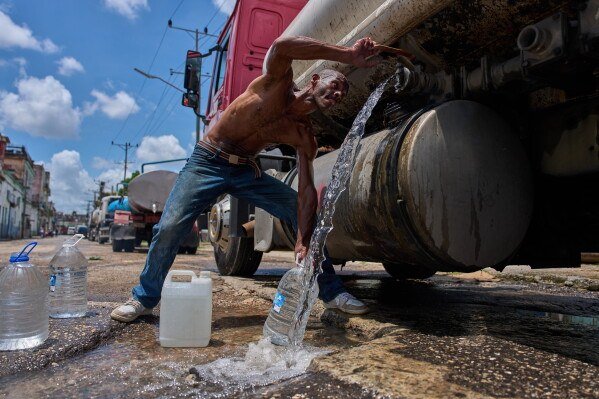
What makes this week's report different is where the shortage now lands. Cuba's National Institute of Water Resources said more than 2.7 million people had their water supply disrupted on October 23, attributing the problem mainly to the power outages and to breakdowns at water sources, compounded by a pipe network degraded by years of underinvestment, according to the wire service ABC Color. In Havana, a break in a main line at Cuenca Sur, the capital's largest supplier, hit more than 200,000 residents across three municipalities. Yunior González, a senior official of the institute's water and sanitation group, told state television the impact was "very large," and that even after the repair, restoring service took six to seven hours.

Supply problems were also reported in Pinar del Río, Artemisa, Granma, and Holguín.
The sun helps, but not at night
The Cuban government's answer, pursued with real urgency, is the sun. Solar photovoltaic parks produced 3,980 megawatt-hours on Thursday, October 22, and peaked at 619 megawatts around midday, a figure that shows the buildout is now a measurable daytime contributor to the grid. It is also a figure that defines the limit of the strategy as currently built. Solar peaks at noon and vanishes by evening, which is precisely when Cuban demand peaks and the deficit runs near 1,800 megawatts.
Without storage at scale, the panels shave the midday gap and leave the nighttime one untouched. The government says it has installed solar specifically to support water pumping, a sensible targeting of scarce new capacity at the most urgent need, and more than 300 emergency works are underway.

The context behind the breakdowns is a fuel crisis that the government traces to the tightening of United States sanctions and to the loss of reliable oil imports, a squeeze that the global oil story on this weekend's front page can only make worse: a Cuba that struggles to buy fuel at any price faces a market where the price has just jumped to a six-month high. The result is a country where the electricity emergency and the water emergency have merged into a single failure, and where the distance between a technical problem (a broken pump) and a human one (a family without running water for days) has collapsed to nothing.
Why this is the island to watch
Cuba is an extreme, shaped by sanctions, isolation, and the longest-running underinvestment in the region. But the mechanism on display this week is not exotic. It is what happens when an electricity system built on imported fuel loses access to that fuel and has not yet replaced it with something domestic and firm. Every importer in the Caribbean sits somewhere on the same spectrum, further from the edge but on the same line.
The renewable buildout Cuba is racing to complete is the same transition St. Kitts and Nevis, Barbados, and others are pursuing from a position of relative strength and stability. The lesson Cuba is teaching, at terrible cost to its own people, is that the transition is not a green luxury. It is the difference between a grid that holds and a tap that runs, and a grid that fails and a tap that does not.
The Ledger will keep watching, because the question Cuba is answering the hard way is one the whole region will eventually be asked.
Read more at The Caribbean Ledger ›