St. Kitts and Nevis sells out a retail bond built for households, not institutions
The federation's first Household and NGO Retail Bond was fully subscribed at EC$10 million after being expanded twice, a modest sum that the government reads as an outsized vote of confidence.
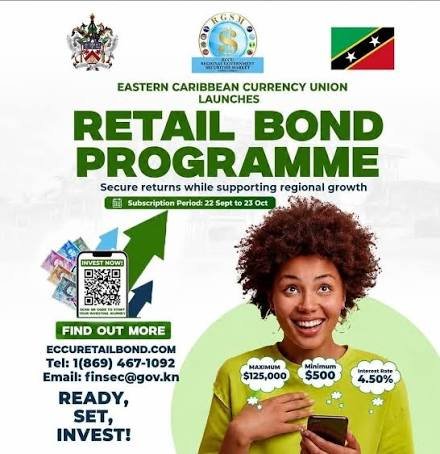
BASSETERRE. The government of St. Kitts and Nevis has fully subscribed its inaugural Household and NGO Retail Bond at EC$10 million, after demand forced it to expand the offering twice, the St. Kitts and Nevis Information Service reported on October 21, 2026.
The instrument was designed from the start to be unusual. Where a typical issue on the Regional Government Securities Market sets a minimum investment of EC$5,000, pricing out most ordinary savers, this bond set the floor at EC$500, with increments of EC$100, and aimed itself squarely at households, families, churches, cooperatives, charities, and non-governmental organizations.
The uptake tells the story the government wants told. Launched on September 22, 2026, the bond started at EC$5 million and sold out within two weeks. It was expanded to EC$8 million and sold out in under a week. The cabinet added a further EC$2 million, and that too was fully taken up.

The result is a two-year instrument paying a fixed 4.5% a year, with interest paid every six months and principal due on October 26, 2028.
Financial Secretary Carlton Pogson announced the result at the 2027 National Budget Forum on October 20, and read it as a barometer. "We started out at five million. That was fully subscribed within two weeks," he said, describing a response that reflected "a high level of confidence in the economy of St. Kitts and Nevis." At the launch, Eastern Caribbean Central Bank Governor Timothy N.
J. Antoine had framed the exercise in broader terms, as a regional effort at financial inclusion, a way to let small savers hold a stake in their own government's debt rather than leaving that market to banks and institutions.
The sum is small in absolute terms, and the government is careful not to oversell it as a financing event. EC$10 million does not reshape a national budget. Its significance is political and developmental rather than fiscal. A retail bond that sells out three times over is a signal that ordinary citizens are willing to lend to their own state at 4.5%, and it builds a domestic savings habit and a retail investor base that a small economy can draw on again.
It also fits the federation's wider Sustainable Island State agenda, which depends on mobilizing local capital alongside the citizenship-by-investment revenues and external financing the government has leaned on. The 2027 budget forum at which Pogson spoke was itself themed around accountability and resilience, with Acting Prime Minister Geoffrey Hanley stressing what he called evidence and candor in public finance. The federation has made domestic capital formation a theme of its economic messaging, arguing that an economy overexposed to citizenship-by-investment receipts and external borrowing needs a deeper home-grown savings base to steady it. A retail bond is a small but deliberate step in that direction, turning citizens into creditors of their own state and giving the treasury a pool of patient local money it can tap again.
Whether the government returns to the well with a larger issue, and whether the appetite holds at a higher volume, will be the real test of the idea. A fully subscribed people's bond is a modest down payment on that promise, and the government intends to make more of them.
Read more at The Caribbean Ledger ›