Greenidge: 2% growth is stability, not weakness
The central bank reports 1.4% growth in the first half, reserves near US$3.1 billion and debt at 93.7% of GDP, with a new precautionary IMF arrangement. Tourism is the soft spot.
BRIDGETOWN. Barbados has settled into a slower, steadier gear, and its central bank governor spent this week arguing that slower is not the same as weaker. Reviewing the economy on Tuesday, October 20, 2026, in remarks reported by Barbados Today, Central Bank Governor Dr Kevin Greenidge said growth had eased to around 2% after the rapid post-pandemic rebound, and he pushed back directly on any gloomy reading of that number. "Growth of around two per cent should not be read as economic weakness or contraction," he said.
The figures behind the statement describe an economy that is stable but working harder for each point of growth. The economy expanded 1.4% in the first six months of 2026, Greenidge reported, carried largely by domestic sectors such as business and other services and by wholesale and retail trade. The central bank projects roughly 2% for the full year, close to the 1.9% that Afreximbank has forecast.
Reserves and the fiscal frame
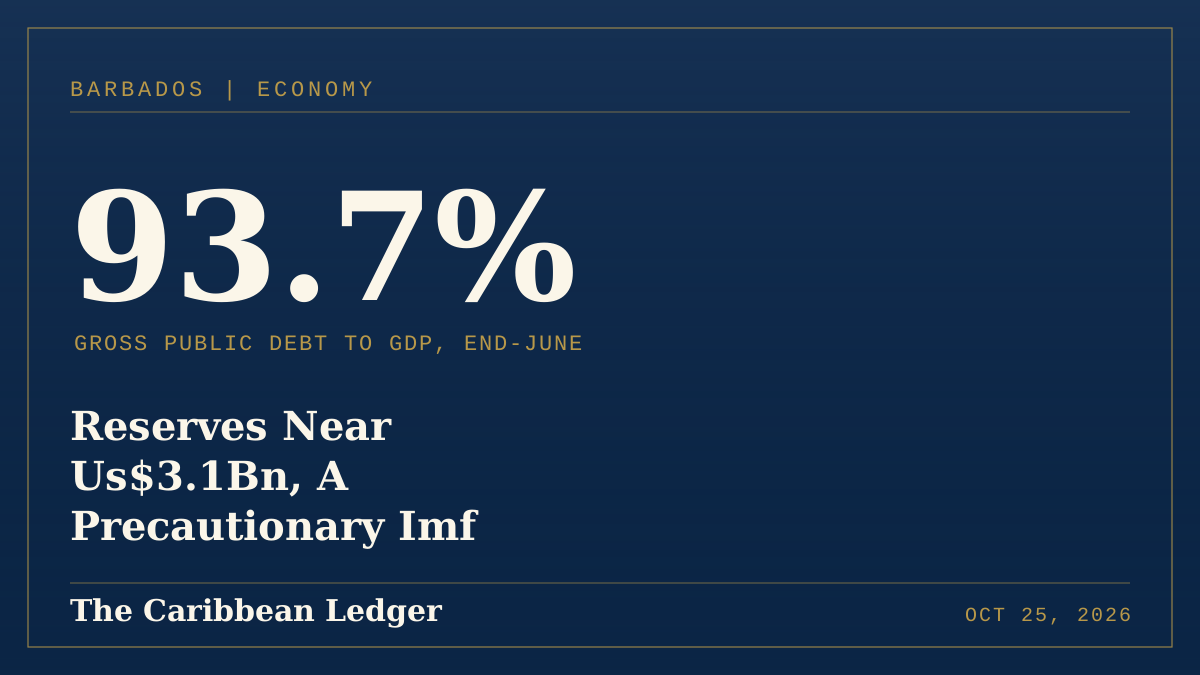
The balance sheet is the stronger part of the story. International reserves stand at around US$3.1 billion, and Greenidge described the financial system as well capitalized and liquid. Gross public sector debt was 93.7% of gross domestic product at the end of June, according to the central bank's latest estimate, still high but on a declining path under a program that targets a primary surplus of 3.5% of GDP for the current and following fiscal years and aims to bring debt down to 60% of GDP by the 2035-36 fiscal year.
Barbados also secured a new US$257 million Stand-By Arrangement with the International Monetary Fund, which Greenidge was careful to frame as precautionary, insurance against external shocks rather than money the country currently needs to draw. For an economy that has spent the past decade rebuilding credibility after its 2018 debt restructuring, a precautionary facility is a vote of confidence as much as a backstop.
Where the risks sit
Tourism, the island's engine, was softer than the bank had expected. Greenidge noted shorter stays, higher airfares and reduced airlift capacity in key markets. Tourism earnings rose 3.7% year-on-year in the first quarter but slipped below 2025 levels from April to June, leaving first-half earnings up only US$10.9 million on the year. He pointed to the broader investment pipeline, tourism developments, roads, water, energy and housing, as the driver that has to carry growth beyond tourism alone.
The governor was candid about the risks, listing geopolitical tension, trade uncertainty, higher freight and energy costs, international interest rates, weaker tourism demand and climate-driven disasters. That last item is not abstract for a small island state, and it links Barbados's macro story to the wider regional argument, led by its own prime minister, for climate-sensitive financing. The Ledger's reading is straightforward: Barbados is not booming, but it is sound, and after the turbulence of recent years, sound is a currency the island has earned the right to value. Every figure in this report traces to the central bank governor's October 20 review as reported by Barbados Today.
Read more at The Caribbean Ledger ›