5.6% in a single month: the DR is pulling away from the region
The Banco Central says the economy grew 5.6% in September and 4.6% over nine months, with inflation easing to 5.12%. It is the clearest sign yet that Santo Domingo's scale is in a class of its own.
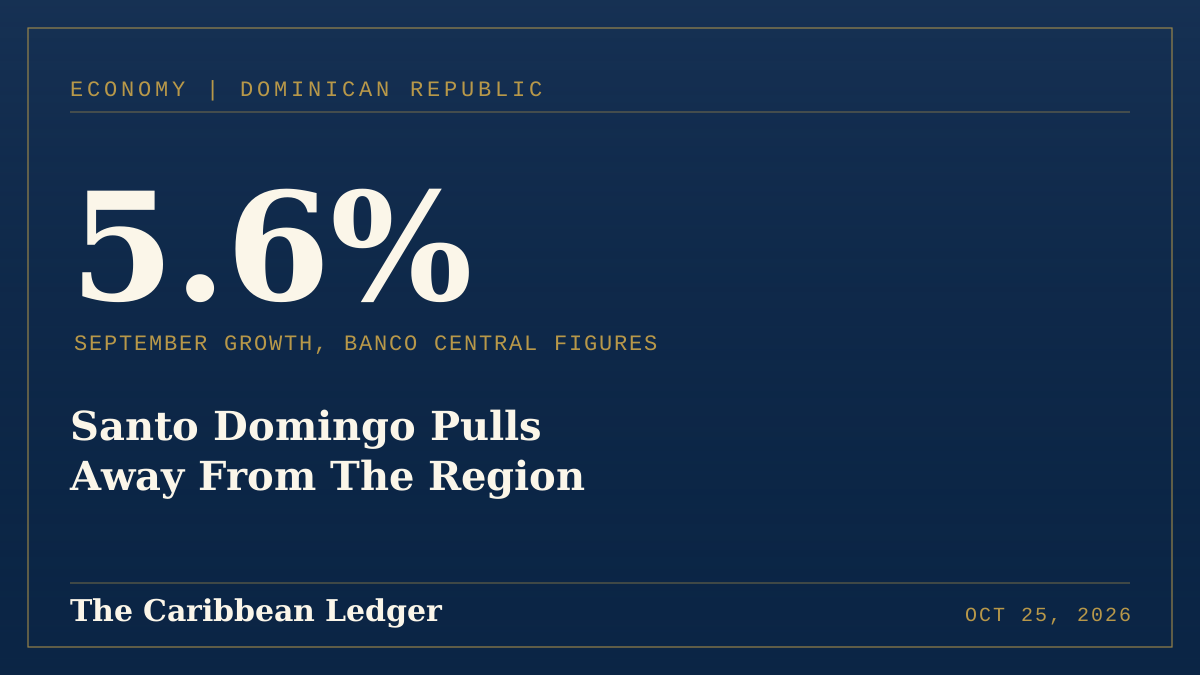
SANTO DOMINGO. The Dominican Republic is once again the region's growth engine, and its central bank spent the weekend making sure everyone knew it. At the Banco Central's 79th anniversary observance, Governor Héctor Valdez Albizu reported that the economy expanded 5.6% in September, according to figures carried by Dominican Today on October 24, 2026. That single month lifted growth for the first nine months of 2026 to 4.6%, and the bank expects the year to close around 4.5% expansion.
In a Caribbean where most economies grow at 1% to 2%, those numbers are in a different league.

Where the growth is coming from
The composition is as telling as the headline. According to the central bank figures reported by Dominican Today, services led the way with 4.6% growth over the first nine months, and within services the spread was wide: financial services up 7.8%, hotels, bars and restaurants up 5.6%, and other services up 5.4%. Local manufacturing grew 3.4% and the free zones, the export-assembly platforms that anchor the country's trade with the United States, grew 2.8%. Construction and mining and quarrying were flat by comparison, each up 0.2%.
This is a services-and-tourism expansion with a healthy export-manufacturing floor underneath it, which is a more durable mix than a boom driven by any one sector.

Inflation, the usual price of fast growth, is behaving. Valdez Albizu said year-on-year inflation had moderated to 5.12%, down from a peak of 5.67% in June, and that he expected it to fall within the central bank's target range in the final quarter. A central bank that can report nearly 5% growth and cooling prices in the same breath has, for now, threaded a difficult needle.
The 2036 ambition
Behind the monthly data sits a larger bet. President Luis Abinader has built his second-term economic program around what his government calls Meta RD 2036, a stated goal of doubling the size of the Dominican economy by 2036. To hit it, the country needs to sustain growth near 5% for a decade, and Abinader has spent recent weeks selling that story abroad. The portal dr1 reported on October 15, 2026 that the president courted Italian business leaders in Rome, pitching the Dominican Republic as a regional hub for investment, and he has used international platforms to highlight poverty reduction and record exports.
The reading
For the wider Caribbean, the Dominican Republic matters in two ways. It competes hard for tourists, call-center work and factories that smaller islands might otherwise win, and it shows what scale, a diversified economy and steady policy can deliver. The risks are external rather than domestic. Roughly half of Dominican trade and tourism is tied to the United States, so any tightening of American demand, any new tariff on free-zone exports, or any sustained rise in global freight and energy costs would be felt first in Santo Domingo.
Three engines explain the Dominican outperformance, and each is worth naming. Tourism is the headline, with the resorts of Punta Cana and the north coast drawing visitor numbers that dwarf any single Eastern Caribbean destination, and the hotels, bars and restaurants line of the national accounts, up 5.6% over nine months, reflects it directly. The free zones are the second engine, assembling medical devices, electrical goods and textiles for the United States market under a trade relationship that has so far survived Washington's wider tariff turn. The third is construction and public investment, financed by a state whose tax base has broadened with the economy.
Remittances from the large Dominican diaspora in the United States add a steady fourth stream, though the Ledger has reported the regional risk that a new American remittance levy poses to exactly those flows. Financial services, up 7.8%, sit on top of all of it, the sign of an economy deepening rather than merely expanding. Set against its neighbors, the gap is stark: while Barbados grows near 2% and most Eastern Caribbean states manage 1% to 3%, Santo Domingo is compounding at close to 5%, and compounding is how small annual differences become vast ones over a decade.
The caution worth keeping is that a single strong month, 5.6% in September, is not a trend, and the Ledger reports it as the central bank's own figure rather than as a settled fact about the year. But the direction is unmistakable. The Dominican Republic entered the final quarter of 2026 growing faster than almost anyone in the hemisphere, with inflation easing and a decade-long doubling target that, on this evidence, is not fantasy. For the Ledger, the discipline is the same as everywhere else in this edition: the 5.6% September figure, the 4.6% nine-month pace and the sector breakdown are the central bank's own numbers, reported by Dominican Today on October 24, and we present them as the institution's figures rather than as independently audited fact.
The direction, though, has been consistent for long enough to be more than a one-month surprise.
The question is whether the smaller economies around it can capture any of the slipstream, or whether the gap between the region's one large success and everyone else simply keeps widening.
Read more at The Caribbean Ledger ›