A billion barrels in under seven years, and a US$4 billion fund to manage
ExxonMobil says the Stabroek block passed one billion barrels on September 28. The production is extraordinary. The harder question is how Georgetown spends a sovereign fund now above US$4 billion.
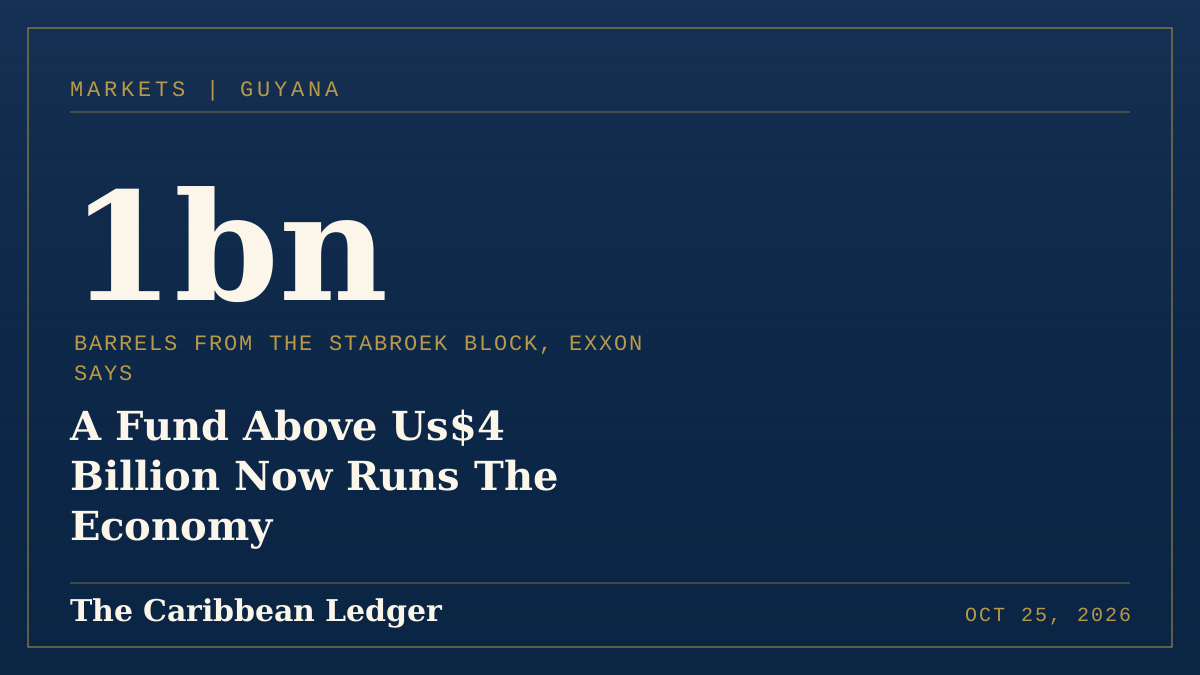
GEORGETOWN. Guyana crossed a line this month that almost no oil province has reached so fast. ExxonMobil and its co-venturers announced on September 28, 2026 that they had produced the one billionth barrel of oil from the offshore Stabroek block, less than seven years after first oil flowed from the Liza field in December 2019. For a frontier that did not exist as a producer a decade ago, a billion barrels is not a vanity number.
It is the marker of an economy that has moved from prospect to heavyweight, and it reframes how investors should read the whole southern Caribbean.
The capacity behind that milestone is what matters now. ExxonMobil's Guyana newsroom puts installed production above 900,000 barrels a day across four floating production vessels, the Liza Destiny, Liza Unity, Prosperity and ONE GUYANA. The company estimates the Stabroek resource base at just under 11 billion oil-equivalent barrels and has mapped up to eight developments by 2030. The next tranche is already scheduled: the Uaru project is expected to start by the end of 2026, Whiptail in 2027 and Hammerhead in 2029.
ExxonMobil operates the block with a 45% stake, alongside Hess and CNOOC. On that pipeline, Guyana's output is set to keep climbing well past the million-barrel mark.

The fund is the real market story
For readers who care about money rather than geology, the number to watch is the sovereign account. Guyana's Natural Resource Fund, the state vehicle that receives the government's oil revenue and profit-oil share, stood at roughly US$4.29 billion according to figures reported by News Americas Now, having passed US$4 billion for the first time earlier in 2026. That balance, in a country of under 850,000 people, is the lever on everything from the exchange rate to the pace of public investment. How fast Georgetown draws it down, and how much it saves, is the single most consequential fiscal decision in the region this decade.
A new discovery, and a caution
The week also brought exploration news, and it is worth handling carefully. The Rio Times reported on October 20, 2026 that John Ardill, ExxonMobil's vice president and head of global exploration, publicly referenced a "big discovery" in the central part of the Stabroek block, with the remarks surfacing on October 19 and 20. Kaieteur News and OilNOW carried the same account. The important qualifier is that ExxonMobil has issued no formal announcement.
The find's size, name, exact location and fluid type are not public, and Kaieteur News notes that Guyana's headline reserve figure has held near 11 billion barrels since 2022. The Ledger treats this as a credible signal of continued upside from a named company officer, not as a booked addition to reserves. We will report a resource increase when the operator confirms one.
The overhang
Two risks sit over the boom. The first is the border. Venezuela's claim to the Essequibo region, which encompasses much of the land abutting Guyana's offshore wealth, remains unresolved, and it is the reason Guyana's political risk premium has not fallen as fast as its production has risen. The second is concentration.
An economy this dependent on one block, one operator and one commodity is exposed to any swing in global crude prices and to the credibility of its own spending discipline.

For the rest of the Caribbean, Guyana's rise is both opportunity and warning. The opportunity is spillover: demand for services, logistics, construction and labor that neighbors such as Trinidad and Tobago and the wider CARICOM market are positioned to supply. The warning is the resource curse that has swallowed better-governed states than Guyana, in which a flood of oil money lifts the exchange rate, inflates local costs and hollows out everything that is not oil. Georgetown built the Natural Resource Fund and a set of withdrawal rules precisely to guard against that outcome, and the credibility of those rules, far more than any single discovery, is what the region should be watching.
The live domestic argument, over whether to hand citizens direct cash transfers now and how much to save for the generations that will inherit a depleted field, is the one that will decide whether this windfall becomes development or merely consumption. On the border, Guyana has taken its dispute with Venezuela to the International Court of Justice, which has asserted jurisdiction, and continues to insist that the 1899 arbitral award fixing the frontier is valid and binding.
None of that dims the scale of what has happened. A billion barrels in under seven years, a US$4 billion-plus sovereign fund, and a development queue stretching to the end of the decade put Guyana in a category of its own in this hemisphere. The question for the next government in Georgetown, and for every regional partner hoping to share in the spillover, is no longer whether the money arrives. It is whether it is spent as well as it has been found.
Read more at The Caribbean Ledger ›