A record power rate takes hold, and the island asks what it is paying for
The new electricity rate took effect October 1 and pushed bills up 18%, Fortune reported. On a grid that still fails, the price itself has become the crisis.
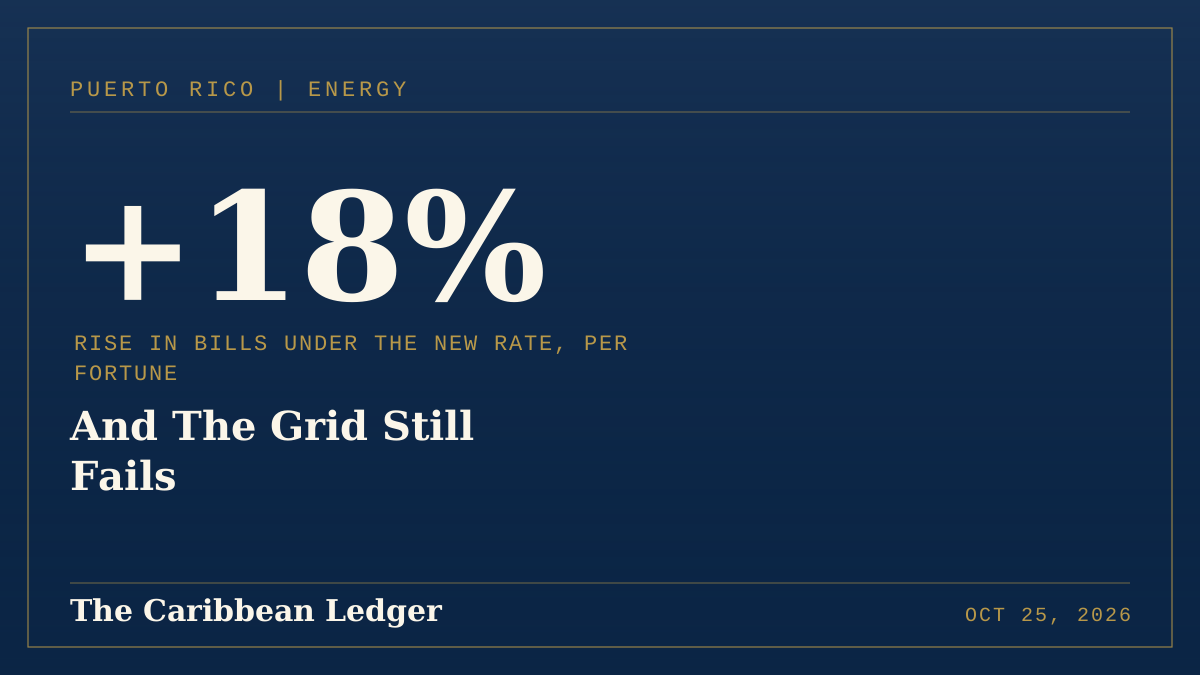
SAN JUAN. Puerto Rico's electricity crisis has reached the point where the price itself, not just the outages, is the story. A record electric rate took effect on the island on October 1, 2026, and the shock has rippled through homes and small businesses ever since. Fortune reported on October 2, 2026 that the change pushed bills up 18%, and NBC News reported that the record rate had gone into effect amid soaring costs and demand.
For an island that has spent a decade defined by an unstable grid, the new burden is the cost of keeping even unreliable power flowing.
The human texture came quickly. El Nuevo Dia reported the case of a shop owner who closed his business because of the rising rates, with citizens responding that "the increases are unsustainable." That sentiment is the center of the political problem. Puerto Ricans already endure frequent outages, and being asked to pay record prices for power that still fails is a combination that corrodes trust in the whole arrangement, including in LUMA Energy, the private operator that runs transmission and distribution.

The government's response
Governor Jenniffer Gonzalez has promised to alleviate the island's power and water shortages, according to ABC News, and her administration has pointed to federal money as part of the fix. The governor announced tens of millions of dollars in new Federal Emergency Management Agency obligations for projects across Puerto Rico, part of the long, grinding effort to rebuild an electrical system that has never fully recovered from Hurricane Maria in 2017 and the bankruptcy of the former public power authority.
The structural problem is that the island is caught between three forces that pull against one another. Rates must rise to fund a grid that was starved of investment for years. Residents and businesses cannot absorb much more. And the federal reconstruction money, while large, arrives slowly and project by project rather than as the single transformative injection the system needs.
The roots of the crisis run back years. The island's grid never fully recovered from Hurricane Maria in 2017, the former public power authority entered a long and contested bankruptcy process, and the arrival of LUMA Energy as the private operator of transmission and distribution did not end the outages that residents endure. Every one of those failures shows up on the monthly bill. For an island already losing population to the United States mainland, where the lights stay on and rates are lower, a record charge on unreliable service is one more argument for leaving, and that quiet exodus is the long-term cost that no rate schedule captures.

Why it carries weight
Energy is not a sector story in Puerto Rico. It is the precondition for every other part of the economy, from manufacturing to tourism to the island's long campaign to keep young professionals from leaving for the mainland. A record rate on an unreliable grid is, in effect, a tax on staying.
The Ledger reports this as a live and continuing issue rather than a single day's news. The verified facts are that a record rate took effect on October 1, that Fortune reported an 18% jump in bills, that El Nuevo Dia documented the reaction, and that Governor Gonzalez has pledged relief and announced new federal obligations. Puerto Rico is overdue in the Ledger's coverage, and this is the issue that matters most to the people who live there right now: the cost of light, and whether it will ever be matched by its reliability.
Read more at The Caribbean Ledger ›