Gold's long year lifts the Guianas, and tests how much of it they keep
Record gold prices are lifting Guyana and Suriname, but the two countries have yet to decide how much of the windfall they keep.
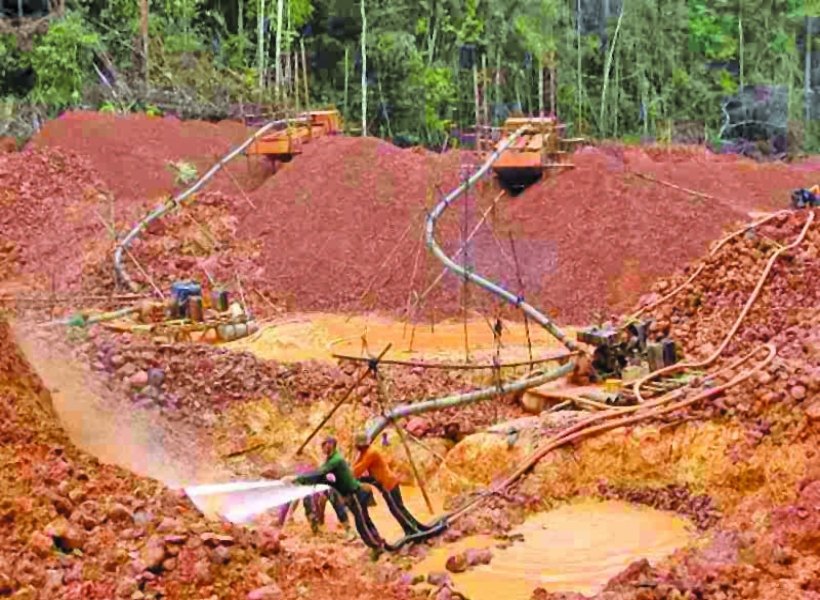
GEORGETOWN. Gold has had an extraordinary year, and the two Caribbean economies that dig it out of the ground are feeling every ounce of it. The metal set a settlement record of about US$5,318.40 an ounce on January 29, 2026, pulled back through the spring, and was still trading around US$4,164.64 on October 16, 2026, according to figures cited in The Rio Times. That is well below the January peak and far above anything these producers budgeted for.
The question running through Georgetown and Paramaribo is not whether the windfall is real. It is how much of it stays home.
The clearest picture comes from Guyana's own books. The Bank of Guyana's Half Year Report for 2026, dated August 27, 2026, and the Ministry of Finance Mid-Year Report of August 28, 2026 put gold export receipts for the first six months of 2026 at US$826.2 million, up 48.5% from US$556.3 million a year earlier. The striking detail is that the country exported fewer ounces, not more.
Volume fell 6.7% to 182,451 ounces. The entire gain, the central bank says, came from price. The average realized export price was US$4,528.20 an ounce, up 59.1% year on year.
Gold is now a junior partner to oil in Guyana's trade accounts, earning 5.1% of total exports against crude's 92.9%. But it remains roughly 72% of everything the country sells that is not oil, and the non-oil economy is where most Guyanese actually work. The Ministry of Finance projects US$2.31 billion in gold export receipts for the full year, against a budget assumption of US$1.75 billion, which tells its own story about how far reality has run ahead of the plan.
Next door, where first offshore oil is not expected before 2028, gold is still the main export outright. On October 2, 2026 the US miner Newmont presented ten-year results for its Merian operation, owned 75% by Newmont and 25% by the state oil company Staatsolie, and marked its four millionth ounce. By the company's own accounting, reported by The Rio Times on October 4, 2026 and sourced to the Government of Suriname and local outlets Suriname Herald and Starnieuws, Merian generated US$6.6 billion in revenue over the decade, of which about US$4.74 billion stayed inside the country: US$2.7 billion to suppliers and contractors, US$1.54 billion to the state, US$504 million in wages, and US$620 million in net proceeds to Staatsolie.
Those are Newmont's figures rather than an independent audit, and the distinction matters, because US$4.74 billion "kept in country" is not the same as the government's own US$1.54 billion share. Still, the shape is favorable. Local spending by the mine rose from US$160 million in 2016 to US$345 million in 2025, and nearly 97% of the workforce is Surinamese. Merian expects about 300,000 ounces in 2026 at an all-in cost near US$1,800 an ounce, which leaves a wide margin at today's prices, and holds reserves to run until at least 2042.
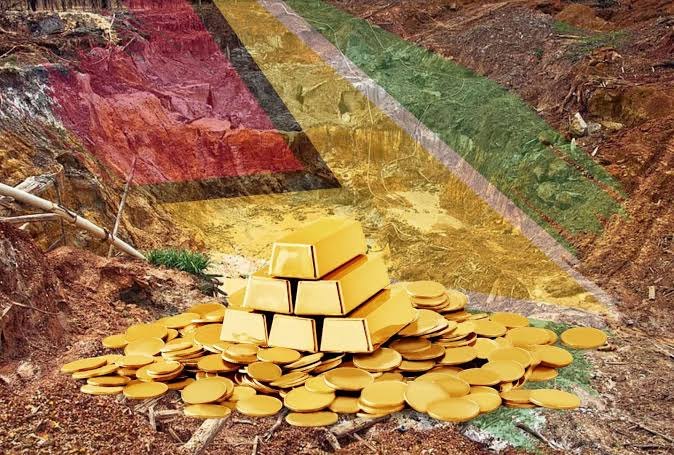
The uncomfortable part is what the official numbers cannot reconcile. In Guyana, total declared output rose 11.3% to 232,287 ounces in the first half, led by small and medium miners at 162,182 ounces, up 18.0%. Zijin Mining's Aurora operation declared 70,105 ounces, down 1.7%. Yet exports fell while declarations rose, and neither the central bank nor the finance ministry explains the gap in its own tables.
The history behind that gap is not abstract. In June 2024 the US Treasury sanctioned Nazar Mohamed, Azruddin Mohamed and the firm Mohamed's Enterprise, alleging that more than 10,000 kilograms of gold were left out of Guyana's declarations between 2019 and 2023, avoiding more than US$50 million in duties. A US State Department narcotics report in March 2025 noted that gold smuggling in the region often moves alongside money laundering. Guyanese law requires gold to be sold to the Guyana Gold Board or a licensed dealer, a channel built in 1982 precisely to keep the metal inside the formal system.
The futures market is not betting on a quiet finish to the year. Prediction-market data cited by The Rio Times on October 19, 2026 put the odds of front-month gold settling at or above US$5,000 an ounce by the end of December at roughly 10.5%, with a smaller chance of a slide back toward US$3,500. For the Guianas, that uncertainty cuts both ways.
A renewed run would widen the windfall, while a sharp pullback would expose how much of this year's gain was price rather than production. Suriname's Merian is insulated by an all-in cost near US$1,800 an ounce. Guyana's small and medium miners, who dug the extra ounces this year, sit closer to the swing.
A record price does two things at once. It swells the receipts a government can count, and it raises the reward for every ounce that never reaches the counter. For the Guianas, the prize in 2026 is not only the money gold is earning.
It is building the machinery to make sure the state, and not the smuggler, is the one who banks the difference when prices are this high. The metal has handed both countries a once-in-a-generation margin. Whether they keep it is a question of plumbing, not of price.
Read more at The Caribbean Ledger ›