The King arrives with the words. The region wants the next step.
King Charles III arrived in Guyana on October 29 for a two-day state visit, his first since 2000. He came to a country that no longer needs the Crown's favor, and that intends to say so.
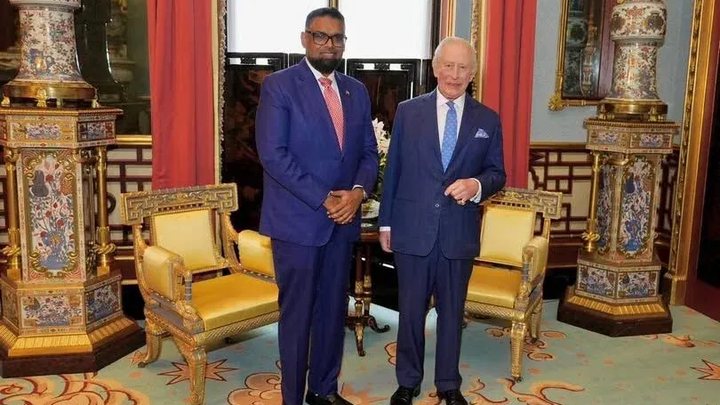
GEORGETOWN. King Charles III touched down in Georgetown on October 29, 2026 for a two-day state visit, the first time he has set foot in Guyana since February 2000, when he came as Prince of Wales. He arrived without Queen Camilla, who joins the tour only for the Antigua and Barbuda leg, and he arrived into a country that has changed beyond recognition since his last visit. The Guyana he saw in 2000 was one of the hemisphere's poorest states.
The Guyana receiving him this week is its fastest-growing economy and the current chair of CARICOM. The welcome is warm. The terms, increasingly, are Georgetown's.
Twenty-five years is a long time in a young country, and almost everything that gives this visit its charge has happened inside that window. The discovery of oil in the waters off Guyana, the production that followed and turned the economy inside out, the border pressure from Venezuela over the Essequibo region, and the hardening of a regional demand for reparations into a formal, costed program all belong to the years since the Prince of Wales last came. He visited a petitioner in 2000. He visited a player this week.

The tour opened in The Bahamas on October 27 and runs through November 4, when the Commonwealth Heads of Government Meeting convenes in St. John's, Antigua. The Guyana itinerary, as reported by Latin Times on October 27, 2026, is compact and pointed. On Thursday the King met President Irfaan Ali at State House. On Friday he engaged local stakeholders and the British commercial sector.
He closes the visit on the Georgetown seawall with a Wilton Park Commonwealth Sustainable Cities Initiative dialogue, a setting chosen with some care, because the seawall is the line that keeps a capital built below sea level from the Atlantic.
The Bahamas leg that preceded it set the tone. The King opened the tour in Nassau on October 27, a capital that closed schools and roads to receive him, and even there the reparations question traveled with the welcome. The pattern of the whole trip is the same: ceremony on the surface, and a steady, unembarrassed claim underneath, pressed hardest in the places that now carry the most leverage. Guyana carries more than most.
From Nassau the King flew south to Georgetown, and from Georgetown he flies on to Antigua, where the Commonwealth summit and his formal address await, and where the same claim will be made again, in chorus, by nearly every government in the region at once.
Ali welcomes the man and presses the institution
President Ali has been precise about the distinction the region now draws. He told ITV News that the King's past expressions of regret, including his reference in Barbados to the "darkest days of our past," are welcome in principle but not adequate in practice. What Guyana wants, Ali said, is two things: a formal apology and reparatory justice, the shape of which is still being defined. That is the same two-part demand the region carried into the week, and Guyana, flush with oil money and chairing CARICOM, is a powerful place from which to make it.
The institutional backing is firm. The CARICOM Reparations Commission, chaired by Sir Hilary Beckles, presses a ten-point plan built around a formal British apology, Caribbean debt cancellation, and sustained investment in public health and education, framed as structural redress rather than symbolic acknowledgment. CARICOM Secretary-General Carla Barnett argues that reparations cannot be separated from sustainable development. Commonwealth Secretary-General Shirley Botchwey has said the time has come for concrete discussions, financial or otherwise, including the return of cultural artifacts.

The anger is not confined to the governments on the itinerary. Jamaica, which intends to become a republic and which was left off this tour, produced the sharpest line of the week, when one activist told reporters the monarchy would be taken seriously on the question only when it was ready to stand on Jamaican soil, look Jamaicans in the eye and apologize. That the King is visiting Guyana and Antigua but not Jamaica is itself read, in Kingston, as a choice rather than an accident of scheduling.
London has drawn its own line, and the Palace has not hidden it. A Buckingham Palace spokesperson pointed to the work the King has done over the years to acknowledge the wrongs of the past and said nothing beyond that. The Palace has confirmed that Charles will not address an apology or debt cancellation by name on this tour. British officials, Latin Times reported, say the King will recognize historic wrongs and stop there, a stance that reflects legal advice warning that a formal apology could invite similar claims from other former colonies.
The King can feel. He cannot commit, and Georgetown knows exactly where the limit sits.
The oil in the room
What makes this visit different from 2000 is the oil. Guyana's offshore boom has turned a country of some 800,000 people into the fastest-growing economy in the hemisphere, and that single fact reorders the etiquette of a royal call. A monarch visiting a former colony that is now awash in petrodollars is not the same scene as a monarch visiting a struggling dependency, and both sides understand it. The British commercial sector the King met on Friday did not come to offer charity.
It came looking for contracts in a market that has capital to spend. The visit, which coincides with 60 years of diplomatic relations between the United Kingdom and Guyana, is as much a trade mission as a ceremony.
The numbers behind that are not subtle. Guyana's offshore production has lifted its economy into double-digit annual growth, the highest rate in the hemisphere, and handed Georgetown a sovereign wealth fund and a bargaining position that no amount of protocol can disguise. When the chair of CARICOM is also the owner of one of the world's fastest-growing oil provinces, a state visit stops being a favor conferred and becomes a meeting of interests, which is precisely how Guyana has chosen to treat it. British firms want in; Guyana can choose among suitors; and both facts were in the room when the King met the commercial delegation.

That inversion is the quiet story of the week. For generations the Caribbean arrived at these encounters asking. Guyana is in the rare position of being asked, and it is using that position to put the reparations question on the table with a confidence that an aid-dependent state could never afford.
The village the tour does not reach
The oil has not reached everyone, and the tour's itinerary makes the gap visible. Nikita Miller, the elected toshao of Chinese Landing, a small Amerindian community on the Barama River in northwestern Guyana, was not invited to any official engagement. Her village has been locked in a long land dispute with a miner holding gold-extraction permits over territory the community has held title to since 1976. Miller told reporters the visit might lift Guyana's profile but would not reach Amerindian villages like hers.
The Guyana Human Rights Association has gone further, accusing the government of using ceremonial occasions to paper over unresolved indigenous-rights questions.
That criticism sits awkwardly beside the reparations claim, and honestly so. A government pressing London to answer for historic dispossession is, at the same time, being pressed by its own first peoples over dispossession that is neither historic nor settled. The Ledger notes the tension rather than resolving it, because it is real and because the week will not resolve it either.
The seawall and the larger bill
The choice to end on the Georgetown seawall, at a dialogue on sustainable cities, points at the other account Guyana is keeping. The capital sits below sea level, and the country that is selling the world its crude is also among the most exposed to the seas that crude helps to raise. Guyana holds vast standing forests and sells the carbon they store, and it will argue, as it has, that climate finance and reparatory justice are two names for the same debt owed by the industrialized world.
Guyana makes that argument with unusual standing. It is at once a major new oil producer and the custodian of vast tropical forest, and it already sells the carbon that forest stores. The contradiction, that a petro-state should also present itself as a climate creditor, is one Georgetown is comfortable holding, because both halves point to the same conclusion: the wealth and the risk of the fossil age were handed out unequally, and the account should be settled on terms that the exposed, and not only the enriched, help to write.
By the time the King flies on toward Antigua, the ceremony will be over and the arithmetic will remain. Guyana received him with genuine courtesy and used every hour of the visit to make a point: the relationship is being renegotiated, and the country doing the renegotiating is no longer the supplicant it was in 2000. He came to acknowledge the past. His host came to talk about the bill, and about who, in an oil age, now holds the stronger hand.
Read more at The Caribbean Ledger ›