Dominica puts the voter ID card in hand, and answers a long grievance
The Electoral Office is distributing the national voter identification card as an island-wide confirmation exercise cleans the register. After an opposition boycott of the last election over the absence of reform, the government says it has moved from legislation to implementation.
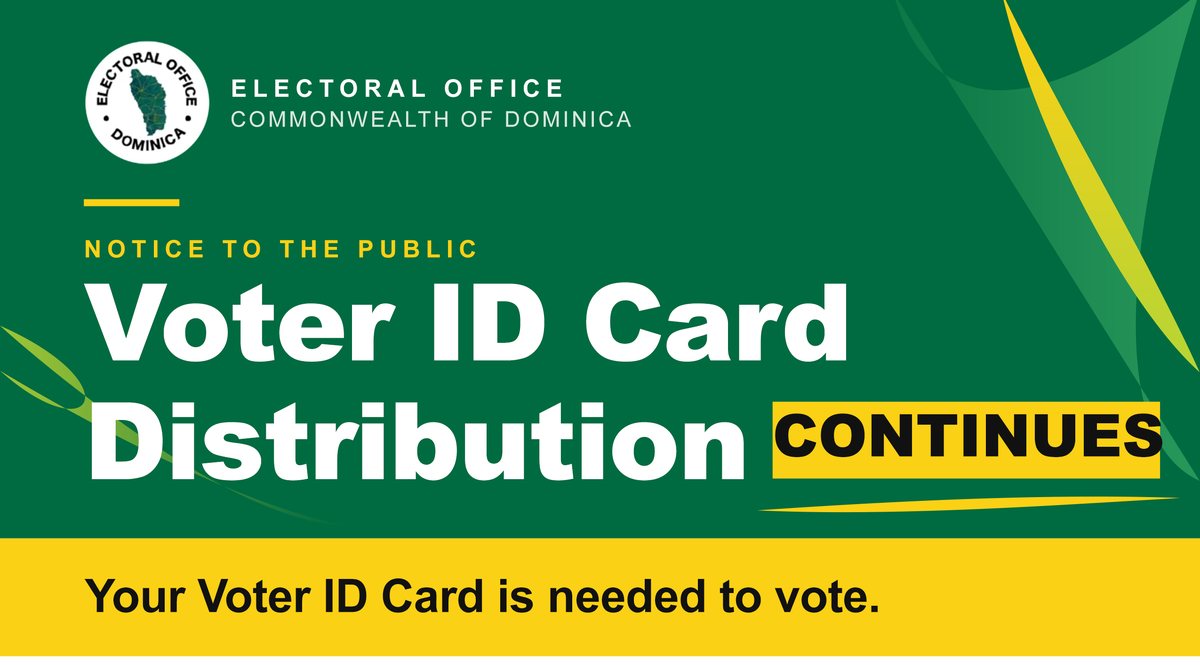
ROSEAU. The Electoral Office of the Commonwealth of Dominica is handing voter identification cards to citizens across the island, an administrative exercise that carries unusual political weight. For much of the past two decades, the absence of a voter ID card, and of a trusted, up-to-date voters list, was the loudest complaint in Dominican politics, the grievance that drove an opposition boycott of the last general election and repeated appeals for outside intervention. The card now being collected at registration offices is the answer to a question the country has argued over for years.
Citizens are told plainly that it is needed in order to vote, and that it must be picked up at the registration office for their area.
The distribution is the visible end of a long machine. The Electoral Office announced the commencement of printing the cards on August 7, 2026, as Nature Isle News reported, after Prime Minister Roosevelt Skerrit said in early July that issuance was expected to begin by the end of that month. We have now moved from legislation to implementation, he told a July news conference reported by Caribbean Today, language chosen to mark the shift from promising reform to delivering it.
What the fight was about
To understand why a plastic card matters this much, go back to the complaint. For years the opposition United Workers Party, the Dominica Freedom Party, civil society groups and visiting international observers argued that Dominica's voters list was inflated and unverifiable, and that without a voter ID card there was no reliable way to confirm who was actually casting a ballot. The fear, stated bluntly by critics, was electoral fraud, the possibility that a padded register could be used to manufacture votes. The teams that came to watch the country's elections, from the Commonwealth Secretariat to the Organization of American States and the Caribbean Community, had recommended reform, and for years it did not come.
The dispute boiled over at the snap general election of December 6, 2022, which Skerrit announced on November 6 and brought forward from a vote due in 2024. The United Workers Party and the Dominica Freedom Party boycotted it, saying none of the reforms observers had recommended were in place. The result was a mandate and a warning at once. The ruling Dominica Labour Party won 19 of 21 seats with 82.38% of the votes cast, but turnout was just 31.60% of 60,330 registered voters, the first time in the country's history that fewer than half of eligible Dominicans took part in a general election.
A supermajority delivered by a third of the electorate is the hollow legitimacy that electoral reform is meant to prevent, and it left the winner governing under a cloud the reforms now aim to lift.

From a report to a register
After 2022 the government moved. Sir Dennis Byron, the former president of the Caribbean Court of Justice, was appointed sole commissioner on electoral reform and delivered his report in June 2024. Parliament then passed legislation, which Skerrit says was unanimous, setting out procedures for voter registration, confirmation, the electoral register, objections and appeals. An island-wide voter confirmation exercise opened on October 15, 2025, over a 12-month window, and it is deliberately hands-on.
Each elector must appear in person, be photographed, and give an electronic signature captured on a pad, and the Chief Election Officer, Anthea Joseph, has stressed that the software will not complete a confirmation unless both the photograph and the signature are captured. The confirmed register and the voter ID card are the twin products of that exercise.
Progress has been uneven, by the government's own accounting. In a statement dated May 7, 2026, the Office of the Prime Minister said the Electoral Office had received 16,573 confirmation applications between October 15, 2025 and April 30, 2026, with 13,146 of them arriving in the first six weeks, but had approved only 6,592, about 40%, by the end of April, leaving 9,981 voters unconfirmed and no cards yet issued. The government formally asked the Commonwealth Secretariat, the Organization of American States, the Organisation of Eastern Caribbean States and the Caribbean Community for technical assistance on both the confirmation process and the card rollout, including an assessment of how efficiently applications were being approved and a review of the security and accessibility of the card system itself. Skerrit said issuance would begin within six to eight weeks, called the delays a concern, and described the reform as technically complex and nationally important.
Addressed, and still being tested
The government's position is that it has now done what its critics demanded. Legislation drawn from an independent commissioner's report, a register rebuilt on in-person verification, and a physical voter ID card in citizens' hands amount, in its telling, to the reform a generation of elections was fought over. On the two central charges, an unverifiable list and no identity check at the polls, the machinery to answer both now exists, and it is being delivered rather than merely promised. For a government that spent years accused of resisting reform, having the cards in circulation is itself the rebuttal.
Not every question is closed. The confirmation drive has run slowly, and the roughly 10,000 voters still unconfirmed in the spring are a reminder that a cleaned list is only as legitimate as the share of eligible citizens it actually reaches; a process that leaves large numbers off risks trading one complaint for another. Skerrit has argued that the register need not match the estimated voting-age population, because registration can be offered but not compelled, which is sound in principle and will be tested in practice. The exercise also remains politically charged.
The Electoral Office had to publicly reject social-media claims that confirmations could be done without the elector present, with Joseph calling the allegations categorically false on July 22, and Skerrit has accused the United Workers Party of confusing its supporters about the confirmation process, as Dominica News Online reported. A reform meant to settle arguments is, for now, still generating them.
There has already been one live test. On September 7, 2026, Dominica held a by-election in Roseau North, and the Dominica Labour Party's Ashma McDougall won it with 1,506 votes to 983 for the United Workers Party's Danny Lugay, with an independent taking 50, as WIC News reported. The number that matters beyond the margin is that the United Workers Party showed up at all. The party had held no seat since boycotting the 2022 general election, and the by-election was its only route back into the House of Assembly.
A party that stayed home over the absence of reform returned to the ballot once the reform was under way, which is as close to a verdict on the new system as anything a politician has said about it.
The larger verdict will come at the next national vote, and in whether the parties that boycotted in 2022 accept the confirmed register and the card as the fix they asked for rather than the next thing to contest. For now, after years in which the voter ID card existed mainly as a demand shouted across a political divide, Dominicans are collecting the actual object at their registration offices. In a region where electoral trust is slow to build and quick to lose, a credential a voter can hold in hand is a modest but genuine step, and the Nature Isle has finally taken it.
Read more at The Caribbean Ledger ›