The warning in the share price: why governance matters before the crisis
Nvidia remains one of the largest companies in the world. Its chief executive's departure this week is a reminder that governance has to hold when the most important person in the room is the one under pressure.

SANTA CLARA. On November 12, Nvidia said that Jensen Huang had resigned as president, chief executive, and a member of the board, effective immediately. Colette Kress, the company's chief financial officer, will serve as interim chief executive while the board searches for a permanent successor. The company said it would report third-quarter results on November 17, as scheduled.
The departure followed a week of sharp selling. On the Ledger's calculation from daily closing prices, Nvidia closed at $166.19 on November 12, about 30 percent below its October 6 closing peak of $239.24. The steepest single-day fall in that stretch came on November 5, when the shares dropped 9.3 percent. The chart below shows the full period, with the key dates marked.
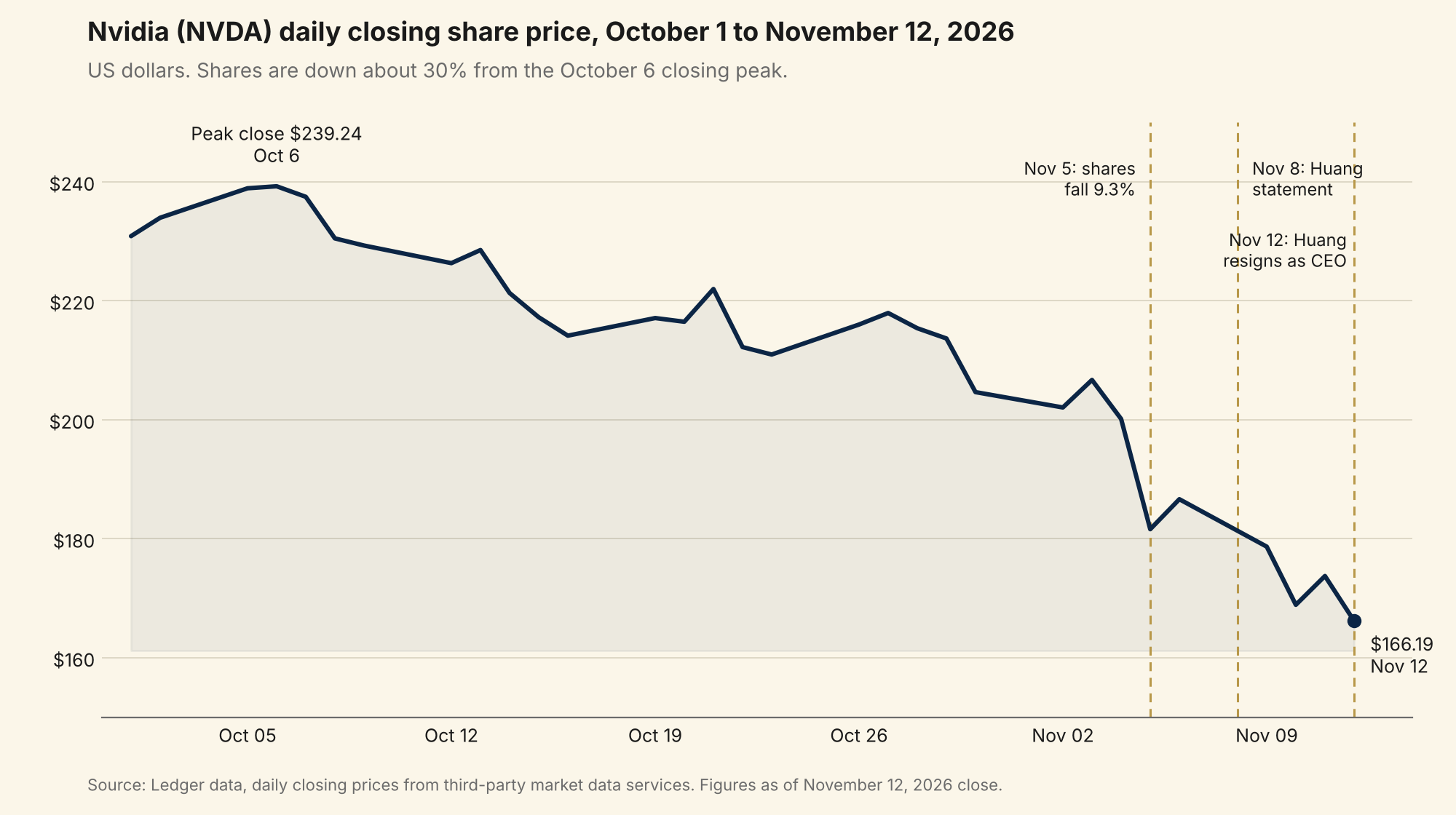
The trigger was personal. On November 8, Huang wrote to employees in a message that Nvidia published on its newsroom. In it he said he was unfaithful to his wife and that his actions had hurt her and their children.
"I take full responsibility for what I did and the hurt I caused," he wrote. He apologized to his family and to colleagues, and said he would cooperate fully with an independent investigation that the board had opened the same day.
Separate reports raised questions beyond the personal. ABC News, citing The New York Times, reported that US intelligence had concluded that a woman connected to the relationship was gathering information for China. These are allegations, and this article does not assess them.
ABC News also reported that a proposed class action accuses the company and Huang of defrauding shareholders by concealing the relationship, and that the FBI is looking into the matter. The investigation continues.

It would be a mistake to read Nvidia's situation as a sign of weakness in its business. The company remains central to the artificial intelligence industry, and the investigation may clear or fault any individual. The lesson for boards is about structure. A company's value rests on more than one person, and its protections should work whether or not that person is at their desk.
What the rules say
International guidance for banks, issued by the Bank for International Settlements through its Basel Committee on Banking Supervision, speaks directly to this. The committee's principles say the suitability of each board member should be reviewed periodically, and at least annually. They ask boards to plan for their own succession.
On committees, they suggest that boards consider occasional rotation of members and chairs, because rotation can help avoid undue concentration of power and promote fresh perspectives. The principles do not set a fixed term limit for directors, and that is worth noting for any board that assumes one exists.
The Caribbean question
Across the Caribbean, many of the largest companies were founded by families or remain closely held. That structure brings real strengths: patient capital, deep local knowledge, and long relationships with customers and communities. It can also make succession, related-party dealings, and board challenge harder to manage.
Founder-led and family-led firms are not weaker for their origins. They are simply more exposed when governance is left informal.
Shareholder rights matter as much as boardroom discussion. Minority shareholders in family-controlled companies rely on clear notice of meetings, fair treatment in related transactions, and access to accurate accounts. Where those rights are written down and enforced, a company is easier to trust.
Where they exist mainly by custom, disputes tend to move toward the courts, and management time shifts from building the business to defending it. Disputes among shareholders, directors, and related parties reach the courts in every market. The question for boards is how many could have been resolved earlier.
Disclosure is the other half. Investors and lenders read a company's filings to judge risk. Timely, accurate reporting of material events, including legal proceedings and changes in leadership, gives markets the information they need and limits the rumor that fills gaps when information is missing.

Questions for boards
Several questions could help boards test their own frameworks:
Does the board include directors who can question the chair, the founder, or the chief executive without hesitation, and who have the time and information to do so?
What does our code of governance say about how long a director can serve and still be treated as independent, and who reviews that judgment each year?
Do we have a written policy on related-party transactions, and does the board see every material conflict before a decision is made?
If our chief executive or largest shareholder were absent for a month, who would decide, and would our controls still work?
Does our internal audit function report to the board, or to management whose work it reviews?
Are we ready to discuss conflicts that arise from personal relationships between senior staff, directors, and suppliers, before those conflicts become public?
The last question is the hardest to ask, and it may be the most important. Well-run companies treat it as a routine part of conduct policy, with clear disclosure rules, a confidential reporting channel, and a board committee willing to act. Raising it does not accuse anyone. It recognizes that conflicts arise in any business, and that companies which handle them openly tend to keep their reputations.
There is also a question of growth. A company with strong controls can borrow on better terms, enter new markets with confidence, and attract investors who intend to hold for the long term. A company with weak controls may find that each expansion brings new risk and that partners hesitate to commit.
Governance, in that sense, protects against collapse and may also determine how far a business can grow. Are Caribbean companies limiting their own scale through the strength of their internal controls?
Regulators across the region have watched global failures, from banks to technology firms, and many have strengthened supervision over time. The more useful question is whether lessons from those cases are being turned into practical expectations for boards, auditors, and disclosure. Supervisors can ask those questions without assuming wrongdoing, and the companies they oversee can answer them without treating the questions as attacks.
The share chart tells a simple story. Confidence can move quickly, and it often moves before a full explanation is available. The lesson is not that founders, families, or technology leaders are the problem. It is that the systems around them should be strong enough to protect the company, whoever is in charge.
Read more at The Caribbean Ledger ›