Nvidia loses its founder and $550 billion, and the Caribbean rents the fallout
Jensen Huang's abrupt exit and an AI-sector selloff are a Wall Street story on their face. Through tourism, remittances and borrowing costs, the region feels every door it opens.
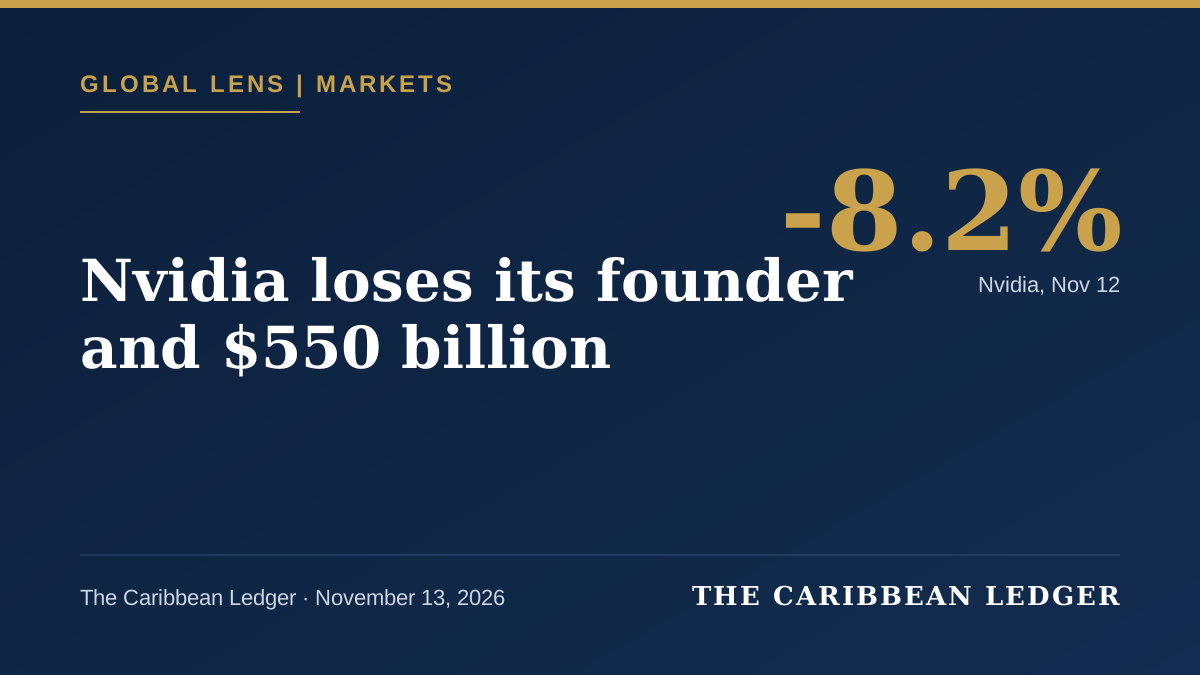
SANTA CLARA. The most valuable company of the artificial-intelligence age lost its chief executive and a large part of its market value in the same week, and while the drama is playing out in Santa Clara and on Wall Street, the aftershocks reach the Caribbean through the channels the region always feels first, the wealth of American tourists, the remittances of the diaspora, and the price of money.
On Thursday, November 12, shares of Nvidia fell 8.2% to a sixteen-month low, according to a Reuters report carried by RTE, putting the company on course to close below US$4 trillion in market value for the first time since July 2025. The fall followed the resignation of Jensen Huang, the founder who built Nvidia into the indispensable supplier of the chips that train AI systems. Nvidia's board had announced on Sunday, November 8 an investigation into Huang's relationship with a businesswoman alleged to be a Chinese intelligence operative, an allegation that has not been proven, and his chief financial officer, Colette Kress, was named interim chief executive. By Reuters' accounting, Nvidia has shed more than US$550 billion in market value since the investigation was disclosed.
A selloff with company
This was not one company's bad week. The whole AI complex fell with it. RTE reported Nebius down 16.2%, CoreWeave down 9.1%, Sandisk off 6%, Marvell 3.8% and Micron 2.5%, with Oracle lower as well, while a few names investors cast as survivors, AMD and Broadcom, rose. The Philadelphia semiconductor index slipped 1.3%.
The selling had begun before Huang's exit. The Nasdaq had already entered a technical correction earlier in November, as investors digested the Democratic sweep of the November 3 United States midterm elections and the prospect of tighter regulation of AI from a Congress now controlled by the party. Asian and European technology shares followed Wall Street down.
Why a chip selloff reaches an island
The temptation is to file this under distant finance, the sort of story that moves screens in New York and nothing on a Caribbean quay. That would be a mistake, because the region is more exposed to American asset prices than it likes to admit, and the exposure runs through three doors.
The first is tourism. A meaningful share of the Caribbean's visitors are Americans, and American travel budgets rise and fall with American household wealth. When US stock portfolios are climbing, the booking curve for winter in the islands firms up. A sustained correction in the most valuable part of the US market, the technology sector that has carried the indices for three years, chips away at exactly the consumer confidence that fills hotel rooms in Montego Bay, Punta Cana and Nassau over the coming season.
The Caribbean does not own Nvidia shares, but it rents the confidence of the people who do.
The second door is remittances. The money the diaspora sends home to Jamaica, the Dominican Republic and Haiti is one of the region's largest and most reliable foreign-exchange flows, and it is sent by people whose own finances track the American economy. A market wobble that becomes a slowdown, with hiring and bonuses pulled back, shows up months later as softer transfers through the money-transfer windows, and it shows up most in the households that can least absorb it.
The third door is the price of money, and it cuts both ways. When equities fall hard, investors often move into United States Treasuries, pushing their yields down, and because much of the Caribbean's dollar debt is priced off those yields, a flight to safety can quietly lower the region's future borrowing costs. That is the one potential consolation in an otherwise unwelcome picture, and it is contingent, because the same episode that lowers Treasury yields can also tighten the financial conditions that make lenders cautious about small, indebted economies in the first place.
What to watch from here
The near-term signal is whether this is a repricing or a rout. A technology sector giving back some of a three-year run is healthy and survivable. A disorderly unwind of the AI trade, with forced selling and credit stress, is the version that reaches the Caribbean's tourism bookings and remittance windows with force.
The political overlay matters too. If a Democratic Congress does move to regulate AI more tightly, the valuations that assumed an unregulated boom will keep adjusting, and the adjustment will not be confined to Silicon Valley.
For Caribbean finance ministers and hoteliers, the useful posture is neither panic nor indifference. It is to watch the American consumer, because that consumer is the region's real customer, and this week the thing that makes that customer feel rich took a serious knock. Nvidia's trouble is, on its face, a corporate-governance story about one executive and one chip company. Read through the region's own ledger, it is a story about whether the people who fill the planes and send the remittances will feel as wealthy in the new year as they did at the start of this one.
Read more at The Caribbean Ledger ›