The girls who finally said yes
Nigeria's Flamingos became the first African nation to win a FIFA women's world title. Somewhere on a Caribbean field tonight, a girl in borrowed cleats is doing the math. What would it take to be her?
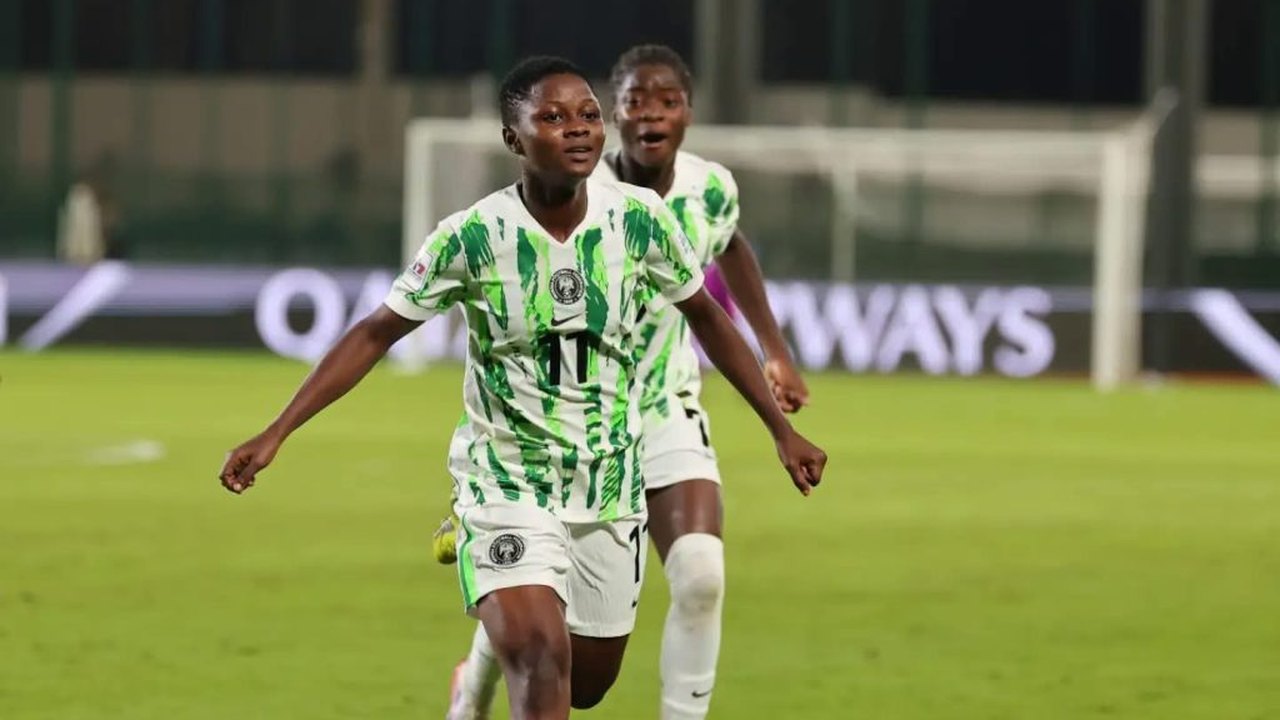
RABAT. There is a photograph from Rabat you will keep thinking about. Gold confetti in the floodlights, a trophy held up by a dozen hands at once, and in the middle of it a teenager screaming with her whole body, the way you scream only when something you were told to be realistic about has just come true anyway.
On Saturday, November 7, 2026, at the Mohammed VI Football Complex, Nigeria's Flamingos beat Japan 2 to 1 to win the FIFA Under-17 Women's World Cup. They are the first African nation to win a FIFA women's world title. Africa has produced men's youth world champions before, but never a women's one.
For years people asked when an African girls' side would finally do it. These children, as Premium Times reported the result, simply answered.

What makes the night worth sitting with is not the scoreline. It is the shape of the road behind it. The Flamingos opened the tournament by losing, 2 to 1 to Poland, the kind of first chapter that ends a lot of stories.
Theirs did not end. They beat Puerto Rico, then took down the defending champions, Korea DPR, the team that had owned this trophy. They beat Mexico in the round of 16 and Venezuela in the quarterfinal.
In the semifinal they beat Brazil 3 to 1, with a 15-year-old named Awawu Bashiru scoring twice. Then, in the final, Bashiru scored again, a dropping effort in the 39th minute that slipped through the Japanese goalkeeper's gloves, and Oluebube Umejiaku made it two just after the break. Japan pulled one back late.

The girls held on.
Behind them stood a coach who had been in the job barely seven months. Akeem Busari, a CAF A-licensed Nigerian coach known for a fast, pressing style, was named head of the Flamingos on April 2, 2026, according to Soccernet, taking over from Bankole Olowookere, the man who had guided an earlier group to bronze in 2022. Busari inherited the oldest problem in youth football, that the players you develop keep growing up and leaving, and he rebuilt the side in time to win the whole thing.
That is not luck. That is a country with a girls' pipeline deep enough that a new coach can arrive, reshape a squad, and still produce world champions. Nigeria has been sending Flamingos teams to this tournament for twenty years.

The win on Saturday was the harvest of two decades of showing up.
Which brings us, gently, to the question a Caribbean reader cannot help but ask. If a group of teenage girls from West Africa can lift this trophy, what would it take for a group of our daughters to get there?
We are closer to that conversation than we sometimes admit. Jamaica's Reggae Girlz were the first Caribbean nation to reach a Women's World Cup, in France in 2019, and in Australia in 2023 they went further than anyone from this region ever had, holding France and Brazil scoreless, beating Panama for a first World Cup win, and reaching the round of 16. Haiti arrived at that same 2023 tournament.
The ceiling the Caribbean once stared at, we have already touched with our fingertips.
But the Jamaican story also tells the harder truth, and every woman who has played here knows it in her body. The same Reggae Girlz who made history did it while fighting their own federation for money. The program was cut entirely in 2010 for lack of funding and sat dormant until 2014, revived in part by fundraising that Cedella Marley helped lead.
As recently as October 2023, the players issued a joint statement refusing to play World Cup qualifiers over missing payments and mistreatment. Khadija Shaw, one of the finest strikers in the world, has carried the weight of a nation's pride and its unpaid invoices at the same time.
That is the gap between touching the ceiling and breaking through it, and it is not mainly about talent. The talent is here, on every parish field and every hard-court goalmouth from Kingston to Castries. What Nigeria has that we have not yet built is the unglamorous scaffolding beneath the talent: sustained funding that does not vanish when a minister changes, girls' leagues in the schools, coaches who are paid and trained, and age-group teams that go to tournaments every single year so that losing to Poland in the first game becomes a thing you recover from rather than a thing that sends you home.
None of that is beyond a region that produces Olympic sprint champions by the handful. It is a choice, repeated for twenty years, to treat a girl with a ball as an investment rather than an afterthought. The Flamingos just showed the entire developing world the return on that choice.
Somewhere tonight, a Caribbean girl is lacing up in the half-dark. The only question that matters is whether the grown-ups will build the road before she outgrows it.
Read more at The Caribbean Ledger ›