The Citizenship Series, Part Four: the numbers behind the 2028 deadline
Five Eastern Caribbean governments have until June 1, 2028 to end their citizenship programs. The IMF's own figures show how much each one depends on them, and what the region should ask for in return.
THE CARIBBEAN. Disclosure. Fletcher St. Jean writes in his own capacity as Managing Director of St. Jean & Company. The views in this piece are his own and do not represent the editorial position of The Caribbean Ledger, which reports the story independently.
This is the fourth part of The Citizenship Series. Parts One to Three set out the case, the region's response, and the UN meeting of September 24. Several of those pieces were written under this byline before The Caribbean Ledger launched. This part turns to the numbers, because the numbers will shape how hard the next round of talks is.
Five Eastern Caribbean governments now have until June 1, 2028 to end their Citizenship by Investment programs. The date comes from a letter that European Commissioner Magnus Brunner sent on June 25, 2026 to Antigua and Barbuda, Dominica, Grenada, St Kitts and Nevis, and St Lucia. It rests on a revised EU visa-suspension mechanism in force since December 30, 2025, which makes operating such a program a ground for review in itself, "regardless of how well it is managed." That phrase changes the debate.
The question is no longer whether these programs are well run. It is whether the region can build what comes next before the revenue that has supported so many budgets falls away, and whether it does so together, while there is still time to plan.
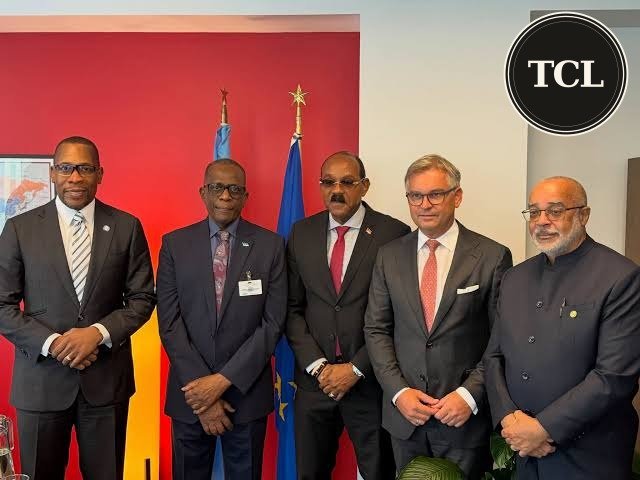
On September 24, Prime Minister Philip J. Pierre of St Lucia and Prime Minister Gaston Browne of Antigua and Barbuda met Brunner at the 81st UN General Assembly. They were accompanied by Timothy Antoine, Governor of the Eastern Caribbean Central Bank, and Didacus Jules, Director General of the Organisation of Eastern Caribbean States. The meeting produced no agreement, and the date did not move.

What the IMF numbers show
Each government measures its citizenship revenue differently, so the table compares shapes rather than sizes. The common pattern is a peak between 2022 and 2025, followed by a fall.
Antigua and Barbuda: CBI revenue, % of GDP. Peak 2.6 (2025). Latest 1.9 (2026, projected).
Dominica: CBI share of capital transfers, %. Peak 34.8 (2023). Latest 19.5 (2025).
Grenada: government CBI revenue, % of GDP. Peak 14.7 (2024). Latest 4.4 (2025).
St Kitts and Nevis: CBI fees, % of GDP. Peak 25.8 (2022). Latest 6.0 (2025).
St Lucia: CBI revenue, % of GDP (other revenue line). Peak 1.0 (2022). Latest 1.0 (2025).
Sources: IMF 2026 Article IV reports for Antigua and Barbuda, Grenada, St Lucia and St Kitts and Nevis; IMF 2025 Article IV press release for Dominica. Fiscal years differ by country. The St Lucia series sits under other revenue and may not capture the full program.

St Kitts and Nevis has gone furthest. Its CBI fees fell from 25.8% of GDP in 2022 to 6.0% in 2025, and the IMF expects low CBI revenue to keep deficits elevated through the medium term.
For Dominica, the IMF projects the CBI share of capital transfers falling to 15.7% in 2026, and it recommends reducing reliance on CBI revenues. In Grenada, government CBI revenue fell from its 2024 peak to 4.4% of GDP in 2025, and the Fund notes that prudent savings from those receipts have given the government room to invest.

The airport that depends on it
Dominica's new international airport shows what happens when a major project rests on this revenue. The contract was signed in 2021 at US$370 million, and the government said at the time that the program would fund it in its entirety. Reporting in March 2026 put the value above US$450 million. In late March 2026, reporting said the developer, Montreal Management Consultants Est.
(MMCE), had begun formal arbitration against the government, alleging that project conditions both parties had agreed were not met. Reporting says formal hearings began on November 5, 2026. The amount allegedly in dispute has not been made public.
The developer's account has since shifted. In a statement dated May 22, 2026, MMC Development said that no legal proceedings or arbitrations were in effect against the government, and that it remained fully committed to completing the project. The March reporting and the May statement do not agree, and we have not yet reconciled them. In November 2025, Prime Minister Roosevelt Skerrit said legal challenges would be addressed through the appropriate channels, and that geotechnical work, land preparation and some engineering design were continuing.
Construction continues on site. In his November 3, 2026 independence address, the Prime Minister said the airport remains on track to open in the first quarter of 2028 and that more than 400 Dominican workers are on site (as reported by The Caribbean Ledger, November 11, 2026). The developer has said a suspension would be the gravest possible outcome.
If work stalls, the state will need new financing for a project it expected to pay for from a revenue stream set to end. The government reported in March 2026 that the Marigot hospital and the Grammar and Mahaut schools were complete. The reporting does not say how those were financed, and that is one of the questions the government will be asked.
What Brussels is asking for
Schengen visa-free access is a shared asset, and the EU regards its integrity as a responsibility to protect. The Commission's concerns are specific. An estimated 107,000 passports have been issued across the five programs, application volumes remain high, and rejection rates are low, which raises questions about the depth of due diligence (Part One).
The Financial Action Task Force has warned that such schemes can be misused to alter identities and facilitate financial crime if they are poorly controlled. Its September 3, 2026 report on professional money laundering found that more than 80% of reporting jurisdictions named underground banking and hawala-type providers as a principal channel. European law has also moved. In 2025, the European Court of Justice found that Malta's program breached EU law (Part One).
The region's own compliance record now sits under the same lens. Dominica's third enhanced follow-up report, adopted by the Caribbean Financial Action Task Force in May 2026, reviews progress on the technical compliance deficiencies identified in its July 2023 mutual evaluation. A follow-up report shows whether the gaps an evaluation found have been closed. Banks weighing whether to keep a Caribbean relationship are likely to look at that record, which makes compliance part of what keeps banking lines open.
What the region has already built
In 2025, the five states signed a 92-article agreement creating the Eastern Caribbean Citizenship by Investment Regulatory Authority, known as ECCIRA. It is headquartered in Grenada, has offices in each participating state, and becomes operational in 2026 (Part One).
ECCIRA sets binding standards across all five programs. These include uniform due diligence, mandatory interviews, biometric collection, a genuine-link residency requirement, shorter passport validity, a common investment floor, and unified registries of applicants, agents and developers. It can compel audits, impose sanctions, and revoke licenses.

Each program already runs its own due diligence office, and the region has now added ECCIRA on top. That work deserves real credit. It was also clearly not the whole answer. ECCIRA was built to make the programs acceptable to Brussels, Washington and London, and the June letter makes clear that acceptability alone does not settle the question.
That raises a question we think every government in the region should answer. How seriously are the governments taking the advice they receive, and how quickly is it turned into action? The region has the institutions and the expertise. The next step is to make sure that advice shapes the decisions that follow.
The asymmetry at the center
If the programs end on the Commission's timetable, the EU and the United States secure their integrity objective, and the five governments absorb the fiscal cost. Antigua and Barbuda has said the program cannot simply be abandoned without viable, concrete and credible replacement revenues (Antigua Observer, as cited in Part Three).

The region's growth plans need the same capital. The ECCB's Big Push, the centerpiece of its 2026 to 2031 strategy, calls for roughly 7% annual growth, against a trajectory near 3% that the Governor calls maintenance, not transformation (Part Two). The Caribbean Development Bank estimates that the region will need US$65.2 billion between 2024 and 2033 to prevent economic stagnation (CDB Strategic Plan 2026 to 2035, as cited in Beyond the Boom, April 18, 2026).
Where the money lands
Every citizenship application runs through a bank. Applicants and their agents open and clear accounts with banks that accept CBI transactions, and the fees move through the same channels. Not every bank in the region takes on this business, and each bank's decision to do so is part of the story.
In St Kitts and Nevis, the law sets the rule. The Citizenship by Investment Escrow Accounts Act (Cap 21.27) requires escrow accounts to sit with a bank licensed under the Banking Act. The banks that handle these flows have a clear interest in seeing the funds cleared properly, and the states that set the rules have an equal interest in seeing that they are.
In St Lucia, a January 2023 memo from the Citizenship Investment Unit recorded delays in clearing the bank fees that applicants must pay. Those delays are a reminder that the system depends on banks working well and on time.
In Grenada, the IMF reports that the government's CBI savings are mostly held in low-yielding local bank deposits. That is a close working relationship between the state and its banks, and it will need a plan as receipts fall.
There is another group that has carried this risk for years. Correspondent banks, the foreign banks that move Caribbean money across borders, have had to weigh the compliance cost of these programs against the value of keeping Caribbean accounts open. A 2016 Caribbean Association of Banks survey found that 58 percent of responding banks had lost at least one correspondent relationship. As the programs wind down, those banks may find a clearer path, and we hope the region will use that moment to rebuild the trust that keeps its banking lines open.
These are the discussions St. Jean & Company intends to bring to the table with the ECCU Governments. The question we will put is a simple one: when the programs end, who bears the cost? The governments, the banks that have handled the flows, the correspondent banks that have carried the risk, or the wider public? We believe that question is best answered together, at that table, and St. Jean & Company is ready to help bring the right people there.
Questions we cannot yet answer
Three questions matter most to the people who work in this system, and the public record does not yet answer them. The first is jobs. We have not found published figures for how many people work in the developer, processing and administrative roles that depend on citizenship applications, or what those roles would need if the programs end. The second is the completion of CBI-funded projects.
We have not found a government analysis of how much of the work funded by citizenship revenue is finished, how much is still underway, or how much would need new financing. The third is transition. We have not found a published plan for retraining or redeploying workers who move out of these roles.
These questions have a micro and a macro side. From the top, the region is asking whether it can finance its growth without the programs. From the ground, the question is what happens to a bookkeeper, a processing clerk or a developer's office manager in the year the work stops. We have not yet seen both lenses applied in full, and we think both need answers.
The banks face a similar question. The institutions that earned fees on these flows will answer to shareholders who have grown used to that income. Their boards will need to set new expectations and new strategic roadmaps as the revenue narrows. We will ask those institutions how they are preparing.
We will put these questions to the governments, to the banks that handle these flows and to the developers, and we will publish what they say.
Have we now lost both?
The region's two lifelines have long been correspondent banking and citizenship revenue. Correspondent banks are the bridge that moves Caribbean money across borders. The ECCB's July 10, 2026 communique describes a CAPSS pilot that would allow instant cross-border payments in local currencies, reducing reliance on those correspondent banks. Yet de-risking, the retreat of large foreign banks from small Caribbean markets, has been a persistent problem.
The IMF's 2017 study of Caribbean correspondent banking found that the cost of services had increased substantially and that some sectors had reduced access. A 2016 survey by the Caribbean Association of Banks found that 58% of responding banks had lost at least one correspondent relationship, affecting 12 countries. Within the Eastern Caribbean Currency Union, correspondent fees doubled or tripled on some occasions, and in St Lucia, the correspondent fees paid by indigenous banks rose about 30% to 40% over five years. The same concerns that drive de-risking, including identity, ownership and financial crime, are the concerns that make citizenship programs hard to hold.
The 2016 and 2017 figures are the most recent published counts we have found. We will ask the ECCB for a current count and will report what it provides.
If the programs wind down as Brussels asks, the revenue that cushioned the budgets will fall away, and the bridges that connect the region to the world may grow narrower at the same time. So have we now lost both? And if so, are these new challenges that require a broader, macroeconomic lens, one that asks how the region finances its growth when neither the banks nor the passports can be counted on? We leave that question with our readers, and we would welcome their answers.
What comes next
The next checkpoint is a Commission report due in December 2026. It will show whether the conditions set in June have moved Brussels at all, and whether the dialogue the prime ministers keep asking for is a real channel or a courtesy.
The Caribbean Ledger will reach out to all ECCU Prime Ministers for comment on the matters in this piece, and will publish their responses in full. We will put the arbitration questions to the Government of Dominica and to MMCE, and report what they say.
The region has also been offered a roadmap. In April 2026, Beyond the Boom: The ECCU's Decade of Decision set out eight priorities for member governments, the ECCB, the CDB and the private sector. They include a Diversification Index for each state, a Regional Medical Excellence Fund built from a minimum 25% of net CBI inflows, and formal CBI Transition Plans for states that depend heavily on the revenue. Those recommendations were concrete then, and the deadline has made them more urgent.
St. Jean & Company is again making that call. It has formally written to all the ECCU governments seeking a seat at the advisory table, and it will continue to reach out to each government directly. That commercial interest is the reason for the disclosure at the top of this piece.
This is the first part of that work, not the last. The Citizenship Series began in July with The Citizenship Crossroads, and it continues with our regional coverage of Grenada, St Vincent and the Grenadines, St Kitts and Nevis, and Barbados. Read together, these pieces set out what is at stake, what the region has built, and what remains undecided. Part Four is where the numbers meet the negotiating table.
Sources
European Commission letter to five Eastern Caribbean governments, June 25, 2026, as reported in Parts One and Three. The primary text is not yet on file.
IMI Daily and The Voice (St Lucia), reporting on the September 24, 2026 meeting at the UN (Part Three).
International Monetary Fund, 2026 Article IV consultation reports for Antigua and Barbuda, Grenada (Country Report No. 26/9), St Lucia, and the St Kitts and Nevis press release of May 7, 2026. The IMF 2025 Article IV press release for Dominica (June 11, 2025).
International Monetary Fund, Working Paper WP/17/209, Loss of Correspondent Banking Relationships in the Caribbean (2017), citing the Caribbean Association of Banks survey of 2016.
The Caribbean Ledger, "Dominica's airport, financed by citizenship money, enters arbitration," November 11, 2026, including the independence address of November 3, 2026, as reported there.
The Caribbean Ledger, "Caribbean banks call their system resilient," November 13, 2026, citing the Eastern Caribbean Central Bank communique of July 10, 2026.
MMC Development statement of May 22, 2026, as reported by DBC Radio.
Dom767, report of November 13, 2025, on the government's response to legal challenges (paraphrased, not quoted).
St. Vincent Times, "MMC developer takes arbitration against Dominica," March 30, 2026.
Financial Action Task Force, Investigating Professional Money Laundering, Underground Banking, and the Use of Hawala and Other Similar Service Providers, September 3, 2026.
Caribbean Financial Action Task Force, Dominica: 3rd Enhanced Follow-up Report and Technical Compliance Re-Rating, adopted May 2026, and the Dominica mutual evaluation report of July 2023.
Beyond the Boom: The ECCU's Decade of Decision, April 18, 2026, citing the Caribbean Development Bank Strategic Plan 2026 to 2035.
The Citizenship Series, Parts One to Three, by Fletcher St. Jean.
Eastern Caribbean Citizenship by Investment Regulatory Authority agreement, signed in 2025.
Read more at The Caribbean Ledger ›