NCB's headline profit falls 24%, but the bank beneath it is stronger
The Caribbean's largest financial group closed its year with a lower bottom line, the arithmetic of a one-time gain that is not there to repeat. Strip it out, and the core banking business grew. The results are the last before a change at the top.
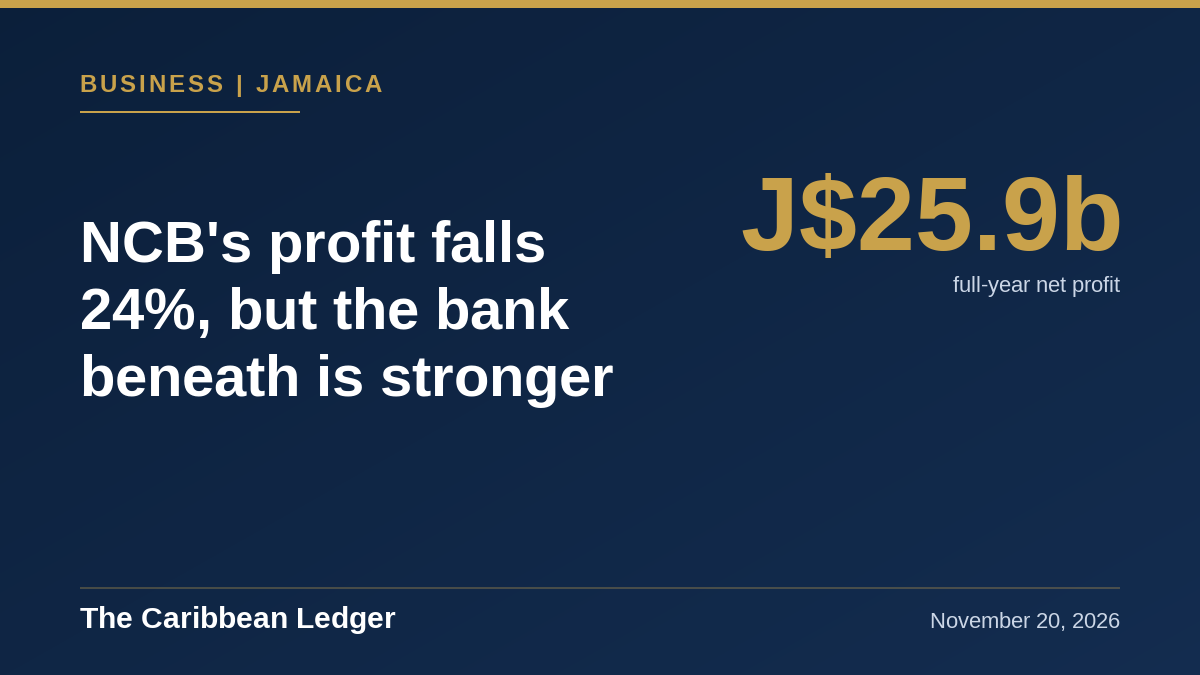
THE CARIBBEAN. NCB Financial Group, the largest financial institution in the English-speaking Caribbean, reported full-year net profit of J$25.9 billion, down 24% from a restated J$34.26 billion the year before, with earnings per share of J$7.91. The Jamaica Gleaner reported the results on November 15. A 24% drop in the headline number reads like a bad year.
The detail says something closer to the opposite, and the gap between the two is a lesson in reading a bank's accounts past the top line.
The prior year's figure was inflated by a single event, a one-off gain of J$15.1 billion from the sale of the group's insurance brokerage in the Netherlands. That kind of gain lands once and never again. Measured against a year that carried it, almost any ordinary year looks worse.
Strip the disposal out, and the comparison inverts: net profit rose by roughly J$6.8 billion, or about 35%, and profit attributable to shareholders climbed 58%, according to the Gleaner's account. The business did not shrink. The accounting base it was measured against did.
Banking carried the year, insurance dragged
Underneath, the group's two engines moved in opposite directions. Operating profit from banking and investment activities reached J$41.33 billion, up 28%, the clearest sign that the core lending and markets business is in good health. The insurance side went the other way, with operating profit falling to J$28.47 billion from J$46.97 billion.
The September quarter captured the turn, with net profit nearly doubling to J$7.33 billion from a restated J$3.81 billion and earnings per share of J$2.45. A bank whose banking is accelerating while its insurance cools is a different proposition from one losing ground everywhere, and investors tend to pay for the former.
The balance sheet backs the story. Total assets stood at J$2.42 trillion and customer deposits at J$878.7 billion, up 9%, a healthy inflow that gives the group cheap funding to lend. Return on equity eased to 9.45% from 11.7%, a step down that reflects the missing one-off rather than any erosion in the underlying franchise, and the ratio of non-performing loans sat at 3.75%, a level that signals the loan book is holding up. The directors declared an interim dividend of J$0.55 a share, with a record date of November 27 and payment on December 11, the sort of steady return to shareholders that a group confident in its cash generation pays.
The timing gives the numbers an extra edge. These are the last full-year results under the current leadership before Julian Mair takes over as group chief executive, succeeding Robert Almeida. A new chief inherits a group whose core is running well and whose reported profit is weighed down only by the absence of a gain that was never going to recur. That is a cleaner starting point than the headline suggests, and it sets a bar defined by the underlying business rather than by last year's windfall.
For the wider market, NCB is a bellwether. Its shares are among the most heavily weighted on the Jamaica Stock Exchange, and its health is a reasonable proxy for the health of Jamaican finance. A year in which the headline fell but the core grew, deposits rose and credit quality held is, read properly, a reassuring one. It is also a reminder that in bank results the first number is rarely the real one, and that the work is always in the lines beneath it.
Send news tips, corrections, or comments to newsroom@caribbeanledger.com.
Read more at The Caribbean Ledger ›