Why Caribbean dollars still answer to someone else's rules
Eighty years after the Bretton Woods conference, the region's debt, reserves and citizenship revenue still turn on decisions made far from its shores.
 Earl Bousquet · November 20, 2026
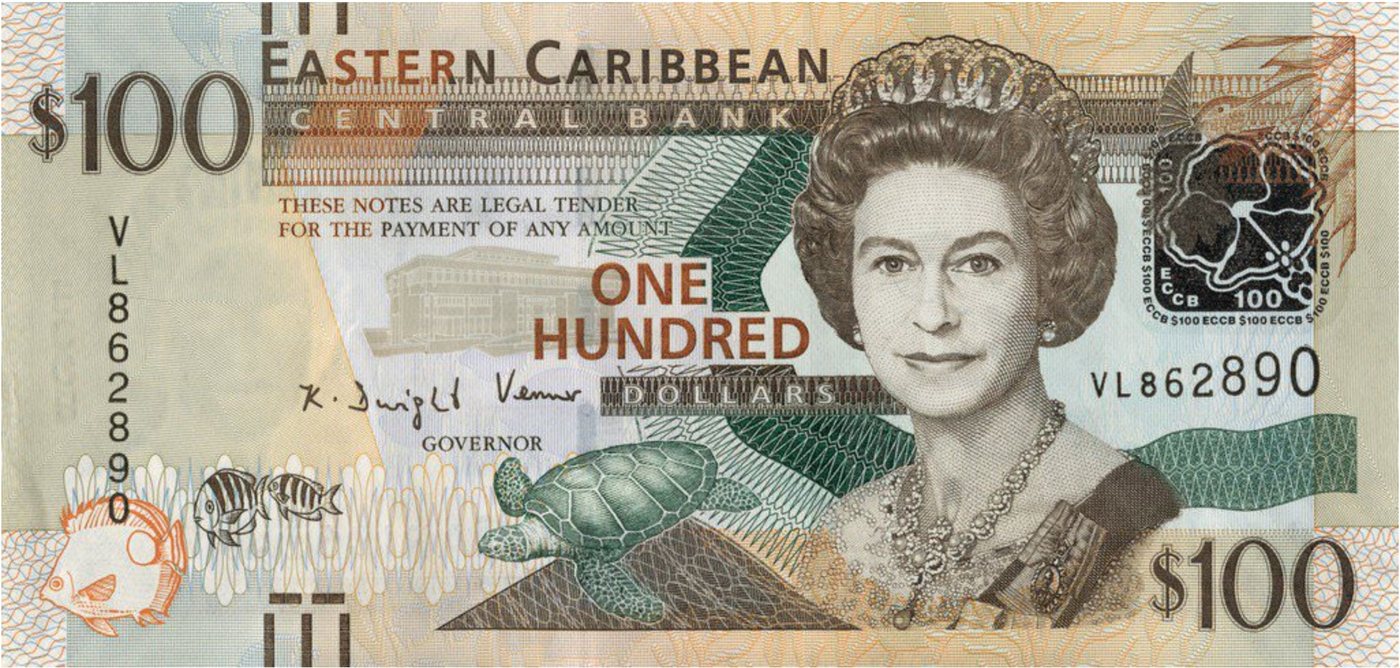
THE CARIBBEAN. The Eastern Caribbean dollar has been fixed at EC$2.70 to the US dollar since July 7, 1976. For half a century that number has been the most dependable price in the region's economy. Almost everything around it is less certain: how much the union owes, how many dollars sit in its reserves, and how much of its budget now comes from citizenship-by-investment programs.
This column is about that gap. It sets out the numbers first, then the history that explains them, so that readers can judge the arrangement for themselves. The argument is that the region's money has never been fully its own to set, and that the citizenship sales now filling its budgets are the newest form of that dependence.
The peg holds. The reserves and the deficit tell the rest.
The Eastern Caribbean dollar has been pegged at EC$2.70 to US$1 since July 7, 1976, and the Eastern Caribbean Central Bank manages that peg. A fixed rate protects shoppers and businesses from sudden swings in the currency. It does not create the foreign money a country needs to pay for imports and debt.
The IMF puts the union's international reserves at US$2.1 billion in 2024 in its April 2026 review, down from the US$2.2 billion it reported in 2025. The current account, which records the flow of money in and out for trade and income, ran a deficit of US$1.0 billion in 2024 in the IMF's 2025 report.
Sources: ECCB, EC dollar currency FAQ; IMF, Country Report No. 25/104, Tables 1, 5 and 6 (May 2025); IMF, Country Report No. 26/85 (April 2026).
Bretton Woods built the house. The Federation tried to change it.
In July 1944, 730 delegates from all 44 allied nations met at the Mount Washington Hotel in Bretton Woods, New Hampshire. Their agreements created the International Monetary Fund and the International Bank for Reconstruction and Development, now part of the World Bank Group. The region's colonies were not among the nations at that table. This column reads that design as one that favored the wealthy economies of Europe and North America, and that left former colonies to borrow on terms set in those capitals.
Adult suffrage came to the British Caribbean in stages. Jamaica granted it in 1944 and Barbados in 1951. Labor-led parties followed, and the islands tried to unite politically in the West Indies Federation, which lasted from 1958 to 1962.
When the Federation failed, each territory was left to run its own economy, mostly on agriculture or tourism, and both depended on demand from Western Europe and North America. Two regional thinkers had already named the problem.
Eric Williams of Trinidad and Tobago and W. Arthur Lewis of Saint Lucia analyzed the colonial economy and called for deep change. That change came slowly, and the ties to Europe and North America stayed in place.
Sources: Wikipedia, Bretton Woods Conference; Wikipedia, Universal suffrage.
The experiments of the 1970s came at a price
Michael Manley led Jamaica's democratic socialist government from 1972 to 1980, and returned to office from 1989 to 1992. Forbes Burnham led Guyana from 1964 until his death in office in 1985, and declared the country a co-operative republic on February 23, 1970. Both leaders set out to use the state to deliver what the market had not.
This column reads their outcome this way. Both governments borrowed on terms set by outside lenders, and those terms narrowed how much they could spend on health, schools and jobs. The lesson is not that the ideas were wrong. It is that a small economy that borrows from abroad has little room to choose its own path.
The pattern outlasted the decade. The IMF's own lending summary for Jamaica records an Extended Fund Facility in 2013, which shows that the borrowing relationship continued well past the 1980s.
Sources: Wikipedia, Michael Manley; Wikipedia, Forbes Burnham; IMF, Jamaica lending case study.
Debt is falling, but not yet at target
Debt across the union fell from 85.6 percent of GDP in 2021 to 74.3 percent in 2023. Since then it has stopped falling. The IMF's April 2026 review puts it at 74.7 percent in 2024, about 75 percent in 2025, and 76.2 percent by 2027 on its projections. The IMF revised its debt series upward in 2026, and this column uses the revised figures throughout.

The regional goal is 60 percent of GDP by 2035, as reported by the ECCB Governor. On the IMF's 2026 projection the union would still be about 15 points above it in 2026. The IMF puts the position plainly: public debt reduction has stalled at around 75 percent of GDP, well above the regional target.
Sources: IMF, Eastern Caribbean Currency Union 2026 staff report, Country Report No. 26/85 (April 2026); Antigua Newsroom, on the 60 percent debt target by 2035 (ECCB Governor).
Citizenship sales now carry part of the budget
Five of the union's eight members run citizenship-by-investment (CBI) programs. The IMF reports that CBI revenue averaged 6.5 percent of GDP across those five countries from 2019 to 2023. In 2023 it made up nearly a third of their non-grant revenue, meaning the tax and other income that does not come in as foreign aid.

The chart shows the central government's overall balance twice: once as the IMF reports it, and once with citizenship revenue removed. The space between the two lines is what those sales add to the budget each year.
Without citizenship revenue, the union's deficit has run between 7.3 and 9.3 percent of GDP in every year since 2021. The IMF projects the overall deficit to widen again in 2025, which makes the coming year the one to watch.

The price of entry is set in dollars. Under the harmonized rules that took effect in 2024, the minimum investment threshold is US$200,000. At the fixed rate of EC$2.70 to US$1, that is EC$540,000.
St. Kitts and Nevis, one of the five programs, widened its 2024 fiscal deficit to 11 percent of GDP, according to the IMF. A budget that leans on one revenue stream can lose ground quickly when that stream slows.
The revenue itself is now in question. St. Kitts and Nevis has announced a wind-down of its program, on a timeline still being negotiated with the European Union. Antigua and Barbuda has offered to end its program by the end of 2030, provided the EU supplies budget and development support, an offer Brussels has not yet accepted.
Saint Lucia says it has already decided and sent its position to Brussels, but it has not disclosed the contents and says it will not simply give up the program. The EU has asked the union's CBI states to phase out their programs by June 1, 2028, or risk losing visa-free access to the Schengen Area. Dominica has said it will engage, and Grenada has said it wants to keep both its program and Schengen access.
That leaves the question the budget must answer. Citizenship revenue has been filling a gap of 4 to 7 points of GDP. If that money falls away on a schedule set in Brussels, how will the dollars and cents add up?
The entry price is set at US$200,000 and the peg at EC$2.70, but the budget that has to absorb the loss is not fixed. The answer will come from tax reform, spending restraint, new borrowing, or some mix of the three, and each carries its own cost.
Sources: IMF, Selected Issues Paper SIP/2025/067 on ECCU CBI programs; IMF, press release No. 25/135 on the 2025 ECCU discussions (May 8, 2025); IMI, St Kitts to wind down CBI program (November 2026); Caribpulse, Antigua and Barbuda offers to end CBI by 2030 and seeks EU financial support (October 31, 2026); antigua.news, Saint Lucia makes decision on CBI program amid EU pressure (November 10, 2026); WIC News, Saint Lucia responds to EU on CBI programme (November 2026); IMI, EU writes to Caribbean states on the June 2028 deadline; IMI, Grenada wants to keep CBI and Schengen access.
Why this ledger, and why now
The Caribbean Ledger launches today, Friday, November 20, 2026, and I am proud to be among its first writers.
Traditional regional media houses, like the Caribbean News Agency (CANA), have been drowned by the New Media, and new voices are being shaped by new tools. It is an opportune time, therefore, for a regional publication like The Caribbean Ledger to arrive, with the specific intent of helping the region's people and policymakers make sense of how dollars and cents are made and spent today, by whom and for whom. It is a business publication for the Caribbean, covering markets, the economy and public policy, and it also covers sports and lifestyle, because business in this region runs through its athletes, its tourism and its culture as much as through its banks. I will put the figures first, name the source for each one, and trust readers to judge for themselves.
The union's debt is still above its own goal. Its reserves have risen in recent years. A growing share of its budget rests on the sale of citizenship, and decisions taken in Brussels and the region's capitals will shape how that budget balances for years to come.
I will track those decisions, and the dollars behind them, every week. That is the work this column was built to do, and I am glad to begin it with you today.
Disclosure: Earl Bousquet is a Communications Adviser to Saint Lucia Prime Minister Philip J. Pierre. He is a former Press Secretary to former Prime Minister Dr Kenny D. Anthony.
About the author: Earl Bousquet is a freelance journalist and veteran Saint Lucia-born Caribbean journalist of fifty years standing.
He holds the Saint Lucia Medal of Honour (Gold). He is a former Vice President for the Caribbean with the International Organization of Journalists (IOJ), former Vice President of the Caribbean Association of Media Workers (CAMWORK), former Vice President of the Saint Lucia Media Workers Association (SLMWA), former Press Secretary to Saint Lucia Prime Minister Dr Kenny D. Anthony and a Communications Adviser to current Saint Lucia Prime Minister Philip J. Pierre.
He also specializes in international and regional affairs.
Send news tips, corrections, or comments to newsroom@caribbeanledger.com.
Read more at The Caribbean Ledger ›