Jamaica wants to build AI. The islands losing their passports should build the power it runs on.
Citizenship sales are ending across the Eastern Caribbean under a 2028 EU deadline, taking a major revenue stream with them. The same islands sit on an estimated 6,290 megawatts of geothermal potential, the firm, round-the-clock clean power that AI data centers are now desperate for. Dominica, Nevis, St. Lucia, St. Vincent and Grenada are already drilling. Does the AI boom finally give them a reason, and a customer, to go faster?
MONTEGO BAY. On Sunday, November 15, at the Jamaica Labour Party's annual conference in Montego Bay, Prime Minister Andrew Holness told delegates that his government had approved a memorandum of understanding with a group of investors to explore building artificial-intelligence infrastructure in Jamaica. Jamaica, he said, should have a footprint in the technology and not only be a consumer of it, and should pursue the opportunity so that its children can have jobs in the new economy.
It was a bold statement of intent, and on the strength of the announcement alone it was almost impossible to assess. The investors were not named. No dollar figure, no site, no job count and no timeline were disclosed, and Holness did not say whether the plan even involves data centers, the power-hungry server warehouses the phrase AI infrastructure usually implies.

The gap between the ambition and the detail did not go unnoticed at home. Within a day, the opposition People's National Party's spokesman on science and technology, Christopher Brown, demanded the MOU be tabled in Parliament and questioned moving before a national AI policy exists. By the post-Cabinet briefing on November 18, Information Minister Dana Morris Dixon was talking the announcement down.
The document is exploratory, she said; there is no investor coming, no deal, no agreement being signed; and Cabinet had set guardrails that the project could not strain the island's water systems or draw from the electrical grid. Those two guardrails are the tell, because they name the hardest constraints on the whole idea. AI computing runs on electricity and cooling, and Jamaica is short of cheap, clean versions of both.
A machine for turning electricity into computation
Jamaica's 2024 average residential electricity tariff was 36.9 US cents per kilowatt-hour, among the three highest of 18 Latin American and Caribbean countries surveyed by the energy think tank Ember and cited in a November Jamaica Observer analysis. A data center is, in essence, a machine for converting electricity into computation, and it will locate where that electricity is cheap, clean and uninterrupted. The jobs math is sobering, too: data centers are capital-intensive, not labor-intensive, run after construction by small, highly specialized teams, so the prize in hosting AI is less about headcount than about revenue, taxes and a permanent place in the digital economy's physical layer.
For most of the Caribbean, the price of power is the obstacle. For a few islands, as this piece will argue, it could become the opening.
Trinidad shows the model, and the catch
The country furthest down this road is Trinidad and Tobago. In July its government signed framework agreements with Ernst and Young and with Hummingbird AI Holdings to build AI-ready data centers near Debe, two of a package of three memorandums it valued at a potential US$5 billion in all, the third an unrelated steel-plant refurbishment. The data-center plans are concrete where Jamaica's is vague: a 300-megawatt facility proposed with EY and a 150-megawatt one that could grow to 500 under Hummingbird, up to roughly 800 megawatts combined, with operations targeted for the first quarter of 2028 and more than 5,000 jobs promised, all subject to due diligence.
Trinidad's real advantage is energy. It sits on cheap domestic natural gas, which is precisely why it can contemplate feeding hundreds of megawatts of servers. Most of its neighbors cannot, which raises the question this story is really about.
The Caribbean will not invent AI. It could power it.
Start by separating two things the word AI blurs together. Developing artificial intelligence itself, the models, the research, the intellectual property, is a frontier that demands gigawatts of power, tens of billions of dollars in capital and a density of specialized talent that the world's largest firms fight over. No Caribbean island is going to train a leading model, and none should pretend otherwise. But building and operating the data centers that AI runs on is a different business, an infrastructure business, and it rewards something the region can actually supply: land, political stability, proximity to the North American market, and, for a lucky few islands, clean power.

That last ingredient is the one the market is short of. The global AI build-out has become, at bottom, a hunt for electricity, and because the computing runs around the clock, what the hyperscalers increasingly want is not merely renewable power but firm, 24-hour clean power. They are paying up for it, with Google alone signing geothermal supply deals totaling several hundred megawatts to feed its data centers.
Firm clean power is the scarce input. It happens to be the one resource the volcanic Eastern Caribbean has sitting in the ground.
Can the ECCU turn data centers into the revenue its passports no longer will?
The timing is what lifts this above a thought experiment. The small states of the Eastern Caribbean Currency Union are about to lose a revenue stream they have leaned on for years. Under European Union pressure, the region's five citizenship-by-investment states have been told to phase their programs out by June 2028 or risk the visa-free access to Europe that makes the passports worth buying. St. Kitts and Nevis, whose program is the oldest in the world at more than four decades, has already said it will wind its down.
Grenada is fighting for an extension to 2032. The sums at stake are real for economies this size: Grenada's citizenship program alone brought in roughly EC$165.9 million in 2025, and for St. Kitts and for Dominica, citizenship receipts have in some years been among the largest single sources of government revenue, a dependence the International Monetary Fund has long cautioned against. When that money goes, these governments will need something to put in its place.

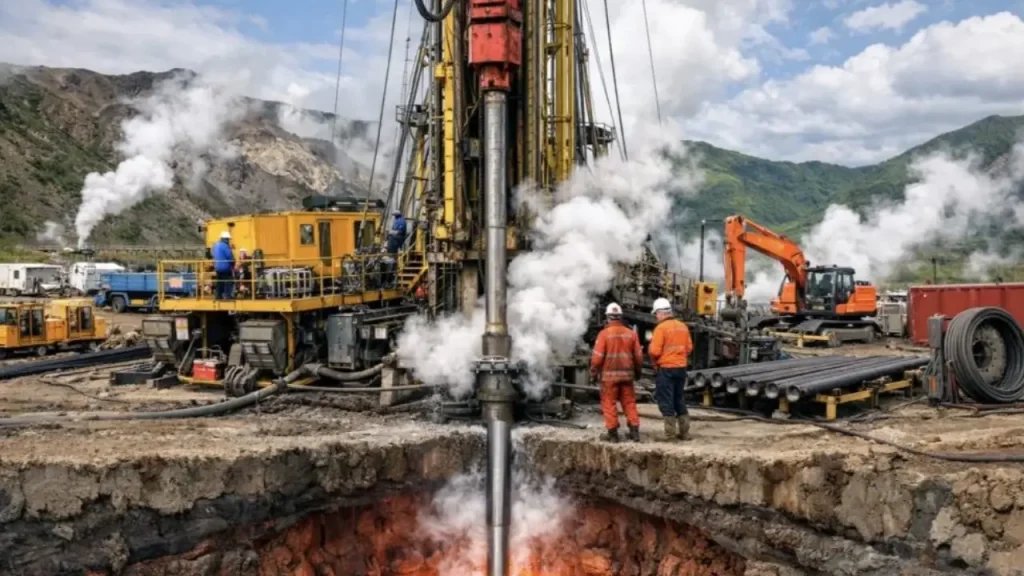
Clean power is the candidate hiding in plain sight, and it is a resource these same islands have in extraordinary abundance. The volcanic arc of the Eastern Caribbean holds an estimated 6,290 megawatts of geothermal potential across five states, by the OECS's reckoning, firm round-the-clock electricity of exactly the kind a data center needs. Five members of the Organisation of Eastern Caribbean States are advancing projects under its GEOBUILD program, and they are worth naming, because the ambition is already real. Dominica is furthest along: its 10-megawatt plant at Laudat in the Roseau Valley, developed with Ormat Technologies after a decade spent assembling a US$68 million financing package, was targeted to come online around the turn of 2026 and will be the first geothermal plant in CARICOM, eventually meeting more than 75% of the island's power needs.
Nevis, in the federation of St. Kitts and Nevis, has expanded its project to 30 megawatts and expects commissioning by 2029. Grenada is working toward a 15-megawatt plant, St. Lucia is drilling and testing, and St. Vincent and the Grenadines is in the group. Guadeloupe, next door and French, has run a geothermal plant at Bouillante since 1983, proof that the resource works in these islands when the money is found.
Does AI give the islands a reason to drill faster?
There are two honest problems with that picture, and the second is the interesting one. The first is pace. These are small plants built slowly, a decade for Dominica's 10 megawatts, where a serious AI campus wants hundreds. The second is purpose.
The region has pursued geothermal mainly to cut its own punishing power bills, with Eastern Caribbean tariffs averaging between 29 and 40 US cents per kilowatt-hour, more than double the United States, and the savings, real but modest at perhaps US$5 million to US$30 million a year per island in avoided diesel, have not been enough to pull in the capital needed to drill at speed. That is precisely what the AI build-out could change. A data-center anchor tenant is a large, paying, long-term customer for exactly the firm clean power these projects produce, and a committed customer is the thing that moves a stalled energy project off the drawing board and makes a bigger, faster plant financeable.
The question for the region's leaders has shifted. It is no longer only whether to develop geothermal to save money at home. It is whether AI has just handed them a reason, and a buyer, to accelerate that development far beyond what domestic demand alone would ever justify, turning a cost-cutting project into an export industry.
So should the ECCU governments be building green-powered data centers to replace their citizenship cash, and moving faster on the geothermal to run them? The honest answer is two-sided. Yes, they should be studying it seriously and starting now, and no, it will not arrive in time to plug the 2028 revenue hole. The case in principle is strong.
Firm geothermal power is the single input the AI industry most lacks and the one thing these islands can uniquely offer; a cluster of data centers would be a recurring, taxable revenue stream that a foreign capital cannot switch off the way Brussels can switch off a passport; and it would leave behind real infrastructure rather than a sold document. But the obstacles are serious and deserve stating plainly. Caribbean geothermal has been painfully slow, the capital runs to billions the region does not have and must attract on fair terms, connectivity still depends on thin and often monopolized subsea cables, and there is the oldest Caribbean trap of all: a deal in which the land, the power and the water are local while the technology, the profits and the best jobs belong to a foreign operator.
None of that is a reason to dismiss the idea. It is a reason to pursue it as a deliberate, decade-long industrial strategy rather than a press release, and to pursue it as a region. The ECCU already shares a central bank, a currency and, through GEOBUILD, the early work of joint geothermal drilling; sharing a common compute strategy and a single table across from the hyperscalers is the logical next move, because no island of 50,000 or 100,000 people can finance or justify a large data center alone, while a currency union of more than a million people selling clean sovereign compute is a different proposition. The citizenship era is ending because the Caribbean sold something the world could take away with a policy memo in Brussels.
The lesson worth drawing from its close is to build something next that the world has to come to the islands to use. Clean power, drawn from under their own volcanoes and sold to the most power-hungry industry on earth, may be exactly that. Jamaica has started the conversation by talking about building AI. The sharper opportunity may belong to the smaller islands willing to build what AI cannot run without.
Send news tips, corrections, or comments to newsroom@caribbeanledger.com.
Read more at The Caribbean Ledger ›