Dickon Mitchell, the lawyer who won Grenada twice, and the questions a landslide leaves open
At 49, with a 14-of-15-seat majority and a first-term record that holds up on the numbers, Grenada's prime minister is the Caribbean's youngest generation of leadership in power. The data, the minimum-wage rise, the citizenship fight with Brussels, and the republic he still has not built.
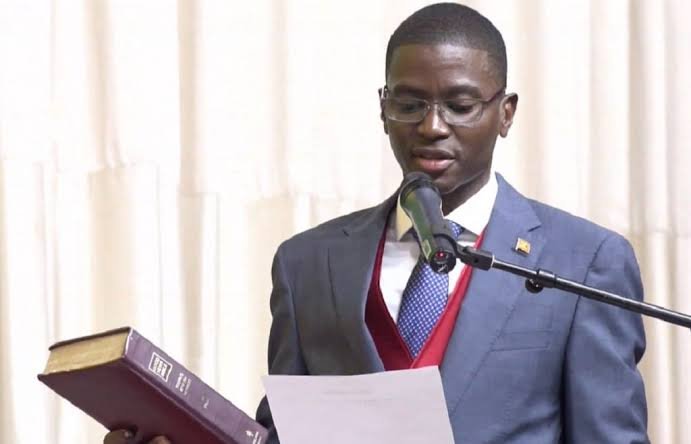
ST GEORGE'S. On the evening of November 5, Grenadians gave Dickon Mitchell almost the entire House of Representatives. His National Democratic Congress took 14 of the island's 15 seats, the opposition New National Party was reduced to one, and its leader lost her own constituency. Three days later Mitchell took the oath for a second term, and on November 16 he swore in a reshaped cabinet built around a new petroleum ministry.
He is 49 years old. He has now won two consecutive general elections, the first leader to do so in Grenada since Keith Mitchell, and he commands a legislature with no meaningful opposition in it. The question the island is entitled to ask is what sort of leader holds that much power, and what the first four years tell us about how he will use the next five.
This profile is drawn from the public record. The Caribbean Ledger has sought an interview with the prime minister, and will update its account when he speaks to us directly. What follows is an assessment of where Mitchell came from, what the data says he did with his first term, and what his second now asks of him.
The newcomer who became the youngest leader in the room
Dickon Mitchell was born on October 8, 1977, in Petit Esperance, in the parish of St. David, according to his entry in the Inter-Parliamentary Union's Parline database. He was educated at Presentation Brothers College in St. George's, took an LLB with honors at the University of the West Indies at Cave Hill in Barbados, and earned his Legal Education Certificate at the Hugh Wooding Law School in Trinidad in 2002. He practiced as an attorney, first as an associate at the firm Grant, Joseph and Co., and in 2017 he founded his own practice, Mitchell and Co. He was, in other words, a working lawyer and not a career politician.

That is what made his rise so unusual. Mitchell took over the leadership of the National Democratic Congress on October 31, 2021, a party then out of power and out of Parliament, and inside eight months he had turned it into a government. In the June 2022 general election the NDC won slightly over 51% of the vote and 9 of the 15 seats, ending nearly a decade of Keith Mitchell's New National Party rule. At 44, Dickon Mitchell became Grenada's ninth prime minister and, as WIC News and other regional outlets reported at the time, the youngest serving head of government in the Caribbean Community.
The youngest-in-the-region description is accurate for CARICOM and worth keeping in proportion. Mitchell was not the youngest national leader in the world. Finland's Sanna Marin had become prime minister at 34, and El Salvador's Nayib Bukele took office at 37.
But in a region whose governments have often been led by men in their sixties and seventies, a 44-year-old lawyer with no prior parliamentary career was a genuine generational break, and the symbolism was not lost on a Caribbean electorate that skews young and has watched its young people leave. In 2024 he served as chairman of CARICOM, and he co-chaired a summit with India's prime minister, Narendra Modi, giving a small island of roughly 115,000 people an outsized seat at larger tables.
What a second term means for Grenada
A 14-to-1 Parliament is a mandate and a hazard in the same breath. It gives Mitchell the freedom to legislate and spend with almost no friction, which is exactly the condition under which governments either move decisively or lose the discipline that opposition normally enforces. He appears aware of the risk.
At the November 16 swearing-in he told his ministers that a larger cabinet must never become an excuse for a larger bureaucracy or unnecessary expenditure, that public office is not a reward but a responsibility, and that no minister is above scrutiny. Those are the right words. In a House where the elected opposition is a single person, they are also the only scrutiny on offer, because the chamber that is supposed to hold the executive to account is now almost entirely the executive's own party.
For Grenada, then, the second term means continuity of direction with a thinner check on it. Mitchell has stepped back from any line ministry to concentrate on what he calls strategic direction, coordination, institutional reform and international engagement, handing finance to David Andrew, the man who unseated the opposition leader, and national security to Dennis Cornwall. Whether a government this dominant can supply its own accountability is the central governance question of the next five years, and the answer will not come from the ballot box until 2031.

A voice for a younger generation, and for the region
Mitchell has leaned into the generational role. His recurring line that citizenship is not a spectator sport, first used at a National Heroes Day observance and repeated at his second swearing-in, is a direct appeal to civic participation by the young. He has positioned himself internationally as an advocate for climate-vulnerable small states, a posture that matters for an island in the hurricane belt still absorbing the lessons of recent storms, and he has been willing to speak for the region on the questions that have defined this Caribbean moment: the defense of CARICOM as a zone of peace against the militarization pressing on Venezuela and Cuba, the push for reparatory justice at the Commonwealth table, and now the defense of citizenship-by-investment against European pressure.
It would be easy to oversell this, and good journalism should not. Mitchell leads a microstate, and the structural limits on what any Grenadian prime minister can change in the hemisphere are real. But within those limits he has chosen to be heard, and his age and manner have made him a natural spokesman for a younger, less deferential Caribbean politics. The test of whether he is a regional voice or merely a regional presence will be whether other capitals follow where he leads on the issues, from CBI to climate finance, where the region's small states are strongest when they move together.
What the data says about the first term
Strip away the symbolism and the first-term record holds up on the numbers, with one honest caveat: Grenada's official statistics are thinner than they should be. The International Monetary Fund, in its 2025 Article IV mission statement, noted that data gaps, including outdated inflation weights and missing national-accounts detail, hamper surveillance. With that caution stated, the picture is of a small economy that grew steadily and brought several hard indicators in the right direction.
On growth, the World Bank's Macro Poverty Outlook for Grenada records real GDP expansion of 4.5% in 2023 and about 3.2% in 2024, with 2025 estimated at 4.9% and 2026 projected near 3.3%. The Bank notes the economy grew at an average annual rate of 4.4% over the past decade, excluding the pandemic year, placing Grenada among the faster-growing economies of the Eastern Caribbean through Mitchell's term.
On jobs, the movement is the most striking. Drawing on the Grenada Labour Force Survey conducted by the Department of Statistics, overall unemployment stood at 16.6% in the second quarter of 2021, before Mitchell took office, having risen to 18.5% at the end of 2020 during the pandemic. By the fourth quarter of 2023 the survey put it at 11.1%.
In November 2025, Grenada's foreign affairs minister stated that unemployment had fallen to 7.5%, according to the government. Youth unemployment, the region's most stubborn problem, followed the same path, easing from 38.6% in mid-2021 to 22.8% by the end of 2023 on the same survey series. The 7.5% headline is a government figure and should be read as such until the next full labor survey confirms it, but the direction across independent survey rounds is not in doubt.
On the cost of living, price pressure has drained away. The World Bank records consumer inflation of 2.7% in 2023, 1.1% in 2024 and 0.5% in 2025, with the first half of 2026 averaging about 1.2%, well below the levels of the 2022 global price shock that greeted Mitchell on arrival. On the public finances, general government debt eased from 74.5% of GDP in 2023 to 70.9% in 2025, on track, by the IMF's reckoning, for the regional 60% target in the early 2030s, though planned infrastructure borrowing will slow that descent. And on living standards, the World Bank estimates the poverty rate fell to 17.9% in 2025 from a pandemic-era peak of 23.2% in 2020.
The minimum-wage increase, and the empowerment argument
The single most concrete first-term act for ordinary workers came in January 2024, when the government raised the national minimum wage for the first time since 2011. The new order set a base of no less than EC$1,200 per month, or EC$60 per day. For some categories the jump was dramatic.
Store clerks who had been earning EC$700 a month moved to EC$1,200, and the government said some workers would see increases of as much as 100%. The increase was announced in Parliament by the then labour minister, Claudette Joseph, who now holds the new petroleum portfolio. After thirteen years without a revision, a floor under the lowest-paid workers is the kind of measurable change a government can point to, and it fits the empowerment language on which Mitchell campaigned.

The promises kept, and the one still open
Mitchell came to office in 2022 promising to end nepotism, reform the electoral system, pay teachers salaries that had been withheld, and govern by example. He took the finance portfolio himself and created a Ministry of Mobilization, Implementation and Transformation to drive delivery. On the measurable commitments, the wage increase, the fall in unemployment and the steady growth, the record supports him.
One signature ambition remains unrealized. Mitchell has said he hoped Grenada would become a republic during his administration, retiring King Charles III as head of state, and that constitutional change has not happened. A second term with a near-total parliamentary majority removes the usual excuse of insufficient votes, and whether he pursues the republic now will say a good deal about his priorities.
The citizenship fight, and why the premise has flipped
On one point the regional story has moved the opposite way from what many assume. Grenada is not exiting its citizenship-by-investment program. It is fighting to keep it.
The European Union has pressed the five Eastern Caribbean states that sell citizenship, Grenada among them, to phase the programs out by June 1, 2028, warning that continued operation could cost their citizens visa-free access to the Schengen area. Grenada has formally requested a five-year extension to 2032 and development assistance to cushion the loss, according to reporting by Times Caribbean and the specialist service Best Citizenships. Mitchell, who has called the program very important to Grenada, is resisting the deadline rather than accepting it.
The stakes are fiscal. Grenada's Investment Migration Agency reported roughly EC$165.9 million in CBI revenue and collections in 2025, a material sum for a government of Grenada's size and a cushion against the island's exposure to hurricanes and fuel prices. The regional field is splitting around that pressure.
St. Kitts and Nevis announced in mid-November that it would wind its program down, and Antigua and Barbuda has signaled a willingness to end its own by around 2030. Grenada, by contrast, is asking Brussels for time and money. How that negotiation resolves is one of the defining economic questions of Mitchell's second term, because a hard 2028 cutoff would tear a real hole in the budget that the new petroleum ambition is nowhere near ready to fill.
The mandate going forward
Mitchell has framed his second-term priorities around education reform, healthcare, climate-resilient infrastructure, food and energy security, public administration and youth employment. The structural choices in his new cabinet point the same way. By standing up a dedicated ministry for petroleum and hydrocarbons under Claudette Joseph, and a separate ministry for the blue economy, marine affairs and environment under Joseph Andall, he has organized his government around a wager that Grenada can follow some distance down the resource road that transformed Guyana, while keeping its climate and ocean commitments in separate hands. It is a speculative bet, built more on possibility than on proven reserves, and it will be judged on exploration results no reshuffle can conjure.
The honest summary of Dickon Mitchell at the start of his second term is this. He is a young, disciplined, lawyerly leader with a first-term record that stands up on the numbers, a genuine claim to speak for a younger Caribbean, and a mandate so large it has removed almost every external check on him. The risks are the mirror image of the strengths. A one-seat opposition leaves accountability to his own restraint.
A budget leaning on citizenship sales faces a European deadline. A republic he said he wanted remains unbuilt. And an island's statistics are thin, which limits how precisely anyone can test his claims. The Ledger will keep testing the record against the data, and has asked the prime minister to answer for it himself.
Send news tips, corrections, or comments to newsroom@caribbeanledger.com.
Read more at The Caribbean Ledger ›