Guyana's fifth production ship begins work, and the country's oil capacity reaches 1.1 million barrels a day
ExxonMobil's Errea Wittu began operations at the Uaru development on November 16, 2026. With five vessels now working the Stabroek block, combined capacity has reached 1.1 million barrels a day, and the next project is already moving.
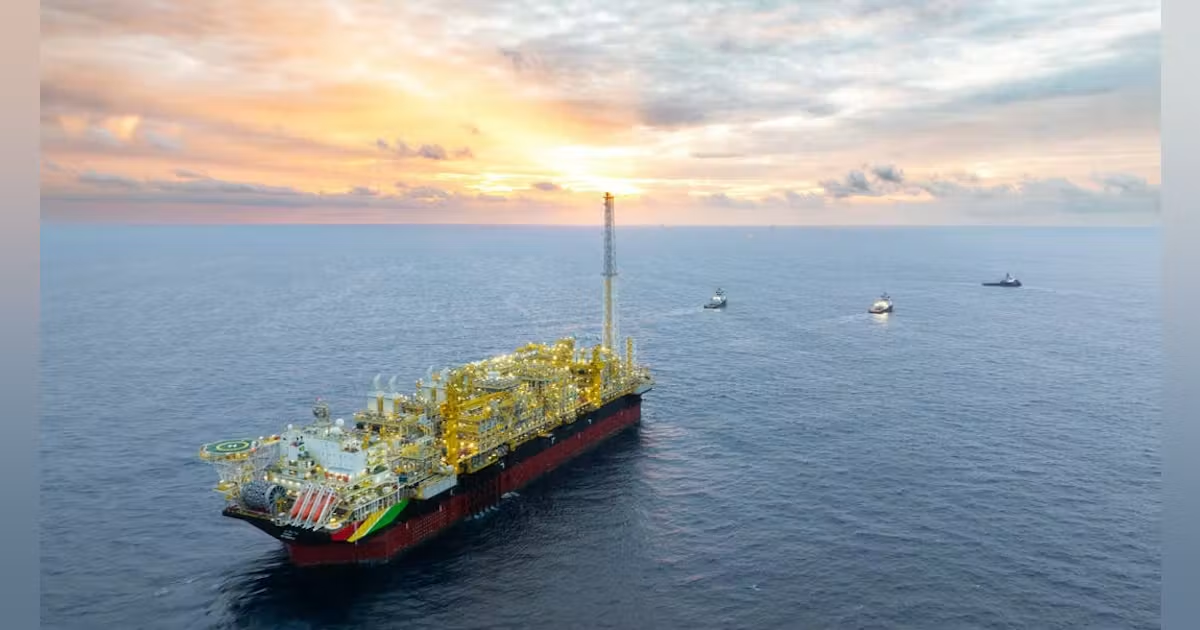
GEORGETOWN. On November 16, 2026, the Errea Wittu began operations at the Uaru development, the fifth floating production, storage and offloading vessel now working the Stabroek block off the Guyanese coast. Its builder, MODEC, said the start came ahead of schedule. Trade press has since reported that the country's installed capacity has reached 1.1 million barrels a day.
Guyana had no commercial oil production until December 2019, and that figure is a measure of how quickly a small economy can change.
WorldOil, which first reported the start of production, said the vessel's initial capacity is 250,000 barrels a day, a level the operators expect to reach in the first quarter of 2027. The vessel can store two million barrels on board and is working in about 1,690 meters of water. Neither the operator nor the reporting has published a separate gross production figure for Uaru. The 250,000 barrels a day describes what the ship can handle, not what the field will ultimately produce.
Readers should keep the two numbers apart as the project ramps up.
Five ships, one number

The 1.1 million figure appears in two accounts that describe it in slightly different terms. WorldOil calls it Guyana's installed production capacity. Offshore, which covered the same start, says the five floating vessels now in operation have a combined throughput of 1.1 million barrels a day on the Stabroek block. The number is consistent across both, but the scope is not identical, and this article uses the narrower description.
The arithmetic explains why the country is moving so quickly. Each new vessel adds a block of capacity, and each one needs years of planning, contracting and construction before it produces a barrel. The Errea Wittu is the product of decisions taken well before its start date, and its arrival shows how much of the work happens out of sight.
The shift is easier to see when the timeline is set side by side. Commercial production began in December 2019, and the fifth vessel began operations less than seven years later. Few economies in the region have moved that far, that fast, on a single offshore resource, and the speed is the reason the decisions taken now carry so much weight.
ExxonMobil put the achievement in its own terms. Dan Ammann, president of ExxonMobil Upstream Company, said that "in just over a decade, Guyana has become one of the world's fastest-growing and most important new sources of energy supply," according to the statement reported by WorldOil.
The annual series tells the same story in numbers. Output was effectively zero before 2020 and averaged 617,350 barrels a day in 2024 and 747,432 barrels a day in 2025, according to the Worldometers compilation of EIA and Oil & Gas Journal data. The 2025 figure includes other petroleum liquids, while the earlier years are reported as oil, so the series is a reliable guide to the trend rather than a precise like-for-like comparison. An April 2026 report in Eurasia Review said output "now tops 900,000 barrels per day." That is a later reading than the annual series and is not reconciled with it here.
The next project is already moving
WorldOil reports that ExxonMobil recently took a final investment decision on Longtail, the next development on the block, and Offshore reports that major contracts have been awarded for it. The two accounts agree on the direction but do not give a start-up date for Longtail. This article does not offer one either.
SBM Offshore will build, install and operate the Longtail floating production vessel for an initial 10 years from start-up, according to Offshore. The vessel is designed to process 1.2 billion cubic feet of gas a day and 250,000 barrels a day of condensate, and it will be spread-moored in about 1,750 meters of water.
Saipem has been authorized to proceed with the subsea engineering, procurement, construction and installation work for Longtail. Offshore values that contract at between $1 billion and $1.5 billion. Fabrication will take place at Saipem's Arbatax yard in Sardinia. The contracts name three vessels for the work: FDS2, Castorone and Constellation.
What it means at home

For Guyana, the most immediate effect is on public finances. Each new vessel brings more royalties, taxes and profit-share payments into the budget, and the government's choices over the next few years will decide whether the boom becomes a lasting change in living standards. Oil money can pay for power, roads and social programs, but only if it is spent with the same discipline that the contracts require.
The harder question is what happens when production is concentrated in a few offshore vessels. A single outage, a fall in the price of crude, or a delay in a new project can move the national accounts in a way that a more diversified economy would absorb. Planners will need a broader base of income, and the Stabroek ships make that need more urgent, not less.
Local content is the second test. The Longtail contracts, including the subsea work in Sardinia, show how much of the supply chain still sits outside the country. Every contract that moves to a Guyanese company, every technician trained locally, and every service firm that stays after the first project adds more value than the barrels alone.
Environmental questions are the third. Associated gas is a valuable resource and an environmental risk if it is flared or poorly managed. Longtail's design to process 1.2 billion cubic feet of gas a day will test how Guyana handles that gas at scale, and the regulators and the communities along the coast will be watching whether the commitments are kept.
The chart shows the scale of the change. Before first oil, total output and output excluding petroleum moved together, rising from G$773.6 billion in 2012 to G$924.2 billion in 2018. Non-petroleum output then kept growing, from about G$944 billion in 2019 to G$1.47 trillion in 2025, a gain of more than half in six years. Petroleum and gas output rose from G$20.3 billion to G$5.13 trillion over the same period, and by 2025 it made up about 78 percent of output at basic prices.
The non-oil economy is growing, but the gap between the two lines is the measure of how much the country now depends on a single sector.
Jobs before and after the boom

The employment record is harder to read than the output record. Guyana does not publish an unbroken annual unemployment series in the sources reviewed for this article. The available readings include the 2012 Census, which recorded 12.5 percent, and two labour force survey quarters in 2017, which recorded 12.0 and 12.2 percent. No survey round in 2018 or 2019 appears in the reporting reviewed, so the years in which the first oil arrived are a gap in the record.
The pandemic years show the sharpest readings. The first quarter of 2020 recorded 12.8 percent, and the first three quarters of 2021 ran between 14.5 and 15.6 percent. Then the fourth quarter of 2024 recorded 6.8 percent, which the Bureau of Statistics described as a significant improvement on the 14.5 percent of the third quarter of 2021.
That is a striking drop, and it is the figure that matters most to a young Guyanese looking for work. But one quarter is not a trend. Survey definitions change over time, the 2012 Census uses a different reference period from the quarterly surveys, and the sources do not establish how much of the improvement comes from the oil sector as against construction, services and public spending. The honest conclusion is that employment improved after 2021, and that a link to oil must be proven with better data, not assumed.
A lesson for the Caribbean
The region has been watching Guyana with a mix of interest and caution. Few Caribbean islands have a discovery of comparable size, so the Guyanese model cannot simply be copied. The lesson of Stabroek is that a government which plans the use of its revenue, and which insists on local participation from the first contract, can turn a single discovery into a generation of investment. The table sets Guyana beside its neighbors' energy choices as reported in the sources reviewed.
Guyana: Offshore oil at scale, five production vessels, Longtail next. Reported position: About 747,000 barrels a day in 2025; 1.1 million installed capacity in November 2026. Source: Worldometers (EIA, OGJ); WorldOil, November 2026.
Suriname: GranMorgu offshore project. Reported position: First oil expected in 2028, nameplate capacity 220,000 barrels a day, cost $10.5 billion. Source: Oilprice, May 12, 2026.
Trinidad and Tobago: Established oil and gas base. Reported position: Energy Minister Ernesto Kesar: reliance on oil and gas "will persist for the foreseeable future". Source: Eurasia Review, April 2, 2026.
Jamaica: Exploration interest; no commercial output reported in the sources reviewed. Reported position: African Energy Chamber chair NJ Ayuk urged drilling in Jamaica and Grenada. Source: Eurasia Review, April 2, 2026.
Eastern Caribbean (OECS): Geothermal power, with shared drilling. Reported position: Five nations hold an estimated 6,290 MW of potential; diesel savings of $5 million to $30 million a year per country. Source: OECS, via Reuters, December 2025.
Guyana's approach differs in one important respect. It treated the oil sector as a national program from the first contract, with local content rules and a sovereign fund designed before large revenues arrived. Trinidad and Tobago has the infrastructure and the experience but is living with a maturing base. Suriname is at the start of a new cycle.
Jamaica and most of the Eastern Caribbean have not yet found hydrocarbons of comparable scale, which leaves them with a choice of energy and revenue strategies rather than a single prize.
The Eastern Caribbean sits at the other end of that spectrum. It has no hydrocarbons of scale, and several of its governments have relied on citizenship programs to fill the fiscal gap. Its energy costs are among the highest anywhere, and its challenge is not a lack of ideas. It is a shortage of capital and of time.
The Eastern Caribbean question: geothermal or something else

Citizenship by investment has been the most visible fiscal tool in the region, and the figures show how sharply the revenue can move. In Grenada, the IMF records CBI revenue at 3.6 percent of GDP in 2020, rising to 14.7 percent in 2024, before estimating a fall to 4.4 percent in 2025 and projecting about 3.2 percent by 2030. The classification also changed: the IMF notes that CBI was recorded under grants until 2022 and under non-tax revenue from 2023, so the swing reflects both the program and the accounting.
St Kitts and Nevis offers the starkest example. A BusinessDay report, citing IMF assessments and government figures, says CBI's share of federal revenue fell from 70 percent in 2022 to 18 percent in 2025. Prime Minister Terrance Drew has said the country will "wind down its Citizenship by Investment program responsibly," and the government is negotiating a transition timeline with the European Union. Antigua's Prime Minister, Gaston Browne, has offered in a letter dated October 30 to end his program by the end of 2030, and reporting in November 2026 says the EU has not yet agreed to that timeline.
Reuters, as cited by Liberty Mundo, puts Antigua's citizenship revenue at about $58 million in 2025, or 7 to 11 percent of recurrent revenue.
Geothermal is a real answer, but it is not a like-for-like replacement. The OECS estimates that each country could save $5 million to $30 million a year by cutting diesel imports by more than 90 percent, and average electricity tariffs of $0.29 to $0.40 per kilowatt-hour compare with a United States average of about $0.15. Those savings lower the cost of living and of doing business. The sources reviewed do not show how much revenue a geothermal plant returns to the state, and St Kitts and Nevis's 30-megawatt project, with commissioning estimated for 2029, is a long way from the scale of CBI receipts.
Dominica's 10-megawatt plant at Laudat shows the timing risk: three OECS releases gave three different targets for its completion.
Our view is that the islands should sort themselves into two groups. The first has a credible resource, a government able to run a multi-year drilling and procurement program, and the patience to take geothermal from exploration to a signed power purchase agreement. For these islands, geothermal can replace much of the fiscal and economic role CBI has played, because it cuts the import bill that drains foreign exchange, lowers the cost of power for every business, and gives investors a reason to build locally. Grenada, Saint Lucia, Saint Vincent and the Grenadines, and St Kitts and Nevis are all at different stages of exploration or production, and the OECS shared drill rig study is the right instrument for them.
The second group has a thinner resource, a limited drilling budget, or a government that has not yet built the procurement capacity. For these islands, the replacement has to come from elsewhere: a broader tax base, professional and financial services where the region already has regulatory standing, agro-processing, digital services, and tourism that keeps more of its spending on the island. Those options are slower and less glamorous, and they demand the same focus that geothermal does.
Closing
Guyana's oil story is still being written, and the lesson it offers is not the one most people expect. The barrels are the easy part. The difficult part is the decision that comes after the revenue arrives: whether the money is saved, invested in productive capacity, shared through local contracts, or spent quickly on consumption that disappears by the next election.
The Eastern Caribbean has less to work with, and therefore less room for error. Its citizenship programs are ending or under review, its tourism is growing but concentrated, and its power is among the most expensive in the world. Geothermal is not a magic fix. It is a serious, multi-year national project that needs sequencing, honest financing and governments willing to refuse shortcuts.
For the islands with the resource and the will, it can replace what CBI once provided in the form that lasts longest: cheaper power, a smaller import bill and an economy that attracts investment on its own merits.
The window is open now. Guyana shows what happens when a country commits to a resource and builds the institutions around it. The Eastern Caribbean can still choose its path before the choice is made for it by the calendar of the European Union, the lenders that finance its debt, and the markets that set the price of its power. The islands that act with focus in the next few years will be the ones that still have options when the next decade arrives.
The lesson of Stabroek is simple to state and hard to carry out: find the resource, plan the money, and keep the promise to the people who live beside it.
Send news tips, corrections, or comments to newsroom@caribbeanledger.com.
Read more at The Caribbean Ledger ›