Two sets of numbers: the Bahamas economy after two recessions
The statistics office reports a 2.7 percent real contraction in the first half of 2026. The Central Bank, speaking before the national accounts were compiled, described healthy growth. The two gauge different things, and only the first compares real output against the same period a year earlier: on that like-for-like basis the economy contracted. Behind the number is a real but slowing recovery from two recessions, and a government betting that roads and homes will carry it forward.
NASSAU. The Bahamian economy has been through two recessions in the period covered by official data, and neither began at home. The first, in 2008 and 2009, was the global financial crisis, set off by the collapse of the United States subprime mortgage market and the banking failures that followed, and it reached the islands as a tourism shock that spread into construction and hotel employment.
The second, in 2020, was the worldwide recession triggered by the COVID-19 pandemic, a near-total stop that pushed the unemployment rate to 25.6 percent. Both were global downturns the Bahamas imported through its visitors rather than isolated local failures, and both were followed by recoveries that the official numbers show are real. They also show that the growth is slowing, and that prices and jobs have not moved as fast as output.
Two sets of numbers
Two official voices describe the same six months in ways that do not match, and the first task is to decide which one is measuring the economy. The Bahamas National Statistical Institute reported that real output fell 2.7 percent in the first half of 2026 against the same half of 2025, a like-for-like comparison of the same six months on the same price base, covered by the Nassau Guardian on November 23. The Central Bank, speaking on July 30 before those accounts were compiled, described healthy growth and put full-year output on pace to finish only moderately below the 3.8 percent estimated for 2025.
The two are not rival readings of one number. The institute measured real output, the volume of goods and services produced once price changes are stripped out, set against the matching period a year earlier. The Central Bank was reading nominal receipts and visitor inflows, the indicators it held before the national accounts existed, and projecting the full year from them.
Those gauges can climb while real output falls. Nominal output, valued at current prices, did rise 6.1 percent to B$9.44 billion, but with retail inflation at 4.2 percent in the second quarter that increase is mostly price, not production. Compared against the same period a year earlier, there is one answer, and it is contraction: the economy produced less, while the price of what it produced rose.
The detail underneath is uneven. Output fell in 13 of the 17 industries the institute tracks: information and communication down 22 percent, manufacturing down 14 percent, and accommodation and food services, where visitor spending lands, down 12 percent in real terms. Construction, which added about B$38 million, and the utilities group were among the few gainers.
The first quarter did the damage, down 5.2 percent on a year earlier, while the second was almost flat at down 0.1 percent. Measured quarter on quarter, though, both periods grew, by 1.9 percent and 5.4 percent. The Central Bank, for its part, pointed to stronger visitor activity, with vacation-rental room nights up 7.7 percent to 170,989 in the second quarter even as hotel room inventory stayed tight.
Stronger visitor counts and weaker real output can appear together when output per visitor slips, which is how the bank could see strength in the inflows while the accounts recorded a contraction. The forecasts had already leaned cautious: the IMF, in February 2026, put 2025 growth at 2.8 percent and projected 2.2 percent for 2026 and 1.9 percent for 2027, all prepared before the half-year number landed.
Five years of GDP
Real output fell 20.1 percent in 2020 and has risen every year since. It grew 17.6 percent in 2021 and 10.9 percent in 2022, then slowed to 3.0 percent in 2023 and 3.4 percent in 2024, the institute's preliminary figure. The institute's advance estimate for 2025, reported in May 2026, put growth at 3.8 percent.

Nominal output rose from B$10.4 billion in 2020 to B$15.8 billion in 2024. The gap between the two lines is price change. In 2024 it came to about B$1.7 billion, output that exists in the accounts because prices rose rather than because more was produced.
Where the output comes from
The composition of output has shifted more than the total. Accommodation and food services grew from 2.7 percent of GDP in 2020 to 12.4 percent in 2024, the sharpest move in the table. The sector produced B$2.0 billion at current prices in 2024. The table does not separate tourism from the rest of the sector, but this is where visitor spending lands.

Real estate, including owner-occupied rents, remains the largest single industry at 13.3 percent, though its share has fallen from 18.5 percent in 2020. Wholesale and retail trade has held near 11 percent. Financial services slipped from 9.8 percent to 8.2 percent over the same period, and public administration eased from 8.1 percent to 6.2 percent.
Construction is the industry the government most often describes as a driver, and its share is smaller than that language suggests. It was 6.6 percent of GDP in 2020, eased to 4.6 percent in 2023, and recovered to 5.4 percent in 2024. Nominal construction output rose about 22 percent in 2024, to B$857 million. That is a real rebound from a low base, but construction is still smaller than real estate, retail or tourism-linked services.

Construction: roads, homes and luxury builds
The government's construction story has three parts: public roadworks, a housing programme and private luxury development. The official record supports the first, supports only part of the second, and cannot measure the third.
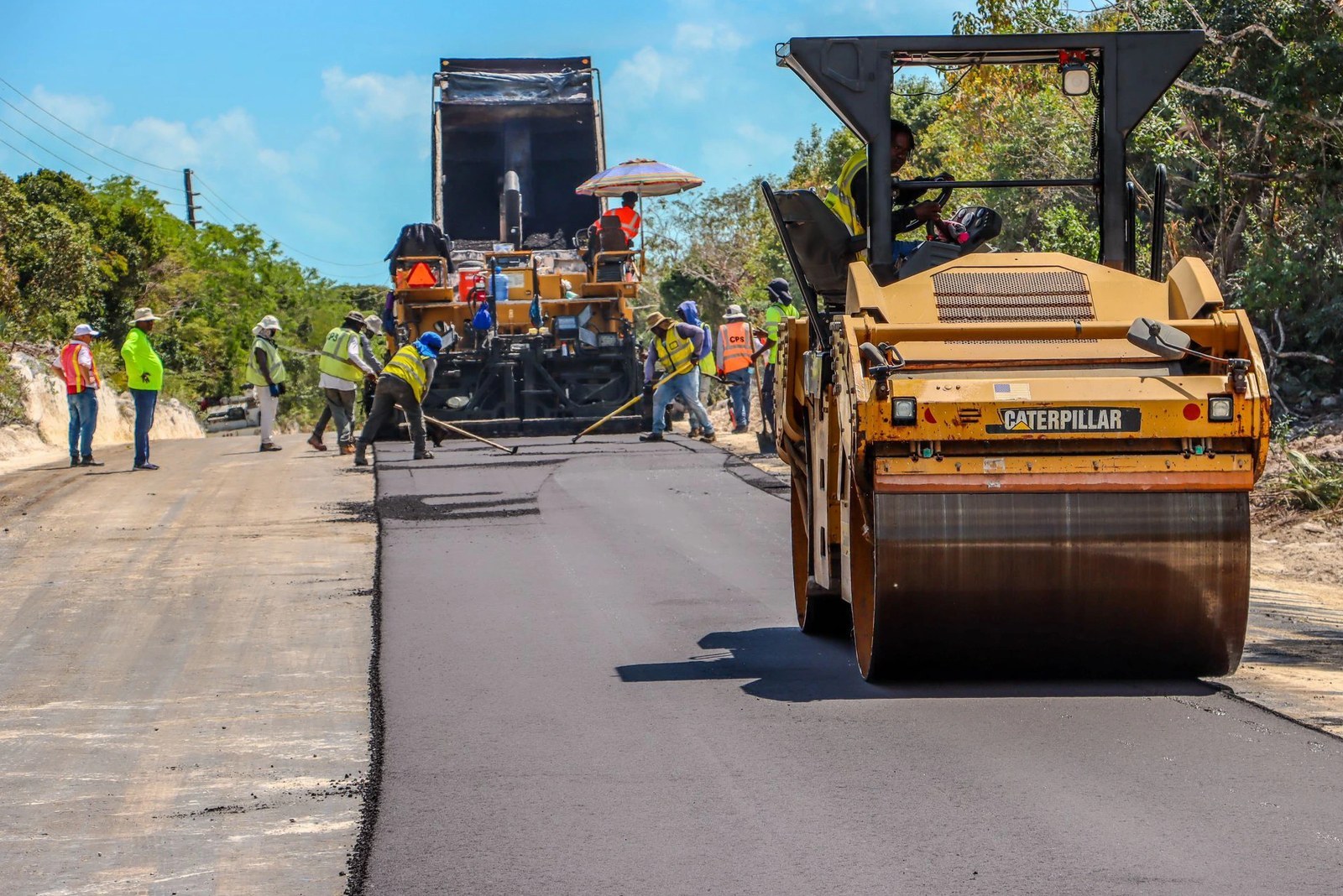
Roadworks are the visible part. The Bahamas Striping Group of Companies (BSGC), a private firm founded in 2010, has been a major contractor on the government's road programme in the Family Islands. In February 2026, the Tribune reported a $100 million accounts receivable factoring facility from the Africa Export-Import Bank covering about 200 miles of roadworks on Exuma and Eleuthera.

The company says the Exuma work is 97 percent complete. Its promotional material also describes about $50 million of public-private partnership projects, with government repayment spread over three to five years.
These arrangements have drawn scrutiny. In April 2025, the Tribune reported a $183 million west Grand Bahama roadworks contract, awarded to Abaco Caribbean Holdings, which it described as a BSGC subsidiary, through what appeared to be a direct award. The Prime Minister's Office described the contract's listing in a December 2024 procurement report as an administrative error and said the matter had been stopped for review.

No published outcome of that review was found for this article. Opposition figures have asked how a project of that size reached Cabinet without a competitive process. Those questions deserve answers on the record.
The claim that BSGC is building more than 1,000 low-income homes for the government does not hold on the record. No government document, contract register or company profile reviewed for this article supports it. The company's public materials describe roads, drainage and infrastructure. The only government programme of 1,000 homes in the public record dates to 2011, and it does not name BSGC as a contractor.
The government's current housing agenda looks different. Housing Minister Keith Bell told the 2026/27 budget debate of a projected yield of more than 900 lots from future subdivisions, which he said would let construction proceed more quickly. The rent-to-own programme is expanding in New Providence, Abaco, Eleuthera and San Salvador, though no unit count has been published. The Bahamas Mortgage Corporation reports more than $109 million lent since October 2021 and more than 700 families assisted.
Luxury residential building for foreign buyers is the third element, and the hardest to measure. Public statistics do not separate luxury homes from other construction, and no official source reviewed reports how many foreign-owned residences are under way or how much of their cost is spent locally. The economic logic is still clear.
Foreign-funded building creates demand for imported materials, licensed trades, engineers, surveyors, marine and landscaping work, and the services that follow new residents and their staff. Real estate is the largest industry in the accounts at 13.3 percent of GDP, and the spillovers likely land there and in accommodation. Whether they are large enough to justify the incentives is a question the Bahamas cannot yet answer.
The statistics office could start by reporting building approvals by value and owner type, and the Central Bank could report the foreign investment behind them.
The last recession, and what it cost
The Bahamas has been through two recessions that official data record clearly. The first, in 2008 and 2009, came from the global financial crisis, but it reached the islands through tourism. According to the IMF, arrivals fell 10 percent in 2009 and foreign direct investment fell more than 30 percent. Real output contracted 4.3 percent in 2009 on the statistics department's estimate, and hotels and construction accounted for the bulk of the layoffs.
The second recession came in 2020, and it was far deeper. Real output fell 20.1 percent in the statistics office's revised series, against the 16.2 percent contraction the IMF had projected in January 2021. The labour market took the shock directly.
Unemployment rose by about six points in 2009, from 8.7 percent to 14.6 percent. In 2020 it rose by more than fifteen points, from 10.1 percent to 25.6 percent, which means roughly one person in four in the labour force was without work at the peak.
By 2023 the rate had returned to 10.2 percent, close to its 2019 level. That recovery is real, but it is a recovery in the rate, not a verdict on the quality of the jobs that came back. The IMF's February 2026 selected issues paper noted that a large share of construction workers are self-employed on project-based contracts and that many lack formal training.

The government's response
The 2009 response was largely off budget. The IMF noted that temporary unemployment programmes were introduced and that some measures were financed through the National Insurance Board, but it did not put a total on the package. The current government's response is more specific, and it rests on three levers.
The first is public infrastructure. The Office of the Prime Minister reported capital infrastructure spending of $69.4 million in the first half of fiscal 2025/26, covering airports, ports, docks and roadworks. It also reported a $265.3 million transfer to the National Investment Fund for airport works in New Bight, Arthur's Town and Governors Harbour.

The government says more than $600 million of infrastructure has been delivered or is underway, though that cumulative figure appeared only in summary form. Against national output of about B$15.8 billion, the first-half spending is modest. The airport transfer is the larger commitment, and its timing will matter more than its size.
The second lever is housing finance. The 2026/27 budget extended first-time buyer VAT relief to duplexes, triplexes and fourplexes and raised the qualifying ceiling from $500,000 to $600,000, according to the Tribune. The Finance Minister said the measure took immediate effect.
Demand support without new supply can push prices up, which is why the 900-lot pipeline matters. Its lots have no published dates or costs yet.
The third lever is land. The government has introduced land registration legislation and created an Office of the Registrar of Lands. Clear title is the precondition for most mortgage lending, and the government has not yet published the counts that would show whether the new office is improving it.
The room for all of this is narrower than the programme. The Central Bank estimates national debt at 74.7 percent of GDP at the end of June 2026, up from 72.8 percent a year earlier. The IMF projects central government debt of about 74 percent of GDP in 2025, falling toward 71 percent by 2027, against a medium-term target of 50 percent.
The IMF's figures cover central government debt. Factoring facilities repaid by government over several years are obligations of exactly the kind that can sit outside a headline figure. The Tribune has reported that critics describe some of these arrangements as off the books.
That is a claim, not a finding, and the country would be better served by a published schedule of deferred and contingent payments.
The recession question, revisited
The 2026 half-year data are the test. The statistics office's report, as covered by the Nassau Guardian on November 23, puts real output 2.7 percent lower than a year earlier in the first half. The first quarter fell 5.2 percent year on year and the second quarter 0.1 percent.
Measured quarter on quarter, both quarters grew, by 1.9 percent and 5.4 percent. The Central Bank, speaking on July 30, before the half-year figures were reported, described healthy growth.
A technical recession requires two consecutive quarters of falling real output on a seasonally adjusted basis. On the quarterly figures reported so far, that test is not met. That finding cuts against alarm.
The second finding cuts the other way. Output is still below last year's level, and the Central Bank itself warns that fuel cost pass-through is restraining tourism demand. Retail price inflation rose to 4.2 percent in the second quarter of 2026, which the bank linked to higher global oil prices.
Unemployment is the least settled figure. The IMF's 2025 estimate of 9.5 percent is above the 8.4 percent recorded for 2024, but the Central Bank's quarterly data put the final quarter of 2025 at 8.7 percent. The annual average for 2025 is not yet settled.
The third finding is the one the government has to answer. Slower output growth, rising prices and unemployment between 8.5 and 9.5 percent describe a stagnation risk, not a recession. The infrastructure and housing programmes are sized to offset that risk, but their effect depends on whether spending reaches households through wages and local supply chains, rather than through imported materials and visiting contractors. The official data do not yet show which way that is going.
What to watch
Three things will settle the argument over the next two quarters. The first is the statistics office's full half-year release and any revisions to it, which will show whether the 2.7 percent contraction holds. The second is the Central Bank's next Quarterly Economic Review, which should show whether fuel-driven inflation has eased from 4.2 percent.
The third is labour data. The official tables do not yet publish a 2026 unemployment series, and without one the most important question for households cannot be answered from public statistics.
Sources
Official publications: Bahamas National Statistical Institute, Advance Estimates for GDP 2024 (May 2025) and Half-Year GDP report, first half 2026. Central Bank of The Bahamas, Governor John Rolle, remarks at the Quarterly Press Briefing, 2nd Quarter 2026 (July 30, 2026), and Quarterly Economic Review, June 2026. IMF Country Report No. 10/369 (October 2010); IMF Country Report No. 21/24, 2020 Article IV Consultation (January 2021); IMF, The Bahamas 2025 Article IV Consultation (February 2026); IMF Country Report No. 26/32, Selected Issues (February 2026). Office of the Prime Minister, 2025/26 mid-year budget statement (March 2026).
Press reports cited for context, not treated as official findings: Nassau Guardian, "Bahamian economy shrinks 2.7% in first half of 2026" (November 23, 2026). Tribune 242, Bahamas Striping contract report (April 9, 2025), roadworks factoring facility (February 11, 2026), and budget housing measures (June 2, 2026). EWNews, housing lot pipeline from the 2026/27 budget debate. Caribbean Journal, government housing programme (July 8, 2011).
Send news tips, corrections, or comments to newsroom@caribbeanledger.com.
Read more at The Caribbean Ledger ›