Jamaica's stock index is back above 400,000, but the economy has not followed
Jamaican stocks have climbed back above a level not seen since before the pandemic, and they are doing it while the economy shrinks, the currency slips, and the central bank tightens. The rally is real. What is driving it is not what the headlines assume.
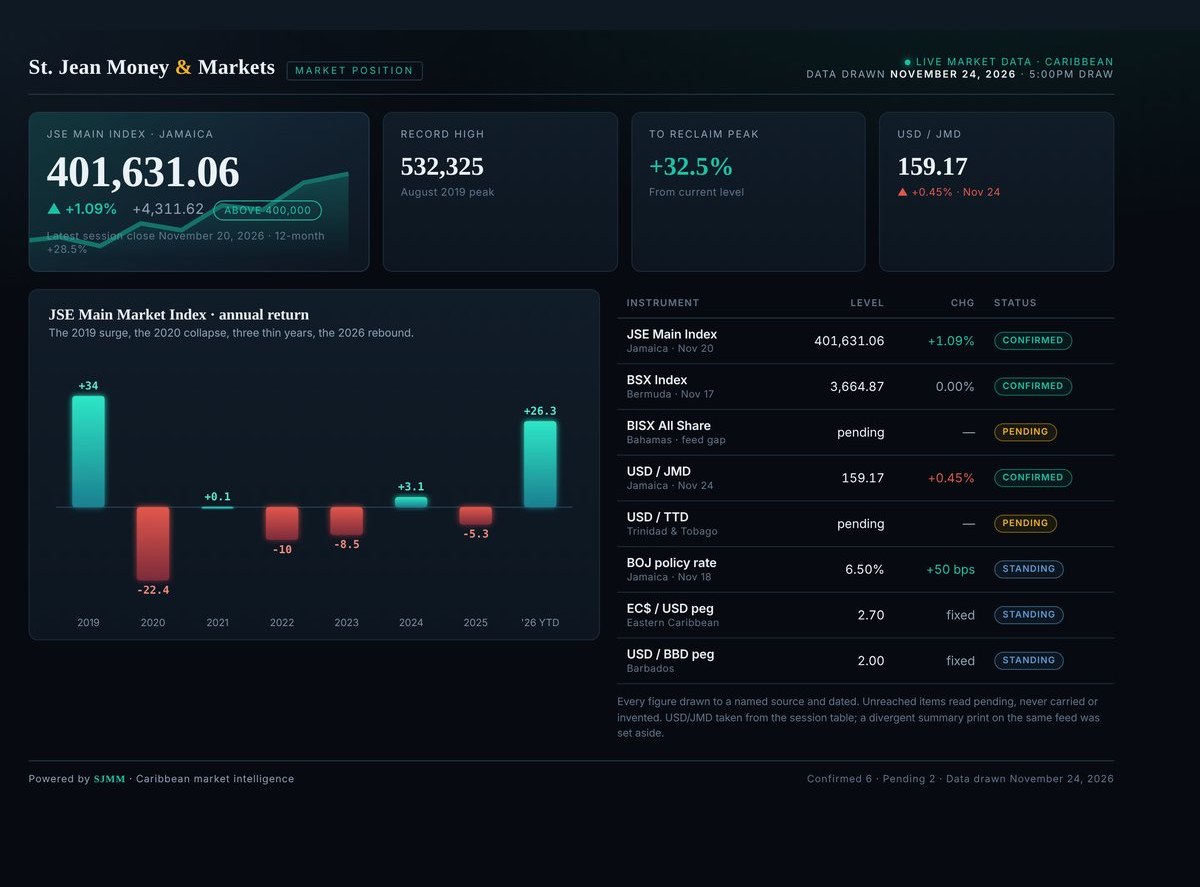
KINGSTON. The benchmark of the Jamaica Stock Exchange has done something this quarter that it had not done in more than six years. The JSE Main Index settled at 401,631.06 on its November 20, 2026 session, up 1.09% on the day and back above the 400,000 mark, according to Jamaica Stock Exchange data compiled by SJMM. On its own, a single session of that size would not lead a market report in New York or London.
The story is not the day. It is the arc.
Measured over twelve months the index is up roughly 28%, and it has spent 2026 recovering ground it lost in a long, grinding drawdown that ran from the 2020 crash through three disappointing years. The round number matters because of where the market has been, not because of where it closed on Friday. And it matters more because of what sits underneath it. Jamaica is, by its own government's accounts, in a recession.
The rally and the economy have, for now, decoupled.

The shape of the last seven years is a round trip. The index surged 34% in 2019, surrendered nearly a quarter of its value in the 2020 crash, and then spent three years grinding sideways to down. The rebound of 2026 is the first clean up-year of real size since the record was set, and it is steep enough to put the old high back within sight.
It is also a narrower market than the index suggests. Through the first three quarters the Main Market rose more than 20%, its strongest run since 2019, while the Junior Market, the board built for smaller companies, fell. An investor who owns the index and one who owns a basket of junior listings have had opposite years.
The anatomy of the rally
Strip the index down to its movers and the picture sharpens. Through September 30, the established leaders were a highway operator, a bank, and a cigarette distributor, not a broad sweep of the market. Add the junior board and a single petroleum terminal that listed at the end of 2025 sits on top of everything. These are the ten largest year-to-date moves on the exchange, by share price, which is the public proxy for where investors have been putting money.
In July alone, by our reckoning of exchange data, three names, Carreras, NCB Financial Group, and TransJamaican Highway, were among the largest contributors to the Main Market's gains. Carreras lifted its distribution and re-rated. NCB came back from a weak stretch and reclaimed the position of most valuable company. TransJamaican Highway, a toll-road operator with predictable cash flows, more than doubled.
These are company stories, earnings and payouts and a cheap starting point, not a wave lifting all boats.
The rate decision almost no one in the rally was watching
The obvious assumption is that the Bank of Jamaica's move has something to do with this. It is the wrong assumption, and the dates are the proof. The central bank raised its policy rate to 6.50% on November 18, 2026, a 50 basis point increase, its second in a row, and an 11-year high. Yet the market had already risen more than 20% by the end of September, and the bulk of the advance was booked long before the November decision and the September step that preceded it.
A rate hike is a headwind for equities, not a tailwind. Higher policy rates raise the return on cash and government paper and, in theory, pull money away from stocks. The Jamaican market has risen into the tightening rather than away from it, which tells you the rally is being driven by something the central bank does not control: company earnings, a handful of corporate events, and a market re-rating off a deeply depressed base. The hike is best read not as fuel for stocks but as a defense of the currency and a response to inflation.
If anything, the market is shrugging the hike off. That is worth saying plainly, because the lazy version of this story credits the central bank, and the data does not support it.
Scotia's exit through the front door
The year's largest single event on the exchange was a departure. Scotia Group Jamaica, long one of the market's heaviest financials, is leaving the public market, not because the business failed but because its Canadian parent bought out everyone else. The Bank of Nova Scotia took it private at J$75.00 per share after raising its offer, a price reported as roughly 38% above the volume-weighted average over the thirty trading days to June 11, 2026. Minority holders approved the scheme on October 7, and the court sanctioned it on October 30.
The number that matters for the rest of the market is the cash. The buyout removed one of the market's heaviest financials from the board and returned a large amount of shareholder value to minority holders, who now need a new home for that money on a small exchange. On our reading of the trading, part of the breadth of buying in the remaining large names is Scotia proceeds being put back to work. We would not overstate it.
The pattern is a correlation, not a receipt, and the gains in Carreras, NCB, and TransJamaican Highway rest on their own results as much as on rotation. But the market has not rebounded in spite of Scotia leaving. In part, it has rebounded on the proceeds.
2019 and now are two different countries
The peak this market is chasing was set in a different economy. In 2019 Jamaica was growing, slowly, with the currency firmer and interest rates low. Today the index is closing in on those levels against a backdrop that is harder in every respect except one.
The one genuine improvement is the labor market. Unemployment at 3.3% in the October 2025 survey is the lowest Jamaica has recorded, down from 7.2% to 7.8% in the 2019 surveys. Set against that, the economy is in a brief recession the government attributes to Hurricane Melissa, a category five storm that made landfall on October 28, 2025, with real output falling 4.5% in FY2025/26 and projected by the government to shrink a further 0.5% in FY2026/27. The currency has slid from an average near J$133 to the US dollar in 2019 to about J$159 now.
An investor who rode the index back toward its old high in Jamaican dollars has, measured in US dollars, made considerably less. That gap between the local-currency index and its US dollar value is exactly why a serious Caribbean benchmark has to be published in both currencies.
A note on the benchmark. The figures above are the exchange's own index and named macro sources. The SJMM 100, our forthcoming Caribbean composite, is designed to sit above all of this: one free-float, liquidity-screened number for the whole region, published in both US and local currency, the way the S&P 500 stands for the United States. It is still indicative, built on a base of 1,000, and it will carry a live level only once its methodology is wired to live exchange data.
We will not quote it as a market reading before then.
What it would take to reclaim 532,325
From Friday's 401,631, the Main Index would need to rise a further 32.5% to touch its August 2019 record of 532,325. That is a large distance, and the arithmetic of the last six years shows why it is not a straight line. Getting there asks for more than another good quarter from three large caps. It needs the rally to broaden beyond the handful of names now carrying it.
It needs the Junior Market to stop falling, because a recovery that leaves half the exchange behind runs out of fuel. It needs the currency to steady, so that gains are not quietly handed back through depreciation. And it needs the real economy to turn, which the government does not expect before the back half of the coming fiscal year, with output returning to pre-hurricane levels only later in the decade. A market can lead an economy.
It cannot indefinitely ignore one.
What it means for MSMEs
This is where the headline number is most misleading. Jamaica's small and medium enterprises raise public equity on the Junior Market, a board created with tax incentives precisely to bring smaller companies to the exchange. While the Main Market has run above 400,000, the Junior Market Index has gone the other way, down about 9% year-to-date through September and briefly below 3,000 for the first time since early 2021. Capital is rotating out of small caps and into the largest, most liquid names.
For an MSME founder reading the rally as a green light to list, the market is sending a more specific signal: the money on the exchange right now wants size, liquidity, and a predictable payout, and it is not paying up for small and unproven.
The macro picture compounds it. A 6.50% policy rate raises the cost of the bank credit most small firms actually run on, and a post-hurricane economy squeezes the domestic demand they sell into. The honest read for the MSME owner is twofold. The window to raise equity cheaply on the Junior Market has narrowed for now, so a listing priced on last year's optimism will struggle.
But the same forces are an opening. The pool of cash freed by the Scotia buyout and the hunt for the next TransJamaican Highway mean investors are looking for the next credible growth story, and a small company with real earnings, a clean balance sheet, and a genuine distribution can still command attention. The market is not closed to MSMEs. It has simply stopped rewarding them for being small, and started asking them to prove they are sound.

Prepared by St. Jean Money & Markets. Figures carry a named source and an as-of date; where a figure is computed from sourced inputs, the inputs are named. This analysis is for information and does not constitute investment advice.
Send news tips, corrections, or comments to newsroom@caribbeanledger.com.
Read more at The Caribbean Ledger ›