In Bridgetown, a small island takes a seat at the head of the AI table
Barbados and the United Nations convened the Bridgetown Special Summit on AI Safety on November 23. For the Caribbean, the question is money: how much output AI could add, how many workers need retraining, and what that costs.
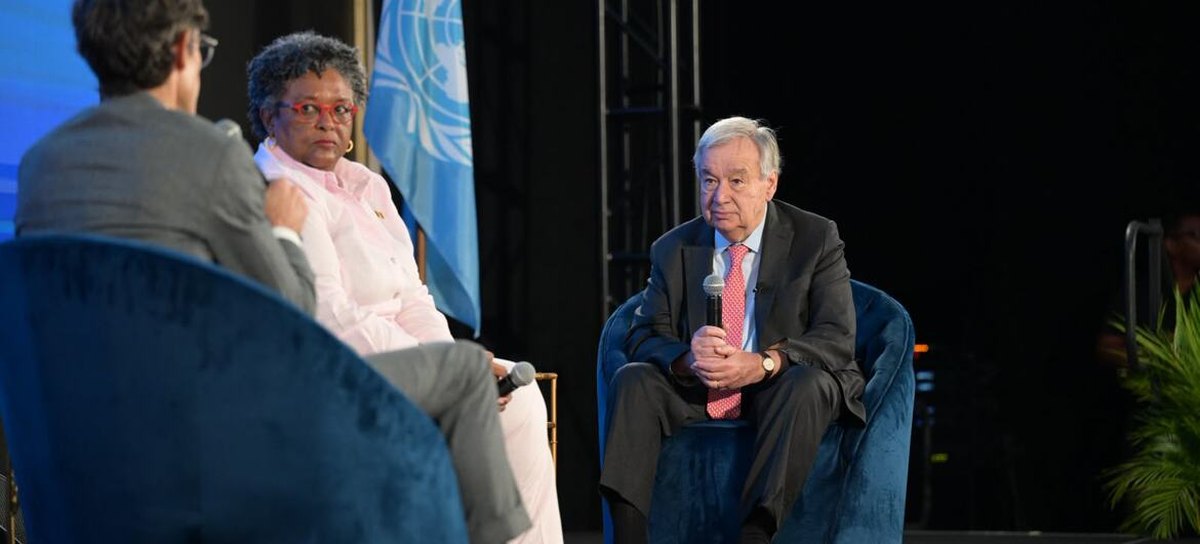
BRIDGETOWN. For one day, the world's hardest conversation about artificial intelligence was not in Silicon Valley, Brussels or Beijing. It was in Bridgetown.
On Monday, November 23, Barbados and the United Nations convened the Bridgetown Special Summit on AI Safety. Prime Minister Mia Mottley and UN Secretary-General António Guterres, in the final weeks of his tenure, shared the stage. The summit's name cards carry both the Barbadian and United Nations emblems.
Barbados has its own history with who owns a person's work. Its 1661 slave code was among the first laws anywhere to treat people as property. Hosting this summit puts the island in the room where the rules of AI are written.

What AI could add
The World Bank estimates that 30 to 40 percent of jobs in Latin America and the Caribbean are exposed in some way to generative AI. It sees 8 to 12 percent of jobs gaining productivity from the technology, and 2 to 5 percent at risk of automation (World Bank, April 2025).
The same report warns that up to half of the region's jobs, some 17 million, cannot use those gains without basic digital infrastructure. For the Caribbean, the bottleneck is connectivity and reliable power as much as skills.
The job market in view
The ILO puts the region's labour force at around 9 million people in 2024, including Haiti, with a participation rate of about 64 percent (ILO, February 2026). Outside Haiti, we estimate the working base at about 3.5 million. Services employ around 70 percent of that group, and agriculture about 10 percent (ILO, February 2026).

Services is where AI tools are most ready to use today: bookings, customer service, finance and administration. It is also where the cost of standing still falls hardest, because those roles are routine enough to automate and specialized enough to need retraining.
The World Economic Forum projects that by 2030, 59 of every 100 workers will need reskilling or upskilling (WEF, January 2025). Applied to our 3.5 million base, about 2.1 million people will need training. About 670,000 will need to move into new roles, and about 390,000 are unlikely to get the training they need.
What it would cost
Our estimate uses two unit costs. In-role upskilling at US$1,000 per worker is our assumption for short digital and AI courses. Redeployment is costed at US$5,000 per worker, our assumption for a regional program with certification and placement, and at US$24,800, the WEF's 2019 average for retraining in the United States.
On those assumptions, the bill runs from about US$4.3 billion to US$17.5 billion by 2030. That is roughly US$0.9 billion to US$3.5 billion a year. Connectivity and power, which make the training useful, would be an extra cost.

The productivity gap
Output per worker is where the money sits. In 2024, the eight CARICOM members with data averaged about 30 percent of US output per worker, in constant 2021 purchasing power (World Bank, November 2026). Jamaica stood at about 13 percent, and Trinidad and Tobago at 45 percent.
Guyana is left out, because oil output puts it at about 133 percent of the US level, a distortion rather than a model. The OECD average is about 73 percent. Korea sits at 64 percent and Portugal at 58 percent.

We suggest 60 to 75 percent of US output per worker as the test of a well-producing economy. The region is far from it, and reaching 60 percent would take roughly a doubling. A 10 percent AI lift moves the Caribbean average only to about 33.5 percent.
Where Caribbean companies make the money
The profit case is in scaling, not in pilots. Many regional firms have tried a chatbot or a dashboard. Far fewer have rebuilt a process around AI and measured it against cost per sale, cost per claim or hours per invoice.
Tourism and hospitality, the region's largest earners, can use AI for pricing, guest service and staffing. Banks can use it to cut onboarding and fraud costs. Each of these pays only when it runs across the whole business.
Jamaica has started this debate at home. Our November 21 article, "Jamaica wants to build AI," argued that the country needs the power to run AI before it can build it. The productivity numbers point the same way.
The Decade of Decision
The Caribbean Development Bank's ten-year strategy, Transforming the Caribbean for Resilience, runs from 2026 to 2035. Its starting point is sobering: productivity growth is close to zero, only 25 percent of measurable SDG targets are on track for 2030, and youth unemployment stands at 17.6 percent, excluding Haiti (CDB, February 2026).
The plan's three operational priorities are investing in youth, strengthening institutions and accelerating climate action. Innovation and digital transformation run through all three (CDB, February 2026).
The phrase Decade of Decision comes from CDB President Daniel Best. The Bridgetown summit is one of the first major decisions the region faces inside that decade, and AI will touch every goal the bank has set.
The question for the region
Our analysis points to three conclusions. Output per worker is about 30 percent of the US level, below the range of a well-producing economy. AI could add a meaningful slice, but not enough on its own. And preparing the workforce costs billions, not millions.
So the question we put to readers is this: within the Decade of Decision, will AI help the Caribbean meet the goals and objectives of the CDB's strategy, or will it widen the gap that strategy was written to close?
Cite this article: The Caribbean Ledger, "In Bridgetown, a small island takes a seat at the head of the AI table," November 24, 2026. Permanent link: https://www.caribbeanledger.com/stories/20261124-policy-barbados-ai-summit.html
Cover photo: UN News.
Send news tips, corrections, or comments to newsroom@caribbeanledger.com.
Read more at The Caribbean Ledger ›