Essequibo: two-thirds of Guyana, nearly all its oil, and one ruling
The territory Venezuela claims is roughly two-thirds of Guyana's land, and the sea off its coast holds the Stabroek Block, more than 11 billion barrels that drive the hemisphere's fastest-growing economy. A judgment at The Hague will decide who owns the line. The harder question is whether the loser will accept it.
GEORGETOWN. On a map of Guyana, the quarrel with Venezuela looks like a line drawn down the middle of a rainforest. On a balance sheet it looks like something else entirely.
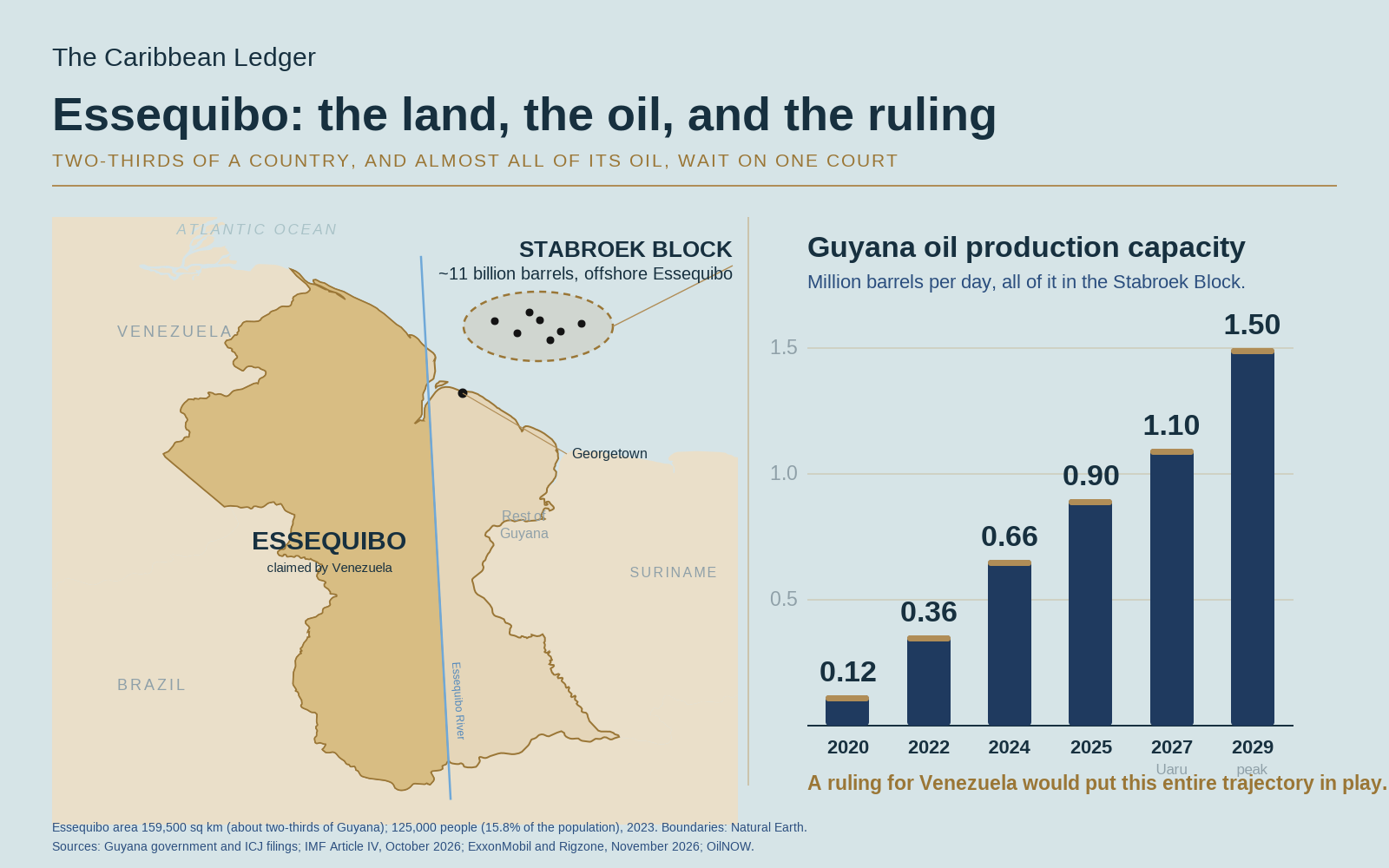
The contested territory, Essequibo, runs to about 159,500 square kilometers, roughly two-thirds of Guyana's land mass, and is home to around 125,000 people, some 15.8% of the country's population, according to 2023 figures. Those numbers are large, but they are not the ones that move capitals. The number that moves capitals lies offshore.
The Stabroek Block, which ExxonMobil estimates holds more than 11 billion barrels of oil equivalent, sits in the Atlantic off the Essequibo coast, in waters Venezuela treats as an extension of its claim. The case now before the International Court of Justice is cast as a border dispute. To any treasury, it is an oil case.
Guyana is the fastest economic story in the hemisphere, and the oil is the whole of the reason. In its Article IV review, reported in October 2026, the International Monetary Fund put real growth at 19.3% in 2025 and projected 22.3% for 2026, after the economy averaged close to 40% growth across 2023 and 2024. Oil production passed 900,000 barrels a day during 2025.
ExxonMobil said in November 2026 that capacity will reach 1.1 million barrels a day by the first quarter of 2027 as its Uaru project starts up, and that installed capacity in the Stabroek Block is on track for 1.5 million barrels a day by 2029. The country's Natural Resource Fund held about US$3.3 billion at the end of 2025, more than 12% of gross domestic product. For a nation of roughly 800,000 people, that is a windfall with few modern parallels, and every barrel of it is drawn from the same contested block of sea.

What a ruling for Venezuela would move
Set the two halves of the picture side by side, the map and the production curve, and the stakes come into focus. A judgment for Venezuela would not hand Caracas a stretch of jungle. It would hand over the engine of the hemisphere's fastest-growing economy, and hand it to a government that has spent years shut out of world oil markets by sanctions and is in acute need of exactly this kind of lifeline.
Venezuela's acting president, Delcy Rodriguez, traveled to The Hague to argue that the 1899 Arbitral Award that fixed the boundary is null and void. For her government, Essequibo is a nationalist cause and a fiscal rescue at once.
It would move Washington as well. The Stabroek consortium is led by ExxonMobil, with 45%, alongside the American major Chevron at 30% and China's state-owned CNOOC at 25%. A ruling that unsettled Guyana's title would place billions of dollars of American oil investment, and a sizable Chinese stake, inside a zone claimed by a government the United States has sanctioned.
That is part of why a reported suggestion from a departing American official, that Guyana consider ceding part of Essequibo to Venezuela, landed so badly in Georgetown last week. Washington is meant to be Guyana's security partner. It is not meant to be the source of the idea that the border is for sale.

What a ruling for Guyana would lock in
The mirror image of that risk is a boom that keeps running. A judgment upholding the 1899 line would remove the single largest uncertainty hanging over the country's oil trajectory, steady the operators who are committing tens of billions of dollars to new developments, and let Guyana keep building toward 1.5 million barrels a day with the question of ownership closed. ExxonMobil has already sanctioned an eighth Stabroek project, Longtail, at a reported US$12.5 billion, a bet that only makes sense if the title holds.
A favorable ruling, in other words, is not a legal footnote for Guyana. It is the line between a generational windfall and a generational dispute.

The law, and the clock
The case itself is narrower than the economics around it. The court is weighing the validity of the 1899 award, which set the land boundary, after hearings that closed in May 2026. The offshore oil is not formally the subject of the case, and a ruling on the land would not automatically redraw the maritime map.
But the two cannot be cleanly separated, because a country's entitlement to the sea flows from its coast, and it is the Essequibo coast that fronts the Stabroek Block. Foreign Affairs Minister Hugh Todd said on November 20 that Guyana now expects a judgment as early as the first quarter of 2027, and the government has pointed to a window running from late this year into early next. On the Essequibo island of Leguan on November 22, President Irfaan Ali reduced the government's position to a sentence: "All of Essequibo belongs to Guyana.
None of it will be surrendered." At the United Nations in September he had urged Venezuela to abide by the coming ruling, and pledged that Guyana would do the same.

The question under the question
Which leaves the hardest question of all, and it is worth posing plainly. Will the decision be accepted by the side that loses, when the thing being decided is worth an entire economy? Venezuela has already supplied part of the answer.
It rejects the court's jurisdiction, calls the 1899 award void, and has offered no commitment to honor an adverse result. Yet the question points toward Georgetown too. Guyana says it will abide by the court, and its entire strategy depends on the law being respected.
But a ruling against Guyana would mean giving up the source of more than 20% annual growth, a sovereign fund, and the country's whole transformation. A court order worth that much is the kind no loser accepts quietly, which is exactly why both governments are so determined to be seen on the right side of it before the judges speak.
The map and the chart on this page are a single story, not two. Whoever ends up with Essequibo ends up with the Stabroek Block, and whoever holds the Stabroek Block holds the fastest-rising oil economy in the Americas. The judges at The Hague will answer the legal question of where a line belongs.
The harder question, the one the money is already asking, is whether any ruling can hold when the stakes run this high. Guyana is betting that the law will settle it. Caracas is betting that it will not.
Send news tips, corrections, or comments to newsroom@caribbeanledger.com.
Read more at The Caribbean Ledger ›