The beach he would not sell, and the rooms he must build
Gaston Browne turned down Royal Caribbean's EC$100 million for exclusive use of Fort James, then set out the investment he is chasing instead: a Qatari-backed expansion of the W at Yepton Beach, two more high-end hotels from his Doha talks, and a diversification plan, including a St. Jean & Co. medical-tourism recommendation, to rebuild the roughly EC$150 million-a-year citizenship footprint the European Union wants gone.
ST. JOHN'S. Prime Minister Gaston Browne turned down Royal Caribbean's EC$100 million offer for exclusive use of the beach at Fort James, then set out the investment he is chasing instead: a Qatari-backed expansion of the W at Yepton Beach, two more high-end hotels out of his Doha talks, a target of 10,000 rooms to win new airlift, and a wider push to rebuild across industry the revenue that the island's citizenship program, now under European pressure, has long supplied.

The passport cliff
The refusal at Fort James was not an act of indifference to money. It came in the same season that the European Union told Antigua and Barbuda to close the business that has cushioned its budget for four decades. The country's Citizenship by Investment line, however, has become a smaller cushion than it once was. The IMF's 2025 Article IV report traces it from a peak of EC$98 million in 2020 to a low of EC$62 million in 2023, with a recovery to EC$74 million in 2024 and a flat EC$74 million projected through the decade, a little over 1% of GDP and under 6% of government revenue (IMF Country Report 25/96).
The program's wider footprint is larger, because much of what it raises arrives as development-fund donations and fees rather than as recorded budget revenue, but even on the narrow measure its loss is a hole, and the University of the West Indies economist C. Justin Robinson has warned that ending the program would erase more than half of Antigua's projected primary surplus this year (Reuters, October 29, 2026).
The clock is not Antigua's to set. The European Commission has asked the country, along with four other Eastern Caribbean states, to shut the scheme by June 1, 2028 or risk the visa-free access to the Schengen area that gives the passport its value. Antigua has written back, willing to wind the program down but asking for until the end of 2030 and for technical and financial help with the transition, and as of mid-November the unit was still taking applications pending further instruction (Antigua News, November 16, 2026). Prime Minister Gaston Browne has said the country will very likely commit to phasing the program out (Reuters, October 29, 2026).
Whatever the final date, the direction is settled, and a line of revenue the state has leaned on is being switched off. Something has to take the weight.
An answer measured in rooms
Browne's first answer is rooms. In a post to his official page this week he reported that the W Hotel rising at Yepton Beach, backed by investors he described as part of one of Qatar's largest business groups, has agreed in principle to grow from 120 rooms to as many as 300, subject to securing about 12 acres of additional land. The project has reached roof level and was designed to include overwater bungalows, the signature inventory on which the Caribbean's luxury tier is built. Interior work alone could take another 12 to 18 months, Browne estimated, and the adjoining land, most of it government-controlled with a privately held portion, would send Cabinet back to weigh a sale or a partnership (Antigua News, November 23, 2026).
Yepton is not the only iron in the fire, and Qatar is not a coincidence. Days earlier, Antigua News Room reported that Browne's investment talks in Doha had put two further high-end hotels, with a combined 300 rooms, within reach, and that a delegation including the prime minister, Tourism Minister Charles Fernandez and Social Transformation Minister Rawdon Turner would travel to the Turks and Caicos Islands to meet an international hotel investor as the discussions advanced (Antigua News Room, November 19, 2026). Taken together, the Yepton expansion and the Doha pair would add on the order of 480 premium rooms to a national stock Browne puts at roughly 4,000 hotel rooms, with short-term rentals adding perhaps 1,000 more. The island, he argues, needs to get closer to 10,000 rooms to attract new carriers such as Qatar Airways, Emirates and Turkish Airlines and to secure additional flights, and the government is also weighing a rise in the loan cap of its Entrepreneurial Development Fund, from US$200,000 to US$500,000, to encourage more locally owned short-term rentals.
What the rooms are worth
The figures are worth modeling, with the caution that what follows is the Ledger's estimate on stated assumptions, not a government projection. Take the Yepton expansion alone. Adding 180 rooms to reach 300, and assuming a blended year-round occupancy of 70% and an average daily rate of US$600, a conservative figure for a branded luxury resort with overwater villas, the incremental rooms would generate on the order of US$28 million a year in room revenue, and the full 300-room property perhaps US$46 million. Luxury resorts typically earn close to as much again from food, beverage, spa and excursions, which would push the complete property toward US$70 million or more in annual on-property revenue.
Against the almost US$900 million visitors spent in Antigua and Barbuda in 2024 (Government Statistics Division), a single resort at that scale would represent something like 7% to 8% of the island's current visitor spend, in an economy where tourism accounts, by the standard reckoning, for more than two-thirds of gross domestic product.
What the rooms pay the state
The state does not collect room rates. It collects taxes on them, plus a share of what visitors spend and what they pay to fly in. We ran the Yepton expansion and the Doha pair together, 480 new rooms in all, through the same tax lines we used for the St Lucia analysis.
At 70 percent occupancy and US$600 a night, the 480 rooms sell about 122,600 room-nights a year and take in about US$74 million, or EC$199 million, in room revenue. Commercial tax guides disagree on the hotel rate. One says Antigua's standard sales tax, the ABST, has been 17 percent since January 2024, with no reduced rate for accommodation. Another still lists a 12.5 percent hotel rate.
We use 17 percent in the base case and 12.5 percent in the low case.
| Tax line | Basis | Base case (EC$ million a year) | Low case (EC$ million a year) |
|---|---|---|---|
| Sales tax on room revenue (ABST) | US$73.6 million of room revenue at 17% (12.5% low case) | 33.8 | 24.8 |
| Sales tax on food, beverage, spa and tours | Half of room revenue taxed at 17% (a quarter in the low case) | 16.9 | 8.4 |
| Tourism accommodation levy | US$5 a guest per night above US$150; in force in base case only | 3.0 | 0.0 |
| Airport passenger charge, arrivals and departures | 22,075 guest stays; US$100 round trip proposed (US$80 today in low case) | 6.0 | 4.8 |
| Payroll contributions | 480 staff at EC$36,000 a year, 15% employee and employer | 2.6 | 2.6 |
| Total | 62.2 | 40.6 |
The room charge is the largest line. At 17 percent it yields about EC$34 million a year, and sales tax on food, beverage, spa and excursions adds EC$17 million if half of that spend is formally taxed. The scenario assumes that ancillary spend matches room revenue, which is the same assumption the article's earlier figures used.
Departure fees are the line most people overlook. Antigua charges US$40 on every international arrival and every departure today. Cabinet has approved US$50, and the bill text names September 1 as a start date, though the government has not confirmed when collection begins. CARICOM travel is exempt.
At about 22,000 guest stays a year, the new rooms would generate roughly EC$6 million in airport charges at the proposed rate, and EC$5 million at today's rate, but only if those guests would not otherwise have come.
The tourism accommodation levy would add about EC$3 million a year at US$5 a guest per night. The Lower House has passed the bill, but we could not confirm that the charge is in force, so the low case drops it. Payroll is the smallest line, because Antigua has no personal income tax on wages, so the staff line is social security only, at about EC$2.6 million for 480 staff.
The base case excludes corporate income tax on hotel profit. At the 25 percent corporate rate and an illustrative 25 percent margin on room and ancillary sales, the state would collect about EC$25 million a year. Tourism incentives and depreciation could cut that sharply, so we show it as a sensitivity rather than in the total.
Two assumptions move the total most. Staffing at 1.5 employees a room lifts payroll to about EC$4 million. If half of the room-nights would have been sold by existing hotels, every line roughly halves, and the total falls to about EC$31 million.
Set against the budget, the picture changes. The IMF records EC$74 million a year of citizenship revenue in the budget. The tax on the 480 rooms plus the patient stream at the hospital comes to about EC$83 million in the base case, and about EC$55 million in the low case. The EC$150 million footprint includes fees and donations, which are not taxes, so the fair test for taxes is the EC$74 million.
On that test, the base case covers the budget line once the rooms open, and the low case covers about three quarters of it. Timing is the constraint. The Yepton build alone needs 12 to 18 months of interior work, and the June 1, 2028 EU deadline leaves less than two years.
Beyond the rooms: a floor to rebuild
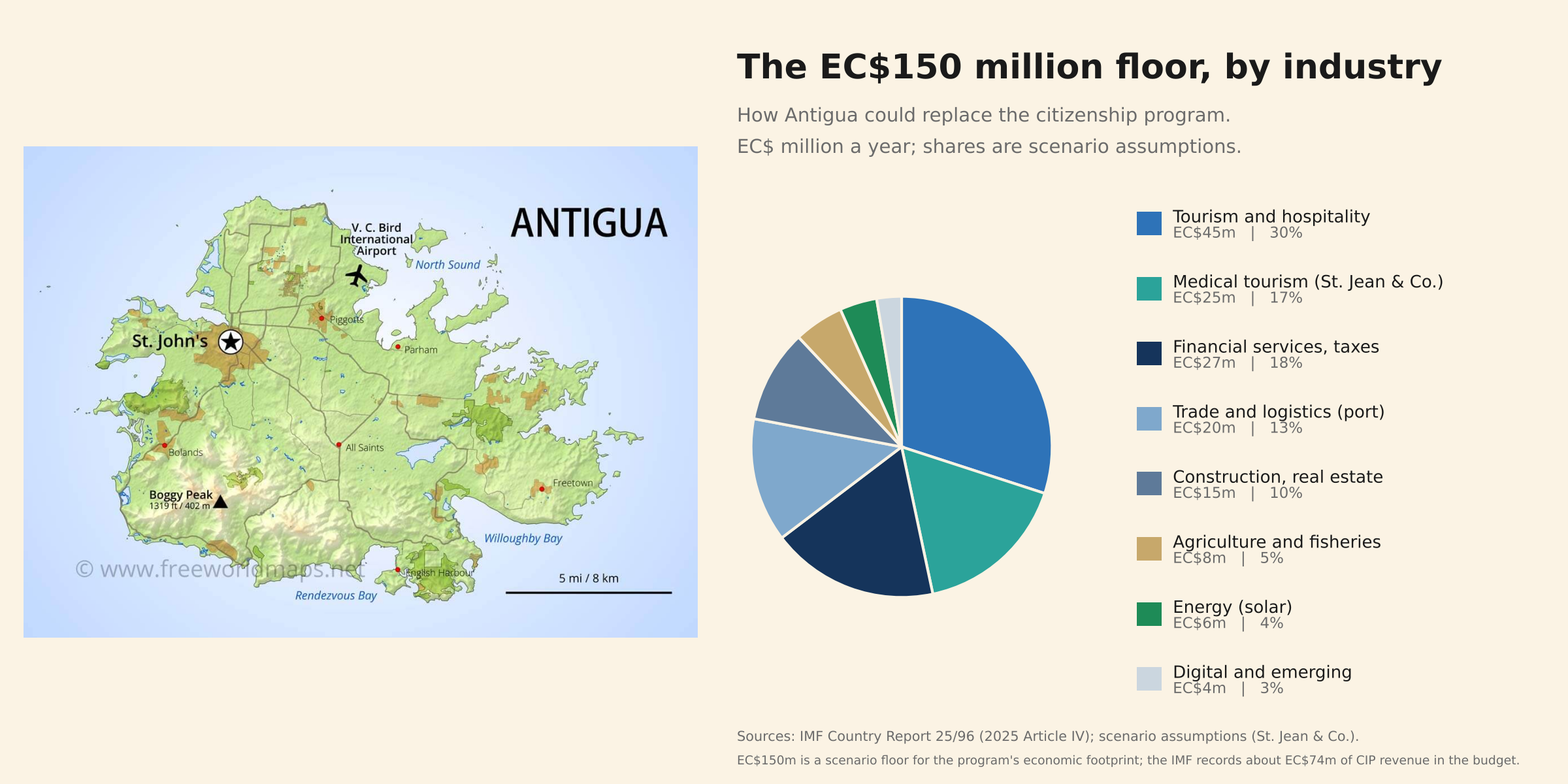
That figure counts the EC$74 million the IMF records in the budget, plus development-fund donations and fees, which are not taxes. One way the island could carry it: tourism and hospitality take about EC$45 million; financial services and a broader tax base add some EC$27 million; and a cluster of newer sectors makes up the rest. The shares are scenario assumptions, not published sector data, but the arithmetic shows that the hole is fillable without a single heroic bet.
Several of those newer sectors are already moving. The government is seeking about US$100 million to expand the deepwater cargo port at St. John's and position Antigua as a regional transshipment hub, a plan Prime Minister Gaston Browne has pressed publicly with potential financiers including, most recently, Singapore's state port operator. Solar energy, which lowers the island's fuel import bill and frees foreign exchange, agriculture and fisheries, and a small but growing digital-services segment each take a slice in the scenario.
None is large on its own. The point of the exercise is that no single industry has to replace the passport; a diversified base does, and it spreads the risk the citizenship program concentrated in one volatile line, a line that, as the IMF series shows, has already swung from EC$98 million to EC$62 million inside three years.
The medical-tourism recommendation
The piece of the scenario most likely to draw attention is medical tourism, and it is there on a specific recommendation. St. Jean & Co., the advisory firm, has recommended that Antigua anchor its diversification with a specialized medical-tourism hospital, a facility built to draw patients from across the region and the diaspora for procedures and care that are scarce or costly elsewhere in the Eastern Caribbean. The island is not starting from nothing.
The 185-bed Mount St John's Medical Centre and the teaching base of the American University of Antigua already give it clinical capacity and a pipeline of trained staff, and Dr. Sir Joseph John, who founded the medical centre and brought the university to the island, has pointed to medical tourism as a rising part of the economy (Luxury Locations, August 30, 2024).
On St. Jean & Co.'s scenario, a specialized hospital could generate on the order of EC$25 million a year, about US$9 million, from international and regional patients. That is an illustrative revenue figure, not a forecast.
Taxed, the patient stream is worth about EC$20 million a year to the state, on roughly 9,300 patients who each spend US$1,000 at the clinic and stay 14 nights at US$250 a night. Most of that comes from accommodation sales tax, the airport charge on the round trip, and corporate tax on the clinic's margin. Medical services are exempt from sales tax, so the hospital bills themselves add nothing. A hospital is still a long build with real clinical, regulatory and staffing demands, but on tax terms the case for the patients is strong.
Selling access, or building it
This is the line that connects the beach Browne would not sell and the rooms and sectors he is trying to build. Royal Caribbean's EC$100 million was real money, and turning it down carries a cost. But exclusive use of Fort James would have converted a public asset into a private one for a one-time sum, the same model, in spirit, as selling a passport: cash today against something harder to recover tomorrow. They want exclusivity, Browne said on The Browne and Browne Show, and we said no, because our people must have access to the beach.
The strategy on the other side of that refusal asks the opposite of the country. It keeps the beaches open, where the government now plans public parks at Fort James, Little Ffryes and Ffryes, and it builds revenue that compounds rather than revenue that is spent once.
The bet is not without exposure. The rooms are agreements in principle, not poured concrete; the Yepton land deal is unsettled; much of the new hotel capital traces to a single Gulf relationship; the port, the hospital and the solar build are each long, capital-hungry projects; and a diversified floor is harder to deliver than it is to draw on a chart. Ten thousand rooms is a long way from four thousand. None of that makes the direction wrong.
With the passport cushion on a countdown and a cruise line's cheque already declined, Antigua has chosen to compete for the slower, harder, more durable kind of money, spread across industries rather than concentrated in one. The test now is execution, and the clock, set in Brussels for 2028 and negotiated toward 2030, is already running.
The Caribbean Ledger has sought comment from the Office of the Prime Minister of Antigua and Barbuda.
Send news tips, corrections, or comments to newsroom@caribbeanledger.com.
Read more at The Caribbean Ledger ›