Saint Lucia's citizenship cliff is smaller than St Kitts's, but the program is bigger than the budget shows
Saint Lucia's program raised EC$402 million in gross revenue last fiscal year, but the government received EC$86 million. That is about 1.2 percent of GDP, a fifth of the St Kitts and Nevis floor. The real exposure is the June 2028 EU deadline, the hotel rooms that must replace it, and a medical tourism earmark the island has not yet built.
CASTRIES. Saint Lucia's citizenship program brought in EC$402.2 million in gross revenue in the fiscal year to March 31, 2025, up 67 percent from EC$240.2 million a year earlier. That is a record, and it arrived as the European Union asked the island to end the program by June 1, 2028.
The budget sees far less of it. The Citizenship by Investment Unit transferred EC$86 million to the government that year, about 1.2 percent of 2025 GDP. The gap St Lucia must replace is therefore about a fifth the size of the floor facing St Kitts and Nevis.
The gap is not the whole exposure. Most of the gross income never reaches the budget: program costs took EC$244.2 million, and real estate administrative fees alone came to EC$183.6 million, nearly half the total.
A fee economy, not a tax base
Due diligence fees came to about EC$200 million in 2024/25, and administrative fees to about EC$180 million. The balance came from National Economic Fund donations, which rose 131 percent to EC$55.4 million, and from smaller lines such as bond purchases and processing charges.
Real estate drives the administrative line. The Unit reports real estate fees of EC$183.6 million, up EC$92 million in a single year.
The applications count explains the swing. The Unit received 5,642 applications in 2023/24 and only 2,957 in 2024/25, while it processed 2,633 and granted 2,278, against 1,171 a year earlier. Our reading is that fees surged as the Unit cleared a backlog, since it processed only 1,248 of the 5,642 it received the year before, though the report does not say so in those words.

What the budget actually receives
The government received EC$86 million in fiscal 2024/25, according to the Unit's own report. Against the FY2026/27 budget that Prime Minister Philip J. Pierre presented, with about EC$1.83 billion in revenue and grants, that is about 4.7 percent of revenue.
| Measure | Value | Source |
|---|---|---|
| Gross program revenue, FY2024/25 | EC$402.2 million, about 5.6% of 2025 GDP | CIP Unit annual report |
| Transfer to government, FY2024/25 | EC$86 million, about 1.2% of 2025 GDP | CIP Unit annual report |
| IMF basis, 2025 | About EC$72 million, 1.0% of GDP | IMF Country Report 26/3 |
| Per resident (179,700 people) | About EC$479 a year | IMF Country Report 26/3; UN 2024 population |
| Share of FY2026/27 revenue and grants | About 4.7% | Budget as reported by LATITUDE 15 |
Regional estimates of the program's share of revenue vary widely, because the answer depends on whether fees or transfers are counted. We use the transfer, since it is the money that funds the budget.

The IMF measures the flow more narrowly. Its 2025 Article IV report puts the program at about 1.0 percent of GDP in 2025 and holds it there through 2030.
The IMF baseline has no cliff in it. It assumes the program keeps running past the EU deadline, which Brussels has asked the island to end by June 1, 2028.

The staff advice points the other way. It recommends continued strengthening of the program, which the report says could further support fiscal planning.
The cliff is a 2028 date, not a slope
The European Commission's letter of June 25, 2026, asks five Eastern Caribbean governments to phase out their programs by June 1, 2028, as reported. St Lucia is one of the five.
A cliff is a single date, so the replacement has to be in place by then, not phased in over years. That makes St Lucia's problem one of timing as much as size.
On the IMF's population of 179,700, the EC$86 million floor works out to about EC$479 a year per resident. St Kitts and Nevis faces about EC$8,650 per resident on its own floor.
Tourism: the new hotel stock
The government's answer is hotels. The Saint Lucia Tourism Authority reports average hotel occupancy of 72 percent and an average daily rate that has almost doubled since before the pandemic, though it has not published a dollar figure.
Arrivals are running ahead of 2019. By the end of February 2026, total visitors reached 356,930, more than in 2025 or 2019, and cruise passengers hit a historic high of 270,452 over January and February alone.
The largest project is A'ila Resorts on Mount Pimard in Rodney Bay. It is the single biggest test of the tourism slice in our scenario.
A'ila Resorts: about 1,290 rooms in three years
A'ila Resorts is a US$1.3 billion multi-concept development, presented at the Caribbean Investment Summit in April 2025. The release lists 1,292 hotel rooms across its components, plus 275 residences and villas.
| Component | Rooms | Residences or villas | Launch, per release |
|---|---|---|---|
| TheLifeCo wellness center | 65 | none | 2025, Phase One |
| A'ila Palm family hotel | 153 | none | 2026 |
| Blue Zone Residences | 47 | 29 | 2026 |
| A'ila Cove, adults-only hotel | 320 | none | 2027 |
| Sunset Residences | 312 | 156 | 2027 |
| Luxury Villas | 395 | 90 | 2027 |
| Total | 1,292 | 275 | 2025 to 2027 |
The 2023 development agreement described a 480-room luxury resort. The 2025 release nearly triples that count, so the project grew after its first approval, and we use the later figure.
Status is the open question. In April 2025 the government said construction was well underway and ahead of schedule, but we could not find a later progress report, so we cannot say which components are open today.
The budget does not collect room rates. It collects taxes on them. We modeled the tax yield from A'ila's 1,292 rooms at 72 percent occupancy and three nightly rates, counting four lines: VAT on the room charge, the tourism accommodation levy, and the income tax and social security on the hotel's staff.
| Nightly rate tested | VAT on rooms | Tourism levy | Staff taxes | Total tax (EC$ million a year) |
|---|---|---|---|---|
| US$250 | 22.9 | 9.9 | 6.8 | 39.6 |
| US$350 (mid case) | 32.1 | 9.9 | 6.8 | 48.8 |
| US$450 | 41.3 | 9.9 | 6.8 | 57.9 |
The tourism levy is US$3 per person per night for rates up to US$120 and US$6 above that, introduced in 2020. At 72 percent occupancy and 1.8 guests a room, it raises about EC$10 million a year at the US$250 to US$450 rates tested here.
Taxes on the room charge are the largest line. At 10 percent VAT, the mid case raises about EC$49 million a year, or 57 percent of the EC$86 million floor, from one resort. If the hotel VAT rate is 7 percent, the mid case falls to about EC$39 million.
Tax rates come from Deloitte's 2026 Saint Lucia tax highlights and PwC's Worldwide Tax Summaries for Saint Lucia. The hotel VAT rate is 10 percent in the base case. PwC's summary is less clear on whether room charges fall under a 7 percent rate, so we use 7 percent as the low case. Medical services are VAT-exempt.
We exclude corporate income tax on the hotel's profit. The Tourism Incentives Act can waive up to 100 percent of income tax for up to 15 years on approved projects. We have not confirmed what A'ila has been granted, so that line may be small or nil.
The staff lines are small. We assume one staff member for each room at EC$36,000 a year, which yields about EC$2.1 million in income tax and about EC$4.7 million in social security. Those are assumptions, since we do not have A'ila's staffing plan.
Replacing the full EC$86 million through hotel taxes alone would take about 2,280 rooms at the mid case. At US$250 a night the figure rises to about 2,810, and at US$450 it falls to about 1,920.

At the mid case, A'ila's full build-out would cover about 57 percent of the floor. The rest would have to come from elsewhere, or from the same hotels filling more of their rooms.
The rest of the pipeline
| Project | Location | Rooms or units | Investment | Timing and status |
|---|---|---|---|---|
| HQ Cas En Bas | Cap Estate, Rodney Bay | 96 residences in phase one; 178 in total | About US$130 million | Planned November opening; year not stated. More than 90 percent sold, per developers |
| Sapphire Sands Villas | Reduit Beach, Rodney Bay | Not stated | Not stated | Opening in 2026, per ETurboNews |
| Budget target | Nationwide | More than 500 new hotel rooms by 2027 | Not stated | Government expectation, as reported in the 2026/27 budget coverage |
HQ Cas En Bas is a different model. Its phase-one units are freehold residences, sold rather than rented. If nonresident buyers pay the 7.5 percent alien landholding license on about US$117 million of sales (90 percent of US$130 million), the government collects about EC$24 million once. That is a one-off, the exemptions and taxable base are not verified, and it is left out of the scenario below.
The budget's 500-room target falls inside A'ila's 2026 and 2027 launches, so the two should not be added together.
Medical tourism: the St. Jean & Company earmark
St. Jean & Company recommends that Eastern Caribbean governments earmark a minimum of 25 percent of net CBI inflows for a Regional Medical Excellence Fund. The fund would bring one tertiary specialty center in each member state to internationally accredited standards within seven years.
The recommendation is set out in Fletcher St. Jean's May 2026 paper, Beyond the Boom: The ECCU's Decade of Decision, published by NOW Grenada and The St Vincent Times.
The earmark is a funding rule for building the center, and it is paid from citizenship money. Once the program ends in 2028, the earmark ends with it, so it cannot replace the floor on its own. The revenue that replaces the floor has to come from patients.
For St Lucia, the earmark on the EC$86 million transfer is about EC$21.5 million a year. We tested what medical visitors pay in taxes.
A typical 14-night stay at US$250 a night pays about US$350 in VAT at 10 percent and US$84 in the tourism levy. Medical services are VAT-exempt, so the treatment itself pays no VAT. A clinic earning US$1,000 per patient with a 20 percent margin pays about US$60 in corporate tax at 30 percent.
That totals about US$494 a patient, or EC$1,334.
At 8,000 patients a year, that is about EC$10.7 million, roughly half the earmark. Matching EC$21.5 million in taxes would take about 16,100 patients a year, or double the figure tested. If a medical visitor stays at A'ila, the room tax is counted in both lines, so the medical figure is a slight overstatement.
St. Jean & Company has written a wider series on citizenship by investment across the region in 2026. Its July piece, The Citizenship Crossroads, ran in NOW Grenada and The St Kitts-Nevis Observer, and readers who want that wider context can start there.
The paper names cardiology, orthopedics, oncology, fertility, dialysis and renal care, and rehabilitation medicine as the specialties the region can credibly compete in.
The competition is real. The paper puts Barbados's healthcare and medical tourism sector at US$538 million in 2024, approaching US$950 million by 2034, and it cites the Cayman Islands' Health City as evidence that one accredited facility can change a small island's health economy.
St Lucia's public base is the Owen King EU Hospital, completed in 2016 and not commissioned until 2019, according to a 2021 government statement reported by Caribbean News Global. We found no published St Lucia medical tourism plan, cost or bed count.
Until one is published, the medical slice is a target, not a forecast.
The scenario by sector: EC$92 million a year
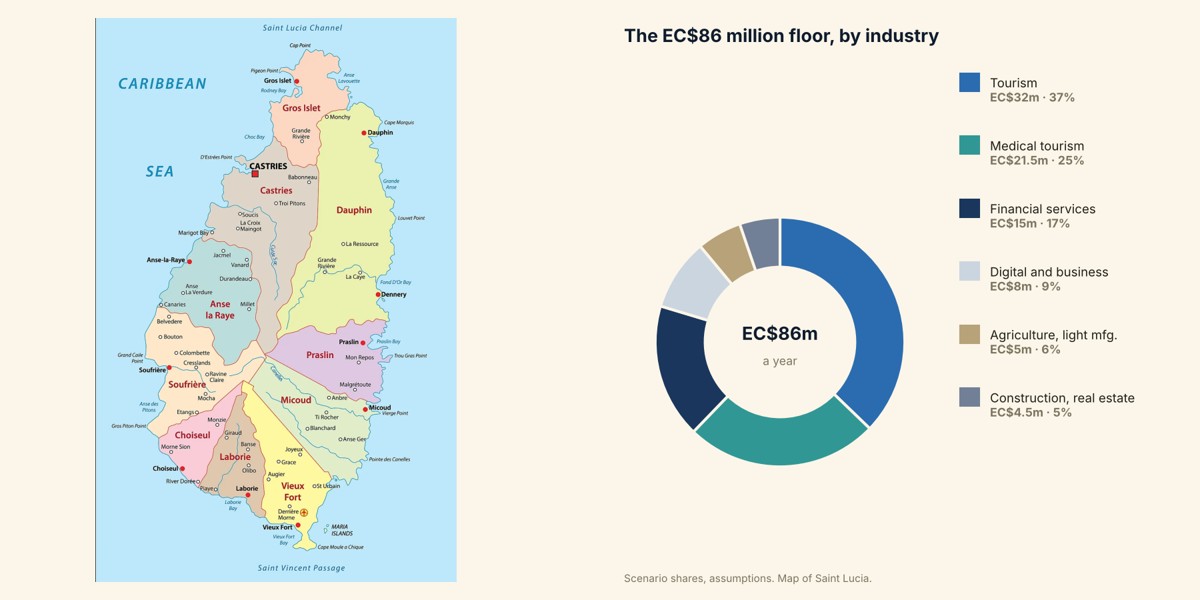
Our scenario adds the tax-basis figures for tourism and medical tourism to assumed contributions from four other sectors. It totals about EC$92 million a year in the base case, or 107 percent of the floor. In the low case, with 7 percent VAT, it totals about EC$82 million, or 96 percent of the floor.
Tourism and medical tourism account for about two-thirds of the total, and only those two rest on a stated tax calculation. The other four are assumptions, and we found no published sector sizes that would let us test them.

| Sector | EC$ million a year | Share | Basis |
|---|---|---|---|
| Tourism (A'ila, mid case) | 48.8 | 53% | Tax basis: VAT on rooms, tourism levy, staff income tax and social security (low case EC$39.1 million) |
| Medical tourism | 10.7 | 12% | Tax basis: VAT on hotel stays and levy, clinic corporate tax; about 8,000 patients |
| Financial services | 15 | 16% | Assumption: captive insurance, fund administration, wealth management; not tax-tested |
| Digital and business services | 8 | 9% | Assumption |
| Agriculture and light manufacturing | 5 | 5% | Assumption |
| Construction and real estate | 4.5 | 5% | Assumption |
| Total | 92 | 100% | 107% of the EC$86 million floor (base case) |
Financial services account for EC$15 million in our scenario, drawn from licensed captive insurance, fund administration and wealth management, the same three sub-sectors we recommend for St Kitts and Nevis. That figure is an assumption, not a tax calculation.
Digital and business services, agriculture and construction make up the balance at EC$8 million, EC$5 million and EC$4.5 million. These are assumptions too.
What else the government is building
The budget names a longer pipeline. The Hewanorra International Airport redevelopment is its main project, but no cost, financing source or completion year has been published.
In May 2024 Prime Minister Pierre listed eight mega-investment projects for that year, including the Rodney Bay City Centre, a Grand Hyatt at Sabwisha and ItelCX. He also announced new legislation to attract such projects, and we could not confirm whether it has passed.
On the Mount Pimard site, the public beach park was 70 percent complete in April 2025, and the A'ila plan includes a conference center for 2,000 people.
Geothermal is further off. The World Bank approved US$21.9 million in 2021 for exploration, but we found no first-power date or tariff, so it sits outside the floor for now.
Verdict: a smaller floor on a harder clock
The floor is EC$86 million a year, about a fifth of the St Kitts and Nevis floor, and it ends on the EU clock. The risk is less the size of the hole than the speed at which the real estate and fee economy around the program would contract.
Our judgment is that A'ila's build-out is the largest single lever, and that St Lucia has roughly even odds of having most of its 1,290 rooms open by June 2028. We could not verify current status, so treat that as an estimate.
Watch three things: A'ila's room openings against its 2026 and 2027 schedule, the Unit's applications and processing after the 2025 surge, and whether the government publishes a medical tourism plan with a cost.
Sources and assumptions
Estimates and assumptions: the 10 percent base-case hotel VAT, the 7 percent low case, 72 percent occupancy, 1.8 guests a room, one staff member a room at EC$36,000 a year, the nightly rates tested, the 25 percent medical earmark, the US$1,000 patient spend with a 20 percent clinic margin, and the four non-tax sector shares are our assumptions and are labeled where used.
Dollar figures are EC dollars unless marked US. The EC dollar is pegged at EC$2.70 to US$1.
Send news tips, corrections, or comments to newsroom@caribbeanledger.com.
Read more at The Caribbean Ledger ›