The two reservoirs Guyana was not told about
ExxonMobil's president acknowledges two oil discoveries reported to the government but never made public, and a third that surfaced at a London conference. In the hemisphere's fastest-growing economy, the fight is no longer about the oil. It is about who gets to see the ledger.
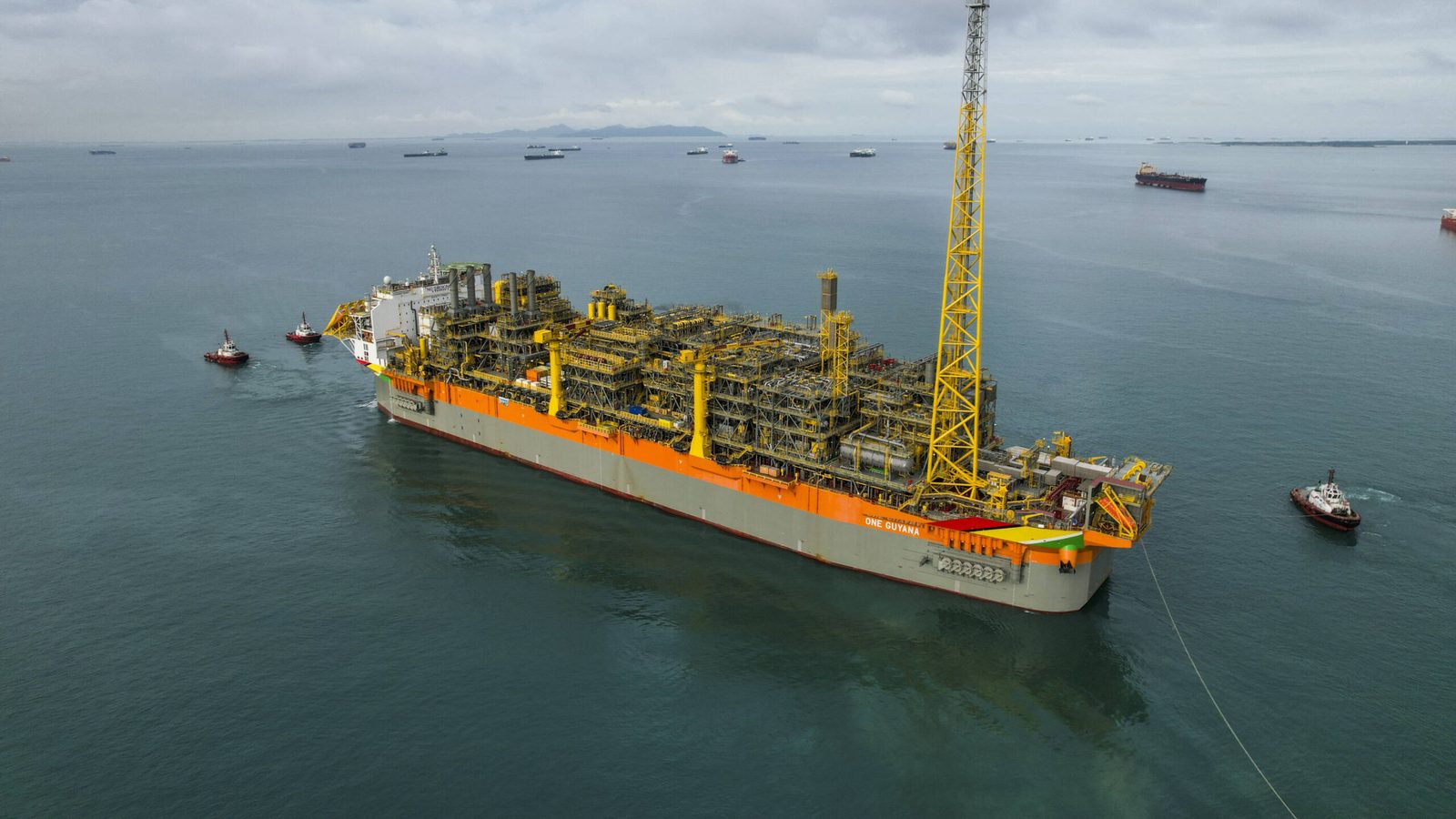
GEORGETOWN. The most valuable thing Guyana owns is counted by someone else, and this week the country was reminded how little of that counting it gets to see. Pressed at a press conference on whether any of its oil discoveries had gone unreported, the president of ExxonMobil Guyana, Alistair Routledge, acknowledged that two additional reservoirs had been found and reported to the government but never made public, he acknowledged at a press conference on November 25. In most oil provinces that would be a footnote.
In Guyana, where the entire political settlement rests on the premise that the resource belongs to the people, it is the story.
The admission landed in a month when the country's numbers have never looked larger. ExxonMobil's sixth production vessel, at the Uaru field, has lifted the Stabroek Block's installed capacity to about 1.1 million barrels a day, and the company said on November 24 that output will pass a million barrels a day in the coming weeks. The Ledger has reported that ramp. What this week added was not another record but a gap, the distance between what the operator knows, what the government is told, and what the public is allowed to see.
What the country was not told

The clearest illustration came from how a separate discovery surfaced at all. A find named Rockhead became public only because ExxonMobil's head of global exploration, John Ardill, mentioned it at the Energy Intelligence Forum in London in early October, far from the country whose seabed it sits beneath. Guyana's Minister of Natural Resources, Vickram Bharrat, later confirmed Rockhead and said testing was underway to establish its size and commercial potential. The government, the paper noted, offered no explanation for why it had said nothing.
The complaint is not that anyone stole anything. It is that the information runs the wrong way. The operator knows first, the government second, and the public third, often from a trade conference in another hemisphere. The opposition parliamentarian Sharma Solomon put the principle at its simplest: the people of Guyana are the owners of these resources.
The attorney and commentator Christopher Ram, among the most persistent auditors of the oil deal, was blunter, describing the company as less than straight and honest in its local dealings and faulting a government that keeps learning the size of its own patrimony from Exxon's press conferences. The government's chief legal officer, Attorney General Anil Nandlall, has long defended the state's handling of the deal, acknowledging that the Exxon contract is lopsided while insisting the government remains committed to maximizing the benefits Guyanese draw from it, and he and Ram have sparred publicly over its terms.

Routledge used the same briefing to reaffirm the headline number, saying the company still assesses the block at roughly 11 billion oil-equivalent barrels even as some earlier field-level estimates have come down, and that it still talks in terms of around 30 or so significant discoveries. Each of those figures is an argument the public cannot independently check. A resource estimate is a forecast, a discovery is a claim, and both live inside the company until the state chooses to confirm them. When the state confirms late, or not at all, the gap becomes a governance problem rather than a geological one.
The owners, last in line
What makes the gap matter is the money behind it. Guyana collects its share of the oil into the Natural Resource Fund, the sovereign account that has become the most contested number in the country's public life, and every barrel and every discovery feeds, eventually, into decisions about how fast that fund fills and how much is drawn into the annual budget. A population that waited generations for this is entitled to audit it, and an audit begins with disclosure. The institutions meant to do the auditing, the fund's oversight, the procurement rules, the local content regime, were built for a smaller and poorer country, and the central question of Guyanese governance is whether they can keep pace with an industry that now measures its output in millions of barrels.

The stakes are not abstract. The International Monetary Fund, in its most recent Article IV review reported in October, put Guyana's real growth at 19.3% in 2025 and projected 22.3% for 2026, the fastest expansion in the hemisphere, and the Natural Resource Fund held about US$3.3 billion at the end of 2025, more than 12% of gross domestic product. ExxonMobil reported $4.67 billion in profit from its Guyana operations in 2025 alone. These are the sums that flow from the barrels and the finds, and they are why a two-reservoir omission is not a technicality.
Each undisclosed discovery is a future entry in an account the public is told it owns, and an owner kept in the dark about the size of the estate cannot plan, tax or save against it.
Guyana has built some of the architecture a resource state needs. The fund has rules on deposits and withdrawals, the oil contracts are public, and a local content law tries to steer work to Guyanese firms. What this week exposed is the layer beneath all of that, the raw information on which every rule depends. An oversight board cannot question a withdrawal it cannot size, and a parliament cannot price a license renewal against discoveries it has not been shown.
Disclosure is not an add-on to the good governance of oil. It is the floor the rest stands on, and the floor, this week, turned out to have two holes in it that the public found by accident.
The pattern extends beyond discoveries. The consortium sanctioned its eighth Guyana project, Longtail, this month, a $12.5 billion gas and condensate development it expects to start producing in 2030, and Routledge said it would reuse the project's floating-facility designs and supply chain for a proposed Haimara development to save up to $2 billion. These are the decisions that shape a national economy for a decade, and they are taken inside a private consortium and relayed to the country as finished facts. Guyana is a partner in its own oil in the formal sense.
In the practical sense, on the evidence of this week, it is often an audience.
The opacity shows up in the plumbing too. Routledge disclosed, almost in passing, that the consortium had replaced a section of gas pipeline after a nitrogen leak, removing more than 200 meters of pipe, and reaffirmed that installed capacity in the Stabroek Block is on track for 1.5 million barrels a day by 2029. Each of those is a material fact about infrastructure and output the country depends on, delivered at the company's chosen moment and in the company's chosen frame. The pattern is consistent.
The operator decides what is routine enough to mention and what is significant enough to announce, and the state receives the news rather than shaping it.
There is a clock on the asymmetry. Routledge said the Stabroek exploration license covering most of the block expires next year, in 2027, which will reopen the terms under which Exxon explores and books new finds. A government negotiating that renewal from a position of partial knowledge negotiates at a disadvantage, and a public that learns of discoveries months late has little ability to hold its negotiators to account. The disclosure fight, in other words, is not a sideshow to the renegotiation.
It is the renegotiation's opening move, and the two small reservoirs acknowledged this week are a preview of how much the public does not yet know going into it.
A cautionary note folded inside an envy
For the rest of the Caribbean, the episode sits awkwardly beside the admiration. Guyana's oil has made it the fastest-growing economy in the hemisphere and pulled neighboring Suriname, itself counting down to first production, into the same conversation about sovereign funds and the Dutch disease that can hollow out everything not made of petroleum. The lesson the region is watching for is not whether the oil arrives. It is whether a small state can stay the master of information about its own wealth, or whether the company that lifts the oil also, in effect, keeps the ledger.
Paramaribo has read Georgetown's decade as a manual, and the chapters it is studying most closely are the ones on the fund and on what the public is allowed to know. A neighbor that watches Guyana stumble on transparency will write its own disclosure rules tighter. A neighbor that draws the wrong lesson will decide that opacity is simply how the business is done. Which lesson Suriname takes may depend on how convincingly Guyana answers the questions raised this week, because the smaller producer is building its institutions now, with Guyana's example open in front of it.
Routledge's tone throughout was matter-of-fact, the manner of an executive describing routine operations, and in the company's terms it was routine. Discoveries are reported to the government under the license, and the government decides what to announce. The problem is not that the process broke. The problem is that the process, working exactly as designed, leaves the owners of the resource last in line to know what they own.
Fixing that is not ExxonMobil's job. It is Georgetown's, and until it is fixed, every new record the country sets offshore will arrive with the same quiet question attached: what else has not been said.
Send news tips, corrections, or comments to newsroom@caribbeanledger.com.
Read more at The Caribbean Ledger ›