A cruise line, a public beach, and a government that said no, then maybe
The story that crossed the region was that Antigua had turned a cruise giant away to keep a beach public. The Prime Minister said as much. Three days later his tourism minister softened it. The Caribbean Ledger reports what was actually decided, and what was not.
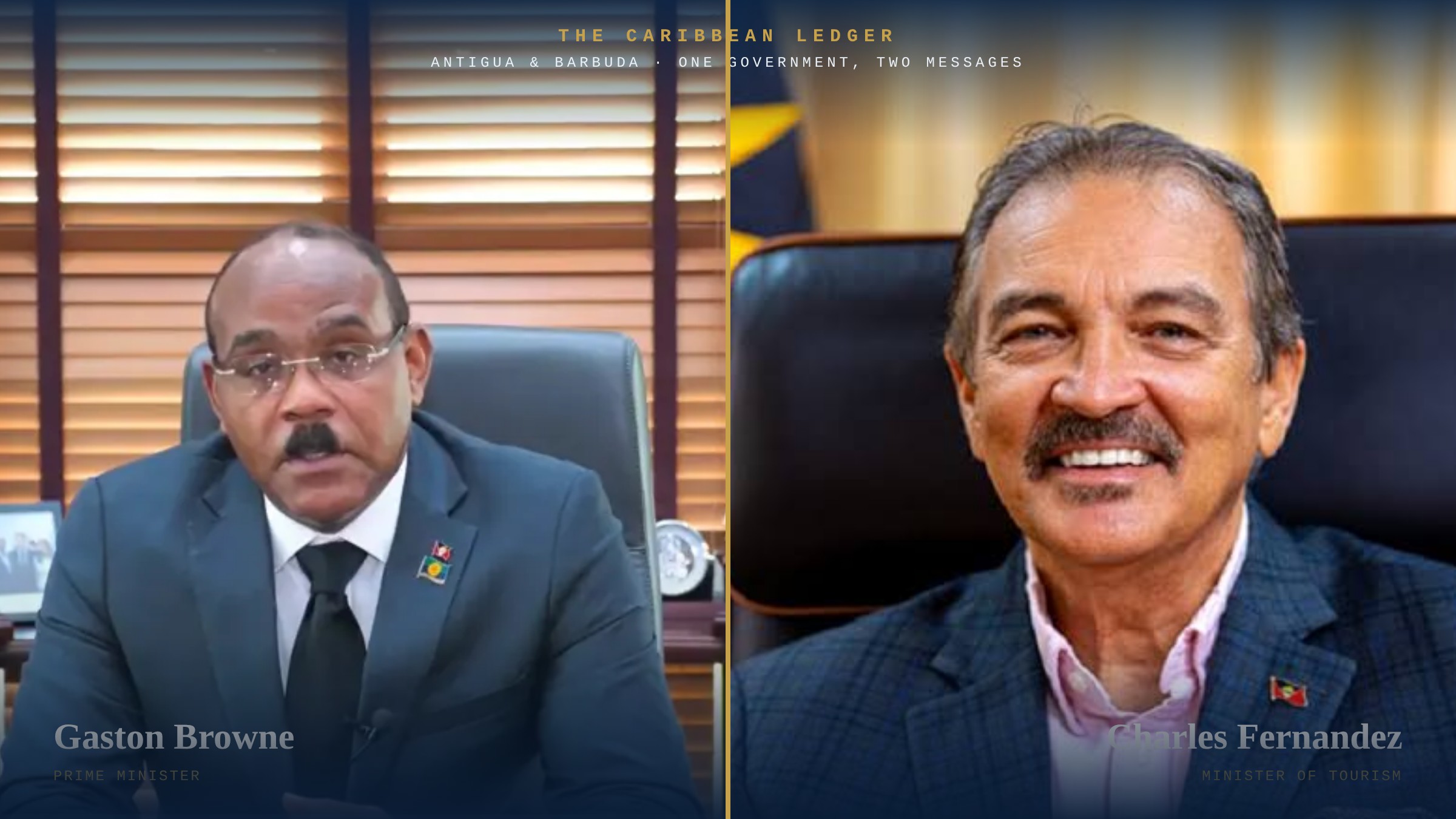
ST. JOHN'S. The story that traveled across the Caribbean this week was a simple and appealing one: Antigua had turned a cruise giant away to keep a beach in the hands of its people. It is the kind of stand the region cheers, and within days the line had hardened into settled fact in living rooms from St. John's to Kingston.
The truth, as The Caribbean Ledger has pieced it together, is more careful than the headline, and more revealing for it.

What the Prime Minister said
On the Browne and Browne Show on November 21, Prime Minister Gaston Browne told listeners that his government had rejected a proposed EC$100 million investment by Royal Caribbean Group because the company wanted exclusive access to Fort James, a public beach on the edge of the capital. They want exclusivity and we said no, because our people must have access to the beach, he said, adding that Fort James sat inside a broader plan to turn several beaches into public parks. It was a clean, popular message, and it landed as one.
What the Prime Minister did not say matters as much as what he did. He did not specify the restrictions Royal Caribbean had sought, how much of the Fort James site the project would have covered, or whether a revised proposal that preserved public access would be entertained. In the absence of those details, the region supplied its own: a flat rejection, a line drawn, a cruise line sent home. That is the version that went around.
It is not quite the version the government has since confirmed.
Then the clarification

Three days later the tone changed. The Minister of Tourism, Civil Aviation, Transportation and Investment, Charles Fernandez, issued a statement saying the Prime Minister's comments had been taken out of context. The Royal Caribbean project, he said, was first contemplated in 2019 and had not resumed after the pandemic, and it had always considered local beach access from its earliest stages. He called Royal Caribbean Group a good partner and said the government valued the collaboration.
That is not the language of a door slammed shut. It is the language of a deal paused, not dead.
The distance between the two statements is the story, and it is where careful reporting earns its place. One member of the government framed the matter as a refusal on principle; another, days later, framed it as a misunderstanding about a long-standing proposal that always protected the public's access. Both men speak for the same administration, and both messages are pitched to real and reasonable audiences: a public that will not countenance its coastline being fenced off, and an investment climate a tourism economy cannot afford to unsettle. This is not an administration caught in a contradiction so much as a small state doing the hard, ordinary work of guarding its beaches while courting the capital that keeps its hotels full, and doing it in public.
That balance is not peculiar to Antigua. Across the Caribbean, public beach access is a settled expectation and, in several islands, a point of law, and the fear that cruise and resort money quietly encloses the shoreline is one of the most durable anxieties in the region's tourism politics. A government seen to hold the line on access earns trust at home. A government seen to wave off EC$100 million of investment invites a harder question about jobs and arrivals.
Antigua and Barbuda, like its neighbors, must answer both at once, and the Fort James episode is that dilemma made visible.

What remains unresolved is the part that matters most: whether the project is revived, and on what terms for public access. The Caribbean Ledger has reached out to the Office of the Prime Minister for further comment, and will update this story as the government responds. For now the record is this. The government has said both that it will protect Fort James for the public and that Royal Caribbean remains a good partner, and it has kept the room to honor both.
That is not a muddle to be mocked. It is a balance worth watching closely, and we will.
Send news tips, corrections, or comments to newsroom@caribbeanledger.com.
Read more at The Caribbean Ledger ›