Mottley asks the region to bet 22 billion dollars on itself
At the Caribbean Investment Forum in Bridgetown, Prime Minister Mia Mottley laid out a decade-long resilience plan and a blunt argument: the money to build it is already sitting in Caribbean bank accounts, earning almost nothing.
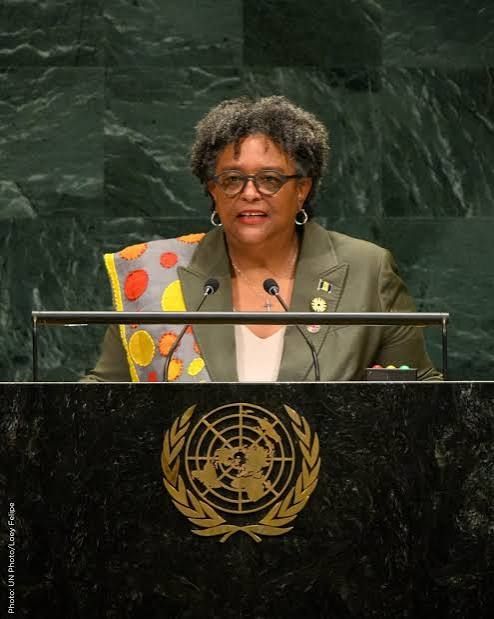
Prime Minister Mia Mottley used the Caribbean Investment Forum in Bridgetown this week to put a number on her ambition for Barbados and to argue that the region has been sitting on the means to pay for it. Speaking on October 6 at the Hilton Barbados, in remarks reported the following day by Barbados Today, she set out a resilience plan valued at about 22 billion Barbados dollars, roughly 11 billion US dollars at the island's fixed exchange rate of two Barbados dollars to one American dollar.
The plan, which Mottley framed as the work of roughly a decade, bundles about a dozen projects meant to be built with a mix of public and private money. Barbados Today listed a desalination plant, battery storage, photovoltaic plants, a port aggregate facility, a national and regional data center, and a set of major real estate developments among them. Taken together they sketch a Barbados trying to buy down its exposures all at once, to drought through desalination, to imported fuel through solar and storage, and to irrelevance through the data infrastructure that a modern services economy runs on.
The more striking part of the pitch was where Mottley proposed to find the money. She pointed to an estimate, attributed to the governor of the Central Bank of Barbados, that regional bank deposits amount to roughly 80 billion US dollars, the equivalent of about 160 billion Barbados dollars, much of it earning little or no interest. Redirecting even 2% to 5% of that pool into productive investment, she argued, would be enough to move the needle on projects the region has long said it cannot afford. The framing matters because it reaches past foreign capital and toward Caribbean savings that are already banked in the Caribbean.

A regional vehicle, and a regional habit
Mottley tied the Barbados plan to a wider regional machinery. She cited a planned Barbados and Guyana investment vehicle, the Trident Arrow Investment Fund, which she said is expected to be established before the end of 2026, pairing the island's planning capacity with the cash now flowing through oil-rich Guyana. She also called for the mutual recognition of corporate entities across the region within a year, so that a company incorporated in one Caribbean jurisdiction can operate across others without re-registering, a quiet piece of plumbing that would make a single regional project far easier to finance and build.
Her language was characteristically direct. There is no transformation without scale, she told the forum, pressing the case that projects too small to interest serious investors have to be bundled into ones large enough to matter. Transport, transport, transport, she repeated, naming the constraint that she has returned to for years, the cost and difficulty of moving goods and people around an archipelago. The region, she said, needs to build a habit of success, the confidence that comes from finishing large things rather than studying them.
The arithmetic of incentives
The pitch arrives against a familiar fiscal reality. Barbados Today noted that Barbados awards more than 850 million Barbados dollars a year in tax incentives, concessions designed to attract investment that also narrow the government's own revenue base. A plan that leans on mobilizing private and regional capital, rather than on new public borrowing, is in part an answer to that squeeze. Barbados has spent the years since its 2018 debt restructuring guarding its credibility with lenders, and a 22 billion dollar public spending program financed on the government's own balance sheet would test that credibility hard. A program financed by redirected deposits and co-investment vehicles is a different proposition.
There is a gap between vision and ground that the forum did not close. The deposits Mottley wants redirected sit in commercial banks for reasons, among them liquidity rules and the absence of enough bankable regional projects to absorb them safely. Turning idle savings into desalination plants and data centers requires instruments that pay savers a fair return while carrying risk the banks can accept, and those instruments have to be built before the money moves. The Trident Arrow fund, if it launches on schedule, will be an early test of whether the region can manufacture them.
The choice of projects is itself an argument about where Barbados is most exposed. A desalination plant answers a drought risk that has grown sharper across the eastern Caribbean, where rainfall has become less reliable and reservoirs have run low in recent dry seasons. Battery storage and photovoltaic plants answer the fuel import bill that leaves island economies hostage to the price of oil they do not produce. A data center answers a quieter fear, that a services economy without modern digital infrastructure slowly loses the business it already has. Each project is a hedge against a vulnerability the region knows well, which is part of why the plan is branded as resilience rather than growth.
Still, the speech reframed an old complaint into a usable target. For years Caribbean leaders have said the region is starved of capital. Mottley's argument in Bridgetown was that the capital is here, parked and underused, and that the real shortage is of the scale, the vehicles and the nerve to put it to work. The next year will show whether a number as large as 22 billion dollars can pull those three things into being, or whether it joins the long regional ledger of plans that read well at a forum and stall on the way to a site.
Read more at The Caribbean Ledger ›