Brussels sets a 2028 deadline on Caribbean passports, and the region answers at the UN
The European Commission has told five Eastern Caribbean states to end their citizenship-by-investment programs by June 1, 2028, or lose visa-free access to Europe. At the United Nations, St. Lucia's Philip J. Pierre and Antigua's Gaston Browne carried the region's case to the commissioner in person. They came away with the deadline intact and the harder question unanswered: what replaces the money.
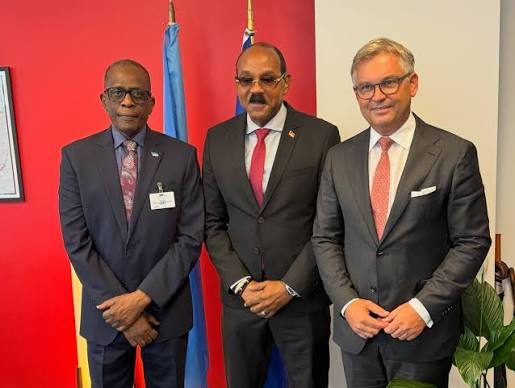
On September 24, in a conference room at the European Union's mission to the United Nations, two Caribbean prime ministers sat across from the man holding a deadline over their economies. Prime Minister Philip J. Pierre of St. Lucia and Prime Minister Gaston Browne of Antigua and Barbuda had come to the 81st General Assembly to make a case that is, at bottom, about money and sovereignty. Across the table was Magnus Brunner, the European commissioner for internal affairs and migration, the official who in June signed the letter giving five Eastern Caribbean states until June 1, 2028 to end the programs that sell their citizenship, or lose the visa-free access to Europe that their passports carry (IMI Daily, The Voice St. Lucia).
They were not alone. Timothy Antoine, the governor of the Eastern Caribbean Central Bank, and Didacus Jules, director general of the Organisation of Eastern Caribbean States, sat with them, a signal that the region intends to answer as a bloc rather than as five separate applicants. The prime ministers put the argument plainly, calling the programs an important source of development financing for the OECS countries that operate them, and pressing for a transition path that takes account of both Europe's security concerns and the economic realities of the region. The meeting produced no agreement and no change to the date. The deadline stands.
The instrument behind that deadline is quieter than the headline. On December 30, 2025, a revised European visa-suspension mechanism took force, and for the first time it made the sale of citizenship an independent reason to suspend a country's visa-free travel, in the Commission's words regardless of how well a program is run. On June 25, 2026, Brunner's letter converted that principle into a calendar: a 24-month transition, ending June 1, 2028, for Antigua and Barbuda, Dominica, Grenada, St. Kitts and Nevis, and St. Lucia. The letter also set nearer-term conditions to be met by this month, among them the full exclusion of anyone under EU restrictive measures and reinforced vetting for applicants of every nationality. The next checkpoint is a Commission report due in December.
The reason the region is fighting a date rather than quietly complying sits in the public accounts. For several of these economies, selling citizenship is not a sideline. It is among the largest sources of revenue the state controls, and the cheapest development capital it can raise, with no interest and no lender attached. In Dominica the scale is stark. The International Monetary Fund, in its 2026 Article IV review, put citizenship receipts at roughly 33% of GDP at their 2022 peak, and projected them falling toward 14.5% of GDP by 2030 even before Brussels named a deadline (IMF Staff Country Report No. 2026/117). In St. Kitts and Nevis, the Fund traced part of a 2025 slowdown directly to lower citizenship inflows. These are not rounding errors in a small budget. They are close to the budget itself.
This is why the region's answer has hardened into a single position. In July, the heads of government of the participating Eastern Caribbean states issued a joint statement through Dominica's Office of the Prime Minister, declining to concede the date and asking instead for a framework to replace the financing a shutdown would remove. Browne has been the sharpest voice. The programs, he said, cannot simply be abandoned without viable, concrete, and credible replacement revenues, and his government will not be pressured into a unilateral phase-out (Antigua Observer). The message from the UN meeting was the same argument, delivered in person and one level higher.
Strip away the diplomacy and the problem is arithmetic. Brussels is asking five governments to give up a revenue line worth, in the largest case, close to a third of national output, and it is doing so without naming what comes in its place. The programs were built precisely because these islands carry narrow tax bases, high exposure to hurricanes, and limited access to cheap borrowing. Citizenship revenue filled that gap. Remove it on a fixed timetable and the hole does not close on its own. It becomes a financing question the region cannot answer alone, which is exactly the framework the prime ministers were asking Europe to help design.
There is a version of 2028 in which the programs do not end so much as change shape, with tighter vetting, higher price floors, shared regional standards, and closer coordination with Brussels buying the region continued access. There is another version in which the date arrives with no replacement framework and the five economies absorb the loss on their own. The distance between those two outcomes is the work of the next twenty months. The December report will show whether the interim conditions have moved Brussels at all, and whether continued dialogue, the phrase the prime ministers kept returning to, is a real channel or a courtesy.
This is the clearest test in the region of a question that reaches well beyond passports: whether small states can defend the revenue that keeps them solvent when a larger partner decides the model has to end. For now the region has done the only thing available to it before a deadline it did not choose. It has said no, together, and asked for a plan. What it does not yet have is the plan. The Ledger will follow this as one story with many chapters, and this is the next.
Read more at The Caribbean Ledger ›