The biggest company on the Jamaican exchange is about to leave it
Scotiabank is paying J$63.5 billion to take Scotia Group Jamaica private and off the stock exchange after 57 years. The buyout lands in the middle of the best year the Jamaica Stock Exchange has had since before the pandemic, and it asks a hard question about who the region's revived equity markets are really for.
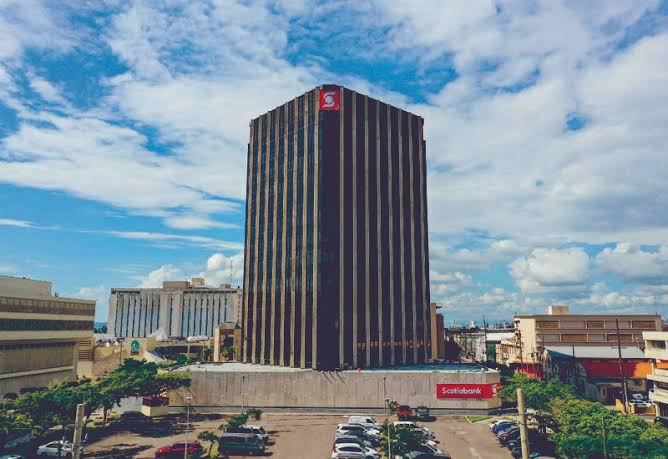
For more than half a century, the surest blue chip on the Jamaica Stock Exchange was the one with the red logo. Scotia Group Jamaica, the local arm of Canada's Bank of Nova Scotia, has traded in Kingston since the exchange opened its doors, and it has spent most of that time as the largest listed company in the country. On October 7, at the AC Hotel in Kingston, the shareholders who still owned a sliver of it voted to let it go.
At an extraordinary general meeting, holders of Scotia Group Jamaica approved a court-directed scheme of arrangement under which Scotiabank Caribbean Holdings, the parent, will buy out every remaining minority shareholder and take the company private. The Jamaica Observer, reporting the result on October 8, put the price of the buyout at J$63.5 billion, or about US$397.84 million, at J$75 a share. The resolution carried, in the language of the scheme, by a majority in number of those voting, representing 77% of shareholders present and 97% of the stock units cast. The company's chairman, Vernon Douglas, presided.
Once a final sanction hearing before Justice David Batts clears on October 30, Scotia Group Jamaica will delist from the exchange it helped define. The largest company on the board, by the Observer's account worth J$226.75 billion and accounting for 10.55% of the Main Market, will simply be gone from the screens.
A premium, and a goodbye

The headline for the roughly 4,000 minority holders is the price. Scotiabank's opening offer earlier in the process was J$61.50 a share. The number that carried the vote was J$75, a figure the parent raised during the process and the one on which holders ultimately signed off. For a shareholder who bought in during the lean years that followed the 2020 shock, that is a real gain banked in cash. For the exchange itself, it is a loss that cash cannot replace.
The buyout is being executed as a scheme of arrangement rather than a simple tender, which is the mechanism Caribbean issuers use when a controlling owner wants to sweep up the float with the backing of a court. It binds the dissenting minority to the majority's decision once the judge signs. Scotiabank already controlled the overwhelming majority of Scotia Group Jamaica, so the EGM was never in serious doubt. What the meeting settled was the terms, and the finality.
That the final number moved from J$61.50 to J$75, a jump of roughly 22%, tells its own small story. A controlling parent that can force a scheme through does not raise its offer by nearly a quarter unless it judges that the lower figure risked a bruising vote or a harder fight at the sanction hearing. The increase is the clearest sign that the minority had leverage, used it, and was paid for stepping aside. Holders who pressed for more got more, which is the system working as designed, even as the system delivers an outcome that removes the company from public hands.
Scotiabank's decision also fits a pattern that Caribbean markets have watched warily for the better part of a decade, as international banks have reviewed, repriced and in some cases exited parts of their regional networks. Against that backdrop, taking full ownership of a star subsidiary reads less like retreat than like a parent deciding that the asset is worth holding whole. Singh's language, a decisive statement of the Caribbean's strategic importance, is plainly meant to settle nerves. The test of it will be whether a privately held Scotia Group lends, hires and invests in Jamaica as visibly as a listed one had to.
Jabar Singh, who runs Scotiabank's Dominican Republic and Caribbean business, framed the decision in strategic terms. The move, he said, is a decisive statement of the Caribbean's strategic importance to Scotiabank. Read one way, that is reassurance to a market that has watched more than one international bank trim its regional footprint in recent years. Read another way, owning the whole of a profitable subsidiary outright, with no minority to answer to and no quarterly listing obligations, is exactly what a bank does when it intends to manage a business for the long term on its own terms.
And Scotia Group Jamaica is profitable. The Observer reported the company's net profit attributable to shareholders at J$16.18 billion, the highest of any company on the exchange. This is not a rescue or a wind-down. It is the parent paying a premium to take full ownership of its single most valuable Caribbean earner at the moment that earner is performing.
The timing is the story
What makes the delisting sting is when it is happening. The Jamaica Stock Exchange is having its best year in a long time. The Jamaica Gleaner reported on October 7 that the JSE Combined Index closed September at 385,314.47 points, up 21.2% since the end of 2025, the strongest advance for the period since 2019. The market's capitalization reached J$2.08 trillion in September, up from J$2.01 trillion a month earlier. Trading volume in September ran to 2.21 billion shares, roughly four times the figure a year before.
Scotia Group itself has been part of that rally, up 32.6% for the year to date by the Gleaner's accounting. The exchange's US-dollar equities index was up 39.2% year to date and 52.6% over twelve months. Gary Peart, chief executive of the Mayberry Group, described the move in the market to the Gleaner as a rebound after several years of fallout. Denise Marshall-Miller of VM Wealth Management offered the sober counterweight, noting that the index remains well below its pre-pandemic peak of roughly 532,000 points.
So the picture is a market climbing back toward its old highs, pulling retail investors back in, and at the same time losing its single largest constituent to a foreign parent who has decided the shares are worth more off the board than on it. A revival that cannot hold onto its anchor tenant is a revival with a question mark over it.
Who are these markets for?
The deeper issue the Scotia Group delisting surfaces is one that runs across the whole region. Caribbean equity markets are thin. A handful of names carry most of the capitalization and most of the daily turnover. When one of the handful leaves, the market does not just lose a line on a screen. It loses depth, it loses liquidity, and it loses a benchmark that pension funds, unit trusts and ordinary savers use to anchor the value of everything else they hold.
Scotia Group was that kind of name. It was the stock an insurance company could buy in size without moving the price, the stock an index fund had to own, the stock a first-time investor could be pointed to without apology. Its departure concentrates the index further into fewer hands and makes the next large listing, whenever it comes, carry more weight than any single company should have to.
There is a counterargument, and it is worth stating fairly. A clean buyout at a premium rewards the people who held the shares. It returns capital to Jamaican investors who can redeploy it into the rest of a rising market. If those investors take their J$75 and buy the next tier of listed companies, the float that Scotia Group vacates could be filled by names that need the capital more than a Canadian bank does. Markets are supposed to recycle ownership. This is ownership being recycled, with a cheque attached.
But that argument depends on new issuers arriving to take the vacated space, and the region's pipeline of large initial public offerings has been slow for years. The Junior Market, the JSE's platform for smaller companies, actually fell 8.7% year to date even as the main board surged, by the Gleaner's figures, which suggests the rally has been concentrated in the established names rather than broad-based across new ones. A market that keeps losing its biggest companies to private buyers and does not replace them at the top is a market that slowly hollows out from the center.
What to watch on October 30
The sanction hearing before Justice Batts is the last formal step, and schemes of this kind are rarely overturned at that stage once the shareholder vote has carried by the margins seen here. Barring a surprise, Scotia Group Jamaica will cease to trade before the end of the month, closing a listing that has outlasted governments, currency regimes and two generations of Jamaican investors.
The lesson for regulators and for the exchange is not that Scotiabank did anything improper. It paid a premium, it followed the process, and it won a lopsided vote. The lesson is that a stock market is only as useful as the companies willing to stay on it, and that a region serious about building deep local capital markets has to give its best companies reasons to list and reasons to remain. A premium buyout is a good day for the sellers. Whether it is a good day for the market depends entirely on what, and who, comes next.
For now, the Jamaica Stock Exchange will record its strongest year since 2019 and, in the same breath, the exit of the largest company it has ever carried. Both things are true. Reconciling them is the work of the years ahead.
Read more at The Caribbean Ledger ›