Island in Focus: Cuba’s peso slides toward 800 to the dollar as the lights keep going out
The informal exchange rate has lost almost 6% in a week and the island’s largest power plant has been offline again. Two crises, one currency and one grid, are feeding each other.
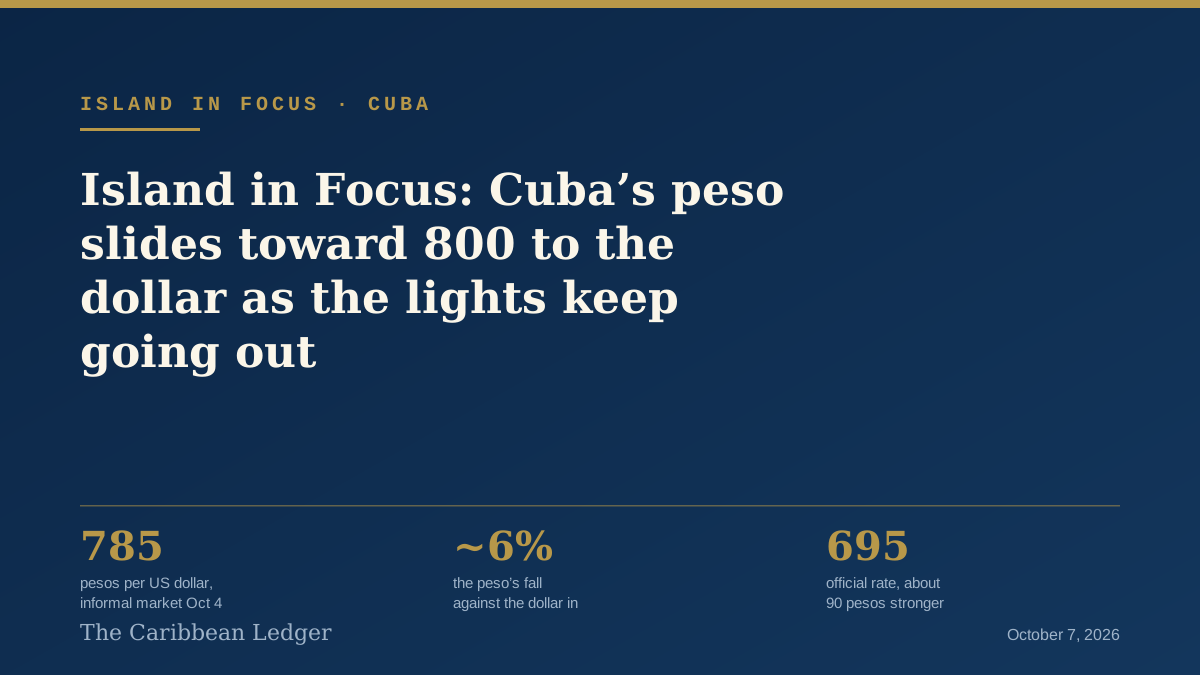
Cuba’s currency is sliding at a pace that is hard to look away from. On October 4, the informal market tracked by CiberCuba put the United States dollar at 785 Cuban pesos, with buyers paying 780 and sellers asking 790. The euro stood at 885 pesos and the freely convertible MLC balance at 475. The dollar had gained 44 pesos in a single week, up from 741, a rise of nearly 6%, and more than 102 pesos over thirty days from 683. The official central-bank rate remains 695 pesos to the dollar, a gap of about 90 pesos below the street.
That gap is the story in miniature. When the price the state recognizes and the price people actually pay drift this far apart, the official rate stops describing the economy and starts describing a wish. Cubans who earn in pesos and need to buy anything imported, which in a shortage economy is nearly everything, are the ones who absorb the difference, and the difference is now large enough to reset prices across the island from one week to the next.
The grid as a second currency crisis
The peso is not falling in isolation. On October 1, Havana lost 267 megawatts across roughly 100 circuits, according to reporting carried by CubaHeadlines and CiberCuba, as the Antonio Guiteras plant, the country’s largest and most important generating unit, went offline yet again. Technicians targeted a reconnection for Saturday, October 4, after repairs to the boiler and reheater. The plant’s technical deputy director, Elmer Garcia Romero, and its director, Roman Perez Castaneda, have become familiar names to a public that now follows the status of a single power station the way other countries follow the weather. The Guiteras plant has suffered more than seventeen unplanned outages in 2026 alone.
Electricity and the exchange rate are bound together more tightly than they look. A plant that keeps failing forces the state to import more fuel and to buy generation it can barely afford, which drains the hard currency that might otherwise defend the peso. A weaker peso makes every imported spare part and every barrel of fuel more expensive, which makes the grid harder to fix. Each crisis deepens the other, and neither has an obvious floor.
A contraction on top of a contraction
All of this is happening against a macroeconomic backdrop that is already among the worst in the hemisphere. The United Nations Economic Commission for Latin America and the Caribbean projected in September that Cuba’s economy would contract by about 10.3% in 2026, a fall steeper than anything else the region expects to record this year. A contraction of that size is not a bad quarter. It is a shrinking of the whole economy, felt in empty shelves, in migration, and in the daily calculation of how many pesos it now takes to buy a dollar.
Cuba’s monetary authorities have tried to keep pace with their own inflation in the most literal way. Last month the central bank put 10,000 and 20,000 peso notes into circulation, denominations that would have been unthinkable a few years ago and that are themselves a quiet admission of how far the currency has fallen. Larger notes do not fix a currency. They acknowledge it.
The human arithmetic is what the figures leave out. A pensioner whose monthly payment is fixed in pesos has watched that payment buy fewer dollars every week, which in an economy that imports most of what it sells means it buys less of everything. Remittances from relatives abroad, long the quiet subsidy that keeps many Cuban households afloat, stretch further at the informal rate but arrive into a system where there is often simply nothing on the shelf to buy. A currency crisis in a shortage economy is measured less in charts than in the hours spent looking for goods that are not there.
For the wider Caribbean, Cuba is both a neighbor and a warning. It is the clearest regional example of what happens when an energy system and a currency fail at the same time, each accelerating the other, with ordinary people left to do the arithmetic. The island has absorbed shocks before that would have broken other states. But a peso heading toward 800 to the dollar, a grid that cannot stay on, and a double-digit contraction are not three separate problems. They are one problem wearing three faces, and it is getting harder, not easier, to see where it ends.
Read more at The Caribbean Ledger ›