Brent is back above 100 dollars, and the Caribbean pays twice
A barrel of Brent closed above 100 dollars this week and the US energy agency now sees prices staying there into the new year, driven by a Middle East that cannot reliably ship its oil. For a region that imports most of its fuel and exports much of its holidays, the bill arrives at the worst possible moment.
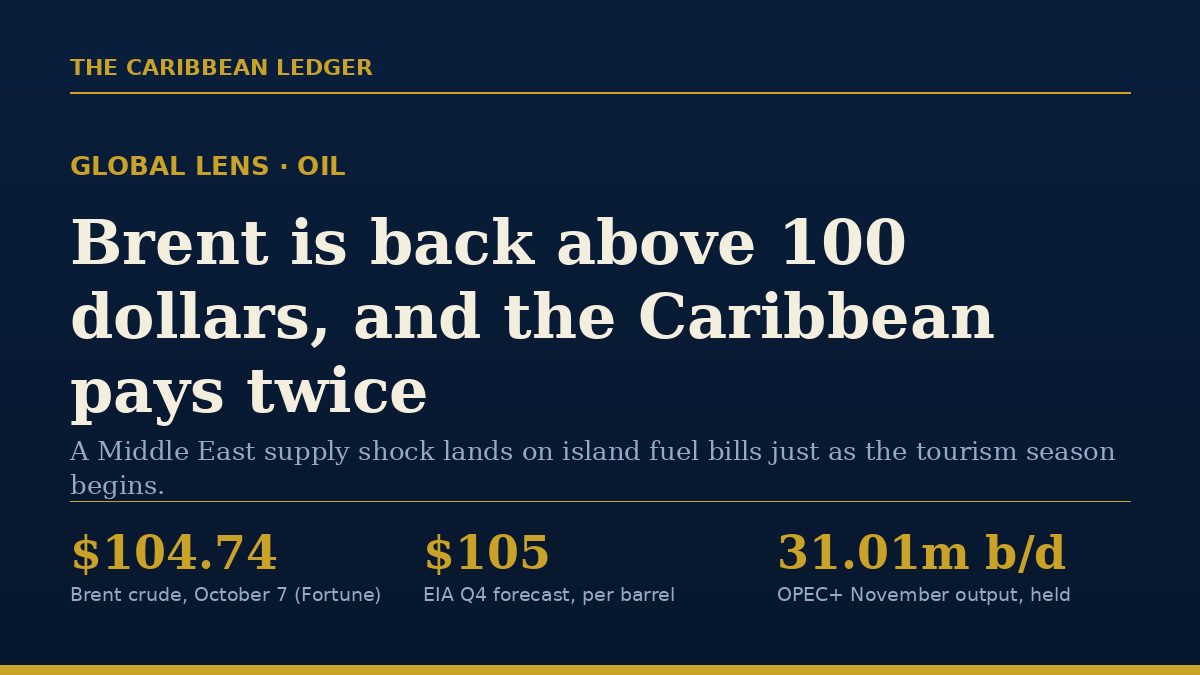
The most important number for the Caribbean this week was set far from it. Brent crude traded at 104.74 dollars a barrel on the morning of October 7, up more than 3% on the day and roughly 58% higher than a year earlier, according to Fortune's market tracker. This is not a one-day spike. In its October Short-Term Energy Outlook, published October 6, the United States Energy Information Administration raised its fourth-quarter Brent forecast by 14 dollars in a single month to 105 dollars a barrel, and it expects prices to stay elevated into 2027 (EIA).
The cause is geography, not demand. The continuing conflict in the Middle East has left the Strait of Hormuz, the chokepoint through which close to a fifth of the world's oil normally passes, what one major bank has called structurally impaired. The EIA now assumes Middle Eastern flows remain constrained through the end of the year, with several million barrels a day of production still shut in. Markets are pricing a supply problem, and supply problems are stubborn.
The policy response has not fixed it
The world's large economies have tried to cap the damage, with limited effect so far. On October 2 the Group of Seven agreed to release up to 100 million barrels of emergency stocks, much of it diesel, over four months in a coordinated action through the International Energy Agency. Two days later, the core members of OPEC and its allies met and chose to keep November output unchanged at 31.01 million barrels a day, reaffirming what they called a commitment to market stability (OPEC). A stockpile release softens the blow at the margin, but it does not add new barrels to the market in the way a production increase would, and the producers declined to add them.
For the Caribbean, the mechanics matter less than the outcome. The price of the single most important imported input for almost every island economy is high and is expected to stay high through the season when the islands can least absorb it.
Where the bill lands first
Start with electricity. Across the Eastern Caribbean and the larger importers alike, power is generated substantially from imported fuel, and tariffs track the cost of that fuel with only a short lag. The signs are already visible. In the United States Virgin Islands this week, the Water and Power Authority said it could no longer absorb higher fuel costs and asked regulators for an emergency increase of three cents per kilowatt-hour in its fuel charge. In the British Virgin Islands, the government has had to add millions in electricity subsidies simply to keep bills from climbing further. These are not coincidences. They are the oil price arriving at the meter.
Then comes everything that moves. Island economies are unusually exposed to transport costs because almost nothing is made where it is sold. Food, construction materials, consumer goods and the fuel for the trucks and ferries that distribute them all carry the price of the barrel. The result is imported inflation, the kind a small central bank cannot tame with interest rates because its source lies offshore. It lands just as the winter tourism season begins, raising the cost of running the hotels and restaurants on which the region depends at the very moment they most need to be competitive.
The other side of the ledger
The region is not uniformly a loser here, and honesty requires saying so. For Guyana, Trinidad and Tobago and Suriname, a Brent price above 100 dollars is a windfall that swells export earnings and government revenue. Guyana's production costs sit far below the market price, which turns every barrel into margin. The same shock that strains Jamaica's and Barbados's accounts strengthens Georgetown's and Port of Spain's.
That split is the uncomfortable truth of the modern Caribbean. A global oil shock no longer moves the region in one direction. It widens the gap between the producers and the importers, rewarding three economies and taxing the rest. The regional interest and the national interest no longer always point the same way.
What to watch
The near-term questions are concrete. Whether the EIA's 105-dollar forecast holds will depend almost entirely on the Middle East, a variable no Caribbean government can influence. Watch for more utilities across the region to follow the Virgin Islands in seeking fuel-charge increases, and for finance ministries in the importing states to weigh fuel subsidies they can scarcely afford against the political cost of letting bills rise into the holidays. For the producers, the question is the happier one of how to bank a windfall without assuming it will last. The EIA already sees Brent easing toward 84 dollars in 2027. The barrel that is a gift today will not be one forever, and the wise among the region's new producers will spend this year's prices as if they know it.
Read more at The Caribbean Ledger ›