A weak American jobs report, and why the Caribbean’s dollar economies are listening closely
The United States added just 29,000 jobs in September, all but closing the door on another Fed rate rise. For economies pegged to the dollar, Washington’s next move is effectively their own.
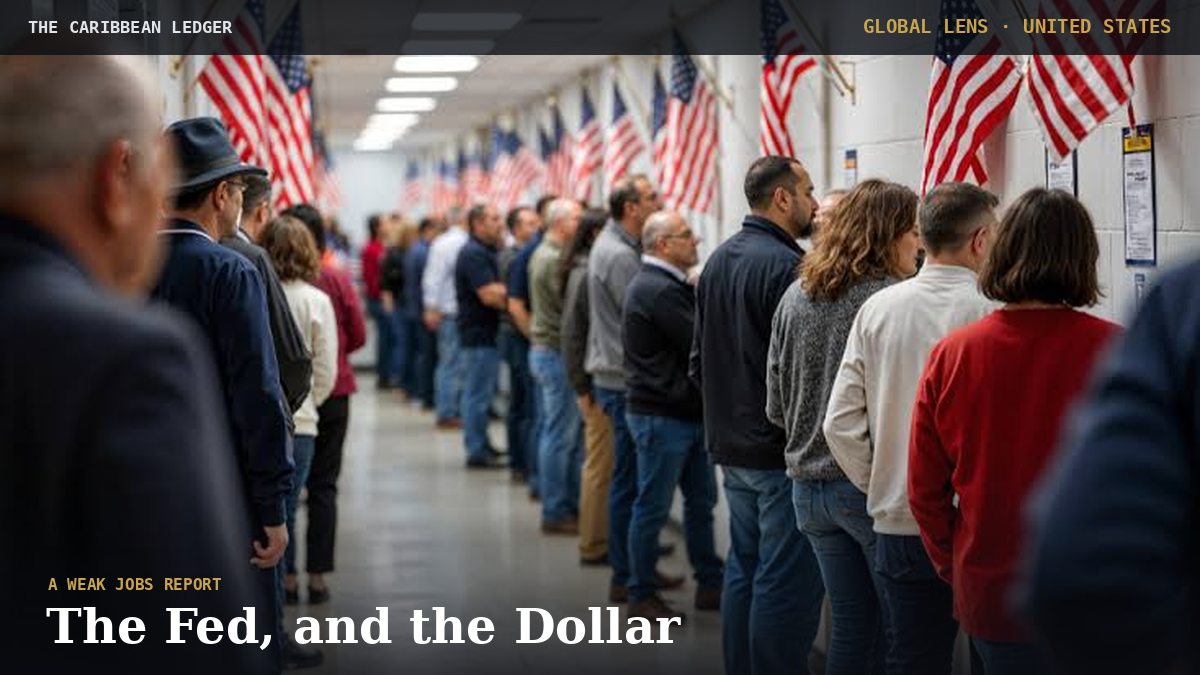
The most important economic number for the Caribbean last week was not published anywhere in the Caribbean. It came from the United States Bureau of Labor Statistics, and it was a disappointment: the American economy added just 29,000 jobs in September, against expectations somewhere between 84,000 and 95,000, with the unemployment rate ticking up to 4.2% from 4.1%, as CNBC and other outlets reported on October 2. A weak jobs print in Washington is, for much of this region, a weak jobs print at home, and the reasons are worth spelling out.
Several Caribbean economies do not run an independent monetary policy in any meaningful sense. Barbados, the Bahamas, Belize and the members of the Eastern Caribbean Currency Union all tie their currencies to the United States dollar, and Trinidad and Tobago manages its exchange rate closely against it. When a currency is pegged to the dollar, the central bank’s first job is to defend that peg, which means domestic interest rates have to track American ones more or less whether local conditions warrant it or not. The Federal Reserve, in effect, sets the floor for the cost of money across a large part of the region.
Why a soft number is a kind of relief
The Fed raised its benchmark rate to a range of 3.75% to 4.00% in September, moving to contain an inflation rate that the BLS put at 3.4% over the year to August. A central bank that is still raising rates is a problem for dollar-linked economies, because it keeps the cost of servicing dollar debt high for governments and businesses that borrowed when money was cheaper. The September jobs miss changes the odds. After the report, the CME FedWatch tool showed roughly a 77% probability that the Fed holds rates steady at its October meeting rather than raising again, CNBC reported.
For a Caribbean finance minister, a Fed that has stopped raising is close to the best news available short of a Fed that is cutting. It caps the cost of new dollar borrowing, steadies the currencies pegged to the dollar, and removes a headwind from sovereigns that have spent years rebuilding their public finances. The relief is not a windfall. It is the absence of a fresh burden, which in a tight fiscal year is worth a great deal.
The other side of the same coin
A cooling American labor market is not an unmixed blessing. The United States is the single largest source of tourists for most of the region and the single largest source of remittances for several of its economies. When American hiring slows and household confidence softens, the first discretionary spending to go is often the vacation, and the money that migrants send home to families in Jamaica, the Dominican Republic, Haiti and Guyana can tighten with it. A Fed that holds rates because the economy is weakening is helping the region’s balance sheet and threatening its income at the same time.
The exposure is not evenly distributed. Jamaica, where tourism accounts for a large share of output and foreign exchange, feels a softening American traveler more acutely than an oil exporter like Guyana. The Dominican Republic and Haiti, where remittances are among the largest single sources of foreign currency, feel a weaker American job market in the money that does or does not arrive each month in family accounts. A single Federal Reserve decision ripples through the region along different channels and at different depths, which is why no two Caribbean finance ministers read the same American data the same way.
There is a further complication sitting underneath all of this, which is the oil price. Crude traded back above US$100 a barrel last week, a move that pushes up inflation everywhere, including in the United States. If American inflation reaccelerates on the back of energy, the Fed could find itself unable to cut even as the labor market softens, the uncomfortable combination that economists call stagflation. For dollar-pegged economies, that would be the worst of both outcomes: borrowing costs that stay high because of inflation, and tourism and remittance income that falls because of weak American demand.
One piece of good news did clear the board. A United States government shutdown, which had threatened to disrupt everything from federal data to travel in early October, was averted when the House passed a stopgap funding measure by 370 votes to 48 to keep the government open through December 11, as Breaking Defense reported. For a region whose tourism and trade run through American airports, ports and agencies, an open federal government is not a small thing.
The lesson the region keeps relearning is one of exposure without a vote. The people who will feel the consequences of the Fed’s October decision include millions of Caribbean citizens who have no say in choosing the officials who make it. That is the price of the stability the dollar peg provides, and most of the governments that pay it would still choose it over the alternative. But it is why a jobs report out of Washington is read as closely in Bridgetown and Nassau as it is on Wall Street.
Read more at The Caribbean Ledger ›