Grenada’s snap election becomes a contest about who comes next
Dickon Mitchell has called a vote for November 5, nearly a year early and from a position of strength. The deeper story is a generational handover in the opposition, a new third party, and a citizenship model Brussels wants wound down by 2028.
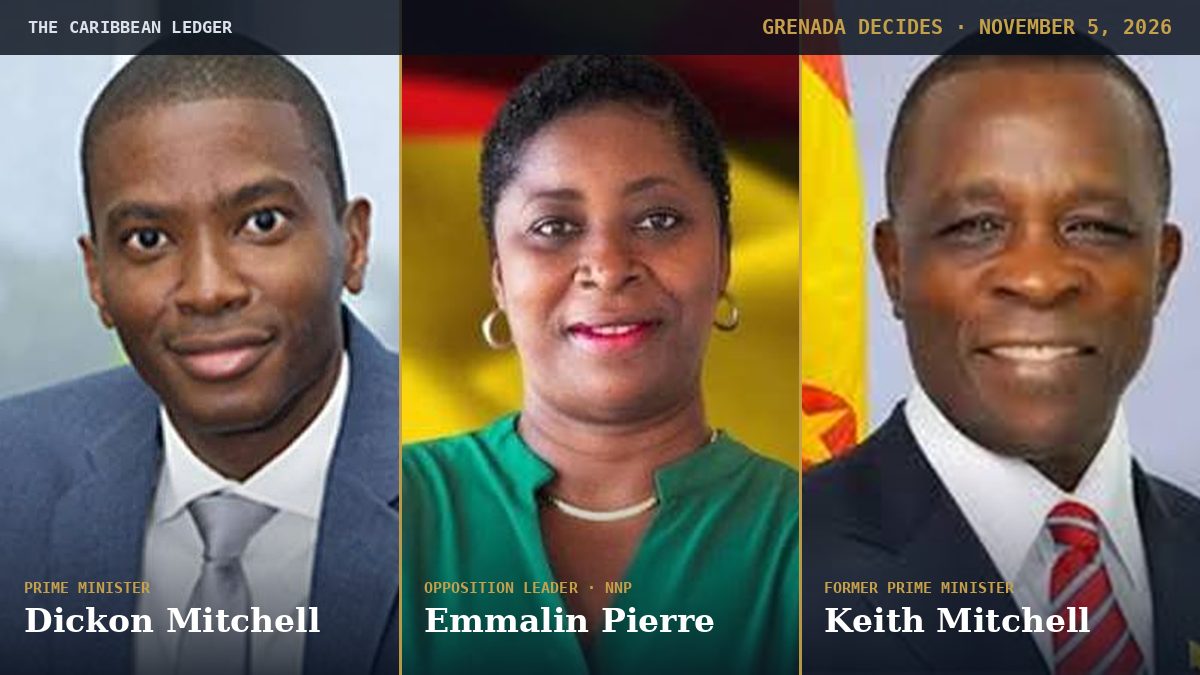
There is a particular confidence in a prime minister who dissolves parliament with a full year still on the clock. Dickon Mitchell has it. On Sunday, October 4, at a rally in St. Mark, the leader of the National Democratic Congress told supporters that Grenadians would go to the polls on Thursday, November 5, almost a year ahead of the constitutional deadline that would otherwise have fallen in October 2027. Two days earlier, on Friday, October 2, Governor General Dame Cecile La Grenade had already dissolved the House on his instruction, as The New Today reported on October 3. Nomination Day is set for October 15, according to the official Government Gazette carried by the Jamaica Gleaner on October 6. That leaves a campaign of barely four weeks for fifteen seats.
A snap call is a reading of the weather. Mitchell has looked at the sky over Grenada, Carriacou and Petite Martinique and decided conditions will not get better than they are now. He is not hiding the ambition behind it. He told the St. Mark crowd that he wants to improve on the 9 to 6 majority the NDC won in 2022, and that his supporters are telling him they want “a clean sweep of all 15 seats,” the Gleaner reported. His organizing message was blunter still: “boots, boots, boots on the ground.” A governing party that believed it was vulnerable would not be talking about a clean sweep. It would be talking about holding on.
Why now, and why early
The logic of an early vote is rarely about a single event. It is about denying the other side time. An opposition that is still assembling itself is an opposition that benefits from every extra month on the calendar, and Mitchell has chosen to take those months away. The timing also lets the NDC fight on its own terms, before the next budget cycle forces hard choices into the open and before the external pressures bearing down on every small Caribbean economy, a crude price back above US$100 a barrel and a cost of living that has not come down to match, have time to curdle into resentment at the party in office.
Grenada runs its money on the Eastern Caribbean dollar, which the Eastern Caribbean Central Bank has held at EC$2.70 to the United States dollar for more than four decades. That peg is a source of stability and a constraint at once. It means the government cannot print or devalue its way out of a squeeze, and it means imported inflation, in fuel, food and freight, lands more or less directly on household budgets. A prime minister who can see those bills climbing has every incentive to seek a mandate before the arithmetic turns difficult rather than after.
The opposition reinvents itself in real time
The most consequential fact of this election is not on the government benches. It is that the New National Party, the force that dominated Grenadian politics for a generation, is going into a general election without Keith Mitchell at its head for the first time since the 1980s. Keith Mitchell, no relation to the prime minister, has been a member of parliament since 1984 and was the country’s longest-serving head of government. He is not seeking re-election. The party he led for decades is now in the hands of Emmalin Pierre, who becomes the first woman to carry the NNP into a general election, as The New Today and the Gleaner have both reported.
This is a larger event than a change of personnel. The NNP’s identity was fused with one man for so long that the question of whether it can win without him is genuinely open. Pierre inherits a disciplined machine and a brand that still commands loyalty in its strongholds, but she also inherits the task of persuading voters that the party is more than its former leader. She has moved quickly. As of October 3, the NNP had already named all fifteen of its candidates, The New Today reported, which is the sort of readiness that suggests the opposition saw this coming and did not intend to be caught assembling a slate while the governing party campaigned.
The NDC, for its part, was still finalizing its own lineup in the opening days of the campaign. The party named Niecal Joseph for St. Andrew North-east and was completing the rest of its slate, according to The New Today. The seats the NDC says it is targeting tell you where it believes the opposition is soft: St. George North-west, St. Mark and St. Andrew South-east. That last one is Pierre’s own seat. A governing party that lists the opposition leader’s constituency among its targets is sending a message that it intends to contest everything, including the ground the other side cannot afford to lose.
A third party, and the shape of the vote
Into this two-horse tradition steps a third runner. The Democratic People’s Movement, launched in November 2025 by the former foreign minister Peter David, is contesting its first general election. Third parties in Grenada have a long history of splitting votes without winning seats, and under a first-past-the-post system in fifteen single-member constituencies, a new party rarely converts national sympathy into parliamentary arithmetic. But it does not have to win a seat to matter. In a close three-cornered race, where a few hundred votes decide a constituency, the DPM’s presence can change which of the two main parties takes a marginal seat, and in a fifteen-seat house, a handful of marginals is the whole game.
David is not a newcomer to Grenadian politics, and a party built around an experienced figure can draw support from both established camps rather than only one. That is precisely what makes the DPM hard to model in the absence of any published polling, and there is none. Nobody contesting this election can point to a credible survey of where opinion sits. The parties are campaigning, in effect, on instinct and on the evidence of their own rallies, which is one reason the governing party is so insistent on numbers, the boots on the ground, as its measure of momentum.
The question Brussels has put on the ballot
Hanging over whoever wins is a decision made far from the Caribbean. Grenada is one of five Eastern Caribbean states, with Antigua and Barbuda, Dominica, St. Kitts and Nevis, and St. Lucia, whose citizenship-by-investment programs have drawn a deadline from the European Union. Brussels has signaled that unless these programs are wound down or fundamentally reformed, the countries risk losing the visa-free access to the Schengen area that their passports currently carry, with a final cutoff pointed at June 1, 2028, as reporting collected on October 2 set out. The five governments have been coordinating a response and are expected to press their case in Brussels.
For Grenada, this is not an abstraction. Citizenship receipts are a meaningful line in the public finances of every one of the five, money that pays for roads, for budget support, for the cushions a small economy keeps against a bad hurricane year. Grenada itself ordered an independent review of its program earlier this year, a sign that the government understands the model is under scrutiny and wants to be seen cleaning it up rather than defending it unchanged. Whoever forms the next government will have to negotiate the program’s future with Brussels on a clock that is already running, and will have to do it while replacing whatever revenue a wound-down program no longer brings in. That is a structural problem, and it does not care which party wins on November 5.
What is actually at stake
It is tempting to read a snap election as pure tactics, a governing party pressing an advantage. That reading is not wrong, but it is incomplete. The more interesting contest here is about the next decade rather than the next term. On one side is a government asking voters to let it finish what it started, with a leader confident enough to seek a bigger majority than he already holds. On the other is an opposition attempting the hardest thing in politics, which is to remain itself while becoming something new, under a leader who has to prove the party is not just the memory of the man who built it.
And underneath both is the quieter question of the Grenadian economic model itself. An economy pegged to the United States dollar, exposed to an oil price it cannot control, and partly funded by a passport program a major trading bloc wants closed, is an economy that will demand difficult decisions from whoever holds office next. The campaign that begins in earnest after Nomination Day on October 15 will be fought on the familiar ground of roads, jobs and the cost of living. The mandate it produces will be spent on something harder.
Mitchell has bet that the weather will not improve and that his opponents will not be ready. He may well be right on both counts. But a clean sweep is a high bar, and Grenadian voters have a long record of declining to give any leader everything he asks for. On November 5 they will decide not only who governs, but whether the country’s dominant opposition can survive the loss of the only leader most voters have ever known it to have. That is a bigger question than fifteen seats, and it is the one worth watching.
Read more at The Caribbean Ledger ›