Grenada's final days before the vote: three parties, one debate, and the cost of living
A snap election called a year early has become a three-way contest over affordability, with a leaders' debate behind them, Commonwealth observers in place, and special voters casting ballots on Monday ahead of Thursday's poll.
ST. GEORGE'S. The campaign that will decide who governs Grenada for the next five years ends this week the way it began, with the price of a shopping basket at its center. Grenadians go to the polls on Thursday, November 5, in a general election called almost a year ahead of its constitutional deadline, and the closing days have made clear that this is not the two-party contest the island is used to.
Three parties are on the field, a televised leaders' debate has come and gone, Commonwealth observers have arrived, and police and other special voters were due to cast their ballots on Monday, November 2, three days before the rest of the electorate. What began in early October as an early call by an incumbent confident of a second term has tightened into a referendum on the cost of living, and on which of three men and women can credibly promise to bring it down.
Prime Minister Dickon Mitchell, an attorney who led the National Democratic Congress to power in 2022, advised the Governor-General to dissolve Parliament on October 2 and set the vote for November 5, according to reporting by the local reporting and the Rio Times. The NDC won nine of the island's fifteen single-member seats in June 2022, ending nearly a decade of uninterrupted rule by the New National Party. Mitchell is asking voters to let him finish what he started. In an interview reported by the Rio Times, he rejected the idea that the result could be close enough to hang the Parliament.
"While anything is possible, I don't think we will have a hung parliament at all," he said. Eight of the fifteen seats form a government.
A crowded ballot
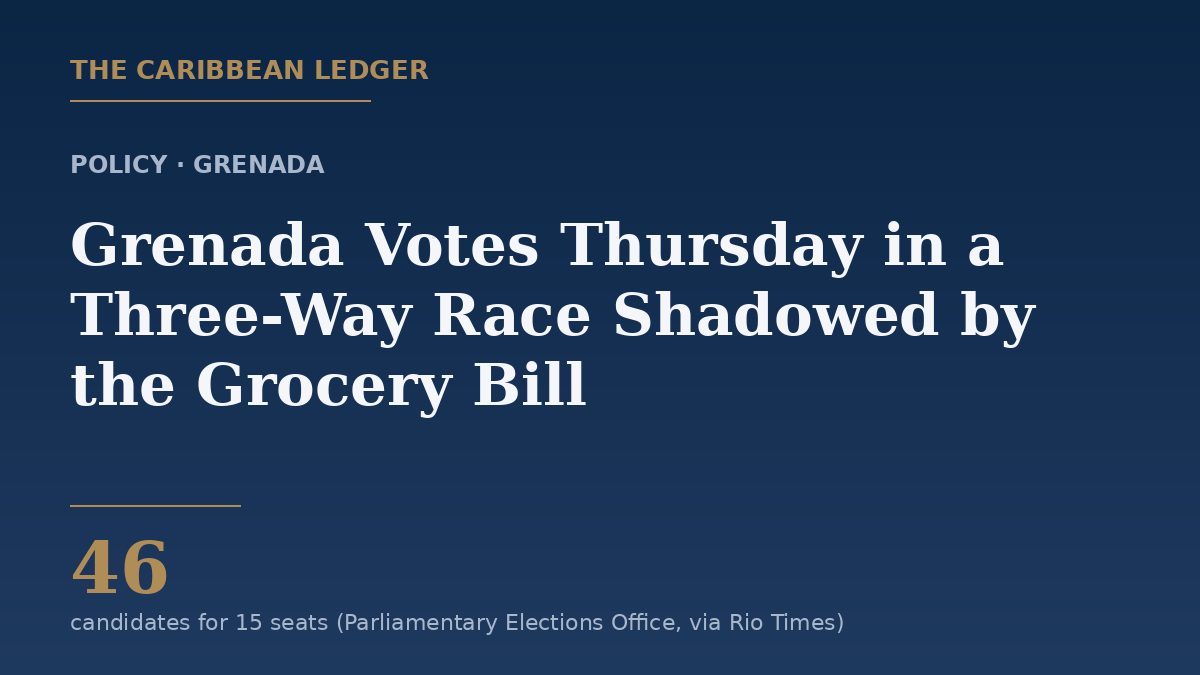
What makes this election different from the ones before it is the arithmetic on the ballot paper. Forty-six candidates were nominated on October 15 to contest the fifteen constituencies, the Rio Times reported, citing the Parliamentary Elections Office. The NDC and the NNP are each fielding a full slate of fifteen. The third force is the Democratic People's Movement, launched in November 2025 by Peter David, a former foreign affairs minister with deep roots in Grenadian politics, which is contesting a smaller number of seats.
For an electorate accustomed to choosing between two parties that have traded power since the 1990s, a serious third option changes the calculus in marginal seats, where a few hundred votes can decide a constituency and, with it, the balance of the House.
Peter David's entry is the variable that makes the outcome hard to read. A seasoned figure who served as foreign affairs minister and has moved across the Grenadian political spectrum over a long career, David brings name recognition and organization that a brand-new party would ordinarily lack. In a system of fifteen small single-member constituencies, a third party does not need to win many seats to change the result. It needs only to draw enough support in a handful of marginals to deny either of the larger parties the eight seats required to govern.
That is the scenario Mitchell was dismissing when he said he did not expect a hung parliament, and it is the one the NNP is guarding against when it tells its supporters to keep their focus on the NDC rather than the DPM.
The New National Party enters the race under new leadership. Emmalin Pierre, the Opposition Leader, is the first woman to take the NNP into a general election. She succeeded Keith Mitchell, the party's dominant figure for a generation, who stepped down as leader in 2024. The NNP's history is a reminder of how quickly Grenadian politics can swing.
The party won all fifteen seats in 1999, lost power, swept all fifteen again in 2013 and 2018, then fell to the NDC in 2022. Pierre has run what the party calls a "Better Grenada" campaign and, according to the Rio Times, has urged her supporters to concentrate on turning the NDC out rather than on the third party.
What the parties are promising
The specific promises on offer are, for the most part, pocketbook promises. The NNP has pledged to cut the corporate income tax rate from 28% to 25%, to provide free transport to students who need it, and to expand night and weekend bus services, the Rio Times reported. The costing of those measures, and how they square with Grenada's fiscal rules, has been a point of contention on the platforms. The NDC is running on its record: three years of management that the party argues steadied the public finances and kept the island on a growth path, and a case that continuity, not a change of government, is what will carry Grenada through a period of higher imported prices.
Cost of living was the organizing theme of the one debate the leaders held. On the night of Wednesday, October 28, the three party leaders met at the Grenada Trade Centre in St. George's for a two-hour event organized by the Media Workers Association of Grenada, the Grenada Broadcasting Network, The Bubb Report, and the Grenada Conference of Churches, according to the Rio Times. Organizers set aside ninety minutes for structured debate on the issues voters had identified, with the price of food and basic goods at the top of the list. In a small electorate where candidates are known personally to many of the people they are asking to govern, the debate was less about introducing the leaders than about forcing them to defend their numbers in front of one another.
A vote within a vote
The mechanics of the vote are already in motion. Police officers and other special categories of voters were scheduled to cast their ballots on Monday, November 2, a standard practice that lets those on duty on election day vote early, the Rio Times reported. The general poll on Thursday runs from 6 a.m. to 5 p.m. in Atlantic Standard Time, which is 5 a.m. to 4 p.m. in Eastern time. Parliament was dissolved and voter registration closed on October 2.
The Electoral Office has not announced a set time for declaring official results, though in a country of Grenada's size, with fifteen compact constituencies, a clear picture usually emerges within hours of the close of polls.
The integrity of the process has itself become a live issue. A claim before the High Court concerning the electoral process remains pending, with the Attorney General's office saying the matter is being handled, according to the Rio Times. And the campaign's closing days brought the arrival of outside eyes. A Commonwealth observer mission was reported on October 31, and earlier coverage indicated that the Organization of American States planned to field observers for the vote as well.
International observation is routine for Caribbean elections, but its presence underlines how much weight both the region and the parties are placing on a result that all sides want to be seen as clean.
Reading the polls with caution
There is very little hard polling to go on, and what exists should be read with care. The only voting-intention figure in circulation comes from an Only Polls online survey conducted October 5 to 14, which found that of 904 responses, 570, or 63.1%, backed the NDC and 334, or 36.9%, backed the NNP, the Rio Times reported. That survey excluded the DPM entirely, used a self-selected online sample, and published no margin of error, which makes it a poor guide to what will actually happen on Thursday. Online panels skew toward the engaged and the connected, and in a three-way race a survey that leaves out the third party tells you little about how its presence will redistribute votes in the seats that matter.
The honest position, with three days to go, is that the outcome is not settled.
What is settled is the frame. This is an election about affordability in a small open economy that imports most of what it eats and much of what it uses, and that has spent the past two years absorbing higher prices set far from St. George's. The party that convinces Grenadians it has the more believable answer to the grocery bill, not the louder one, is the party likeliest to form the next government. The incumbent is betting that voters reward steadiness.
The main opposition is betting that they are tired enough of higher prices to change the management. And a third party is betting that, in at least a handful of constituencies, there is now room for a different choice altogether.
Why the region is watching
The economic frame of the campaign is set by the shape of the Grenadian economy itself. Like its neighbors, Grenada is a small, open, import-dependent economy whose growth rests on tourism, construction, agriculture, and a citizenship-by-investment program, and whose households feel the price of imported food and fuel directly because so little of it is produced at home. That structure is why a campaign about affordability is, at bottom, a campaign about how a small state manages shocks it does not create. Neither a corporate tax cut nor a fuel subsidy changes the fundamental exposure.
What they change is who bears the cost in the meantime, and that distributional question is what the parties have spent the campaign arguing over.
Grenada is one of the smaller members of the Organisation of Eastern Caribbean States, a currency union of roughly 110,000 people that shares the Eastern Caribbean dollar and a common central bank. Its politics rarely make regional headlines, but the stakes on Thursday are larger than the island. A government's room to cushion households from imported inflation is constrained by the same fiscal rules that bind its OECS neighbors, which means the debate playing out in St. George's over how far a state can go to lower the cost of living is a debate every Eastern Caribbean capital is having in some form. How Grenada answers it, and whether it answers it by re-electing the incumbent or turning to one of two alternatives, will be read closely in Castries, Kingstown, and Roseau.
For now, the candidates have made their arguments, the debate has been held, the observers are in place, and the first ballots are being cast. By the weekend, Grenada will have decided whether the grocery bill was a grievance the government could answer or one it could not. The rest of the Eastern Caribbean will be taking notes.
Read more at The Caribbean Ledger ›