Dominica's airport, financed by citizenship money, enters arbitration
A 2021 contract valued at US$370 million for Dominica's first international airport is now in arbitration, and the sum allegedly in dispute has not been made public.
How the project began
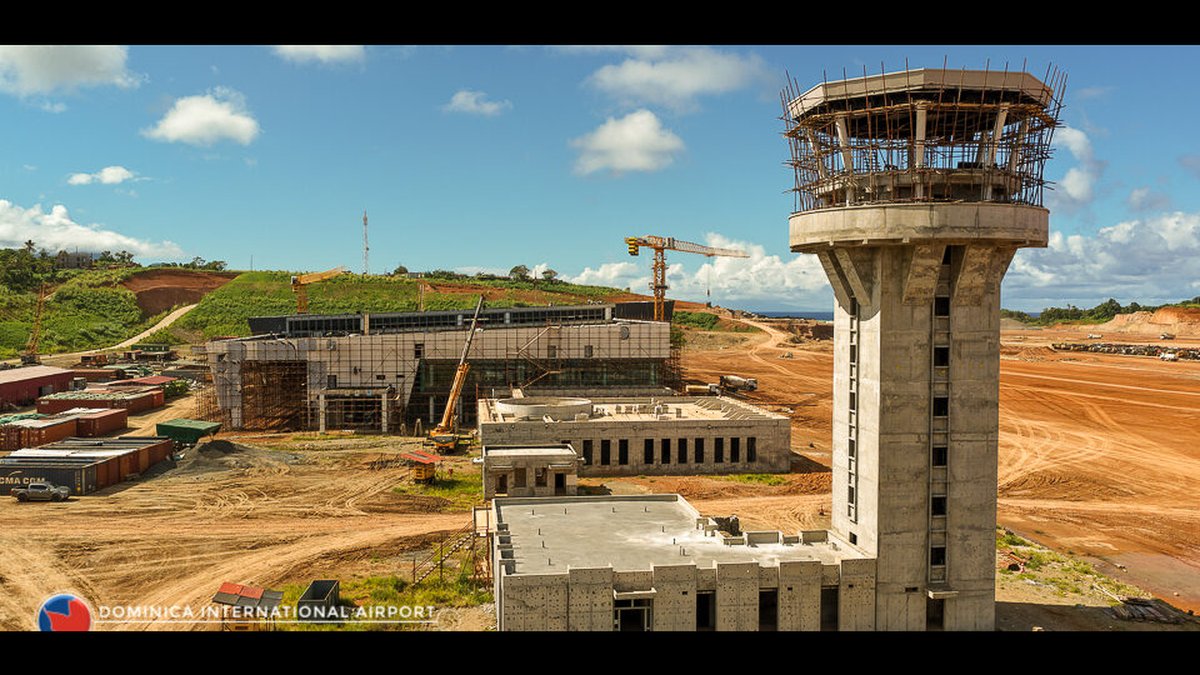
ROSEAU. In June 2021, the government of Dominica signed a contract with Montreal Management Consultants Est. to build the island's first international airport. The company's chief executive, Dr. Anthony Haiden, described it as the largest contracted project in Dominica's history and in the Eastern Caribbean. At the signing, the contract was valued at US$370 million, and the government said the airport would be funded in its entirety by the Citizenship by Investment Program.
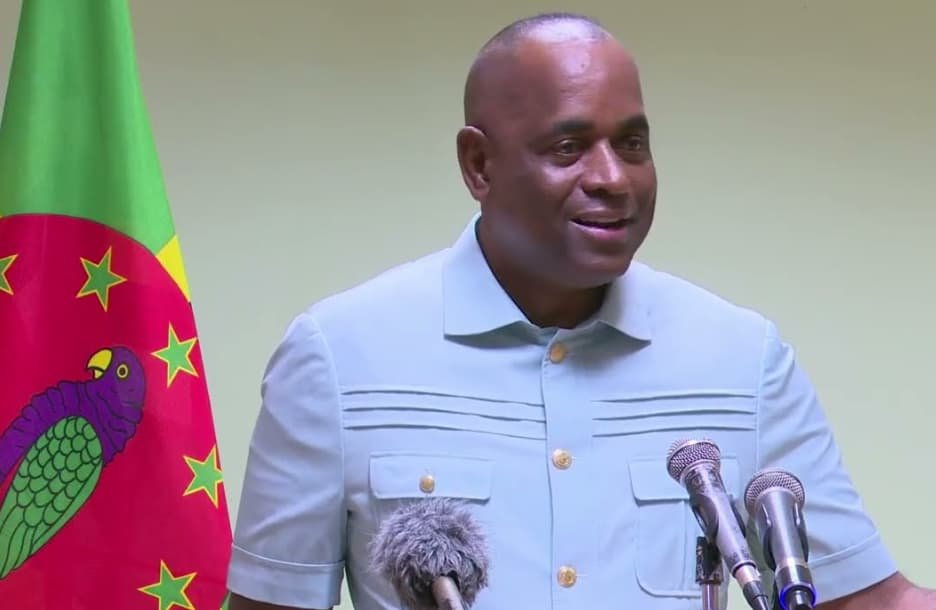
Prime Minister Roosevelt Skerrit promised completion within five years and said that planes would land directly from Europe and the United States in 2025. Reporting at the time noted that those two timelines did not match. The project was expected to create 3,000 short-term jobs, according to the company.
The project met public resistance from the start. Opposition leader Lennox Linton called the decision on the airport's location irresponsible and questioned whether the benefits to certain property owners justified destroying the village of Wesley, where the airport would be built. Opposition factions opposed funding the airport through CBI and held small demonstrations across the island.
The government defended the program. Skerrit described CBI as a prudent policy, and Member of Parliament Melissa Poponne-Skerrit said the project had broad public support. Minister of Health Dr. Irving McIntyre urged citizens to defend the program, citing its role in funding housing.
The contract value has grown
By March 2026, reporting valued the airport at more than US$450 million. Caribbean News Global also reported a construction contract with China Railway No. 5 Engineering Group worth XCD 1.4 billion, which is roughly US$515 million at the fixed rate of about EC$2.70 to US$1. The airport is designed to handle up to 500,000 passengers a year.
The reporting does not explain how the figure moved from US$370 million in 2021 to more than US$450 million. The Ledger has not located a public document that does. The developer's contract and the construction contract are separate agreements, and the reporting does not show how the two relate in payments.
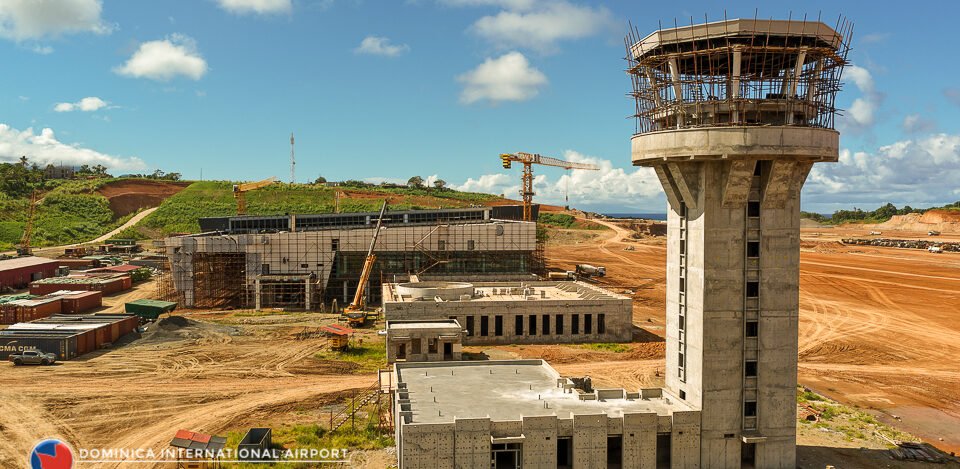
The completion date has also moved. Earlier reports pointed to 2027. In his independence address on November 3, 2026, Skerrit said the airport is on track to open in the first quarter of 2028, and that more than 400 Dominican workers are employed on site.
Construction has continued during the dispute. Reporting from the site says earthmovers continue to work, and the government has said all operational procedures continue to adhere to established guidelines.
The dispute
In late March 2026, MMC Development Ltd, which other reporting names as Montreal Management Consultants Development Ltd, began formal arbitration against the government. The company's project director, Cal Murad, described arbitration as a last resort. He said the company had committed substantial funds, personnel and opportunity costs, and that it expected reciprocal adherence from the government.
Murad called a suspension of construction the gravest possible outcome. The dispute, as the company describes it, centers on what it calls unfulfilled project conditions that both parties agreed to. Caribbean News Global has reported that the impasse may involve breach of contract and non-payment linked to financing agreements.
In May 2026, the company said that no legal proceedings or arbitrations were in effect against the government. In June, Caribbean News Global reported, citing unnamed sources, that the project was back in court facing renewed arbitration and injunctions, and that legal documents had been filed in an appropriate jurisdiction. The court and the claimant in those filings have not been named in the reporting.
Reporting says formal arbitration hearings began on November 5, 2026. The government has not published a statement addressing the claim itself, and the Ledger has not found one in the public record.
How the unpaid balance grew
The public record does not explain how the amount allegedly owed reached its current level, or who is owed what. Reporting refers to financing agreements, to amendments whose terms have not been described publicly, and to unfulfilled conditions. No document setting out payments due, payments made and the outstanding balance has been published.
That gap is the central question of this story. The Ledger will ask the government and the developer to answer it, and will report what they say.
What the amount means for the airport
Without a settled figure, the cost of finishing the airport cannot be estimated from public records. The project's own valuation is above US$450 million, and the government has not said how the remaining work will be financed or how much of the developer's claim it expects to pay.
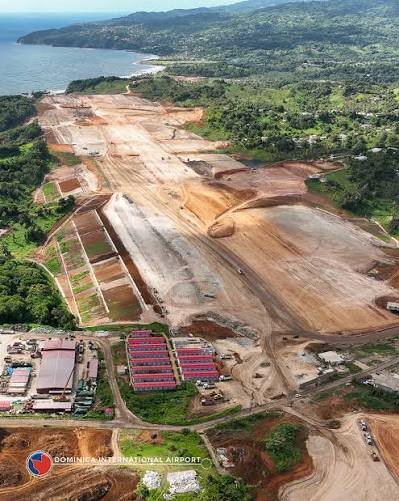
A suspension would open a second gap. The developer has warned that a halt would be the gravest possible outcome, and the reporting shows the site is still active. Whether the 2028 target holds will depend on how the dispute is resolved and on what the financing plan looks like once it is.
What the economy is carrying
The International Monetary Fund's 2026 assessment of Dominica places the airport in a wider frame. Real GDP growth accelerated to 4.5 percent in 2025, up from 3.5 percent in 2024, and the fund projects growth to average around 3 percent across 2026 and 2027. Inflation averaged 2.3 percent.
The fund's view of public finances is more cautious. It says public debt is well above the 60 percent of GDP regional benchmark, that Dominica is highly reliant on CBI flows to fund strategic development projects, and that those flows have supported growth while worsening external imbalances because of imported inputs. It also cites uncertainty around CBI inflows as a risk, and recommends reducing reliance on CBI revenues.
The sources reviewed for this account do not give the share of government revenue that comes from CBI in a given year, or the share of the capital program that depends on it. Those figures would show whether the airport is an outlier or a typical case, and they are being sought.
Europe's deadline
The European Commission has reportedly asked five Caribbean countries that run CBI programs, Antigua and Barbuda, Dominica, Grenada, Saint Kitts and Nevis, and Saint Lucia, to phase out those programs by June 1, 2028. Reports say the Commission warned that visa-free access to the Schengen area could otherwise be suspended under the EU's visa suspension mechanism, which was widened by a regulation that entered into force on December 30, 2025.

According to the reports, the June 2028 date is a negotiating position rather than an agreed closure date. The correspondence does not cancel citizenship or passports already granted, and none of the five programs has closed. Heads of government of the five countries met in Roseau on July 10, 2026, and agreed to respond collectively and seek high-level talks with the EU.
The Ledger has not seen the Commission's correspondence. The account here relies on secondary reporting, and the Ledger is seeking the documents themselves.
How much rests on CBI
The 2021 reporting described the airport as funded entirely by the program. The developer's other work is also tied to CBI. The company said it had built more than 200 social housing units for the government over several years, and the relationship spans housing, health care and other infrastructure, according to the company's chief executive.
Ongoing government housing projects are under way in seven locations, including Canefield, Woodford Hill, Vieille Case, Penville, Pointe Michel, Paix Bouche and Trafalgar. The government reported in March 2026 that the Marigot hospital and the Grammar and Mahaut schools had been completed, but the reporting does not say how those were financed.
No complete list of uncompleted CBI-linked projects has been published, and the Ledger has not yet compiled one.
Has the model peaked?
The IMF's language is a warning, not a finding of default. Public debt is above the regional benchmark, the program is described as a major source of development finance, and the fund says the revenue is uncertain. The European Commission has also put a date on the program's future. Whether the program's boom has passed cannot be answered from the public record.
The airport dispute can be read as an early test of that question. A project financed by one revenue stream and contested by its developer raises the issue of how much of the state's commitments depend on it. Whether it is a leading indicator of wider economic uncertainty is a question the available figures can frame but cannot settle.
Questions still open
The Ledger will put the central questions to the government and the developer: the sum allegedly in arbitration, the cause of the unpaid balance, the financing plan for the remaining construction, and the cost of settling the claim. The government's 2026 to 2027 budget says that the government cannot do it alone and calls for partnering to build a platform for sustainable growth. Reviewed sources do not show whether the government has retained outside advisers to review the project or its CBI finances, and the Ledger will ask.
This is a developing story, and the Ledger will continue to investigate the matter. The Ledger will publish the arbitration filings, the financing plan and the Commission's correspondence when they are obtained, and will update this account as the hearings proceed. The Ledger will reach out to both Montreal Management Consultants Est. (MMCE) and the Government of Dominica for comment, and will report their responses.
The airport will either open in 2028 or it will not, and the answer will say something about how a small state finances a large project when the money depends on a program that outside governments are asking it to end.
Read more at The Caribbean Ledger ›