One year after Melissa, Jamaica is rebuilding. The bill is still coming due.
The strongest hurricane ever recorded to strike Jamaica made landfall on October 28, 2025. Twelve months on, the rebuild is funded, but higher interest rates and a damage bill past 12 billion US dollars show how a physical shock becomes a fiscal one.
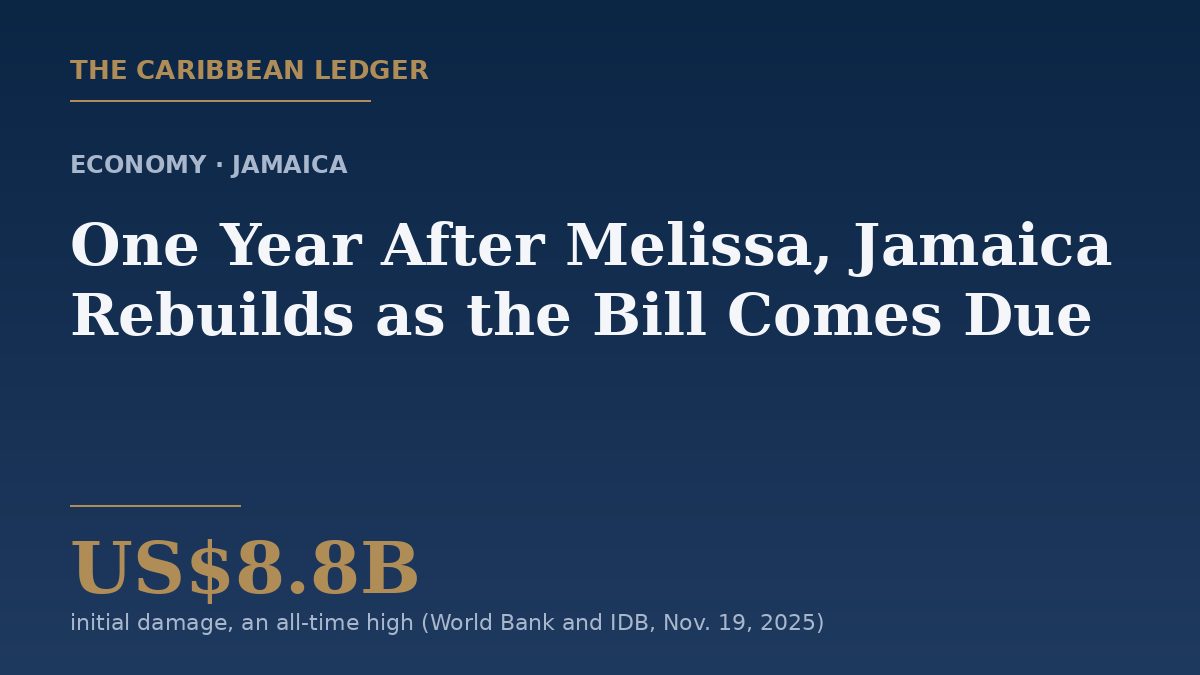
KINGSTON. One year ago this week, on October 28, 2025, Hurricane Melissa came ashore near New Hope in Westmoreland parish as a Category 5 storm, with sustained winds of about 185 miles per hour and a central pressure of 897 millibars. By the measures that matter to meteorologists, it was the strongest hurricane ever recorded to strike Jamaica, surpassing Gilbert of 1988, and it tied Hurricane Allen of 1980 as the most powerful Atlantic hurricane by maximum sustained winds, according to data compiled on the storm. The World Meteorological Organization retired the name Melissa in March 2026.
One year on, the question for Jamaica is no longer how bad it was.
It is how far the rebuilding has come, and how it is being paid for.
The human toll was severe. Melissa killed 45 people in Jamaica and 95 across the region, including 43 in Haiti, 4 in the Dominican Republic, and 1 in Cuba. The financial toll set records of its own. In a joint assessment released on November 19, 2025, the World Bank and the Inter-American Development Bank put the damage to Jamaica at an all-time high of about 8.8 billion US dollars, a figure later revised upward as losses and additional recovery costs were tallied past 12 billion US dollars in subsequent reviews reported by Jamaican outlets.
For an economy of Jamaica's size, that is not a line item. It is a multiple of a normal year's capital budget, arriving all at once.
Paying for the rebuild
The money has come from several directions at once. Within weeks of the storm, Jamaica had assembled what the local reporting described in December 2025 as a trillion-dollar aid package, in Jamaican dollar terms, drawing on insurance, catastrophe instruments, multilateral lending, and bilateral support to begin the rebuild. International relief organizations have continued to fill gaps. Direct Relief reported that, as of October 28, 2026, it had delivered more than 41 million US dollars in medicines and medical supplies and more than 1.3 million US dollars in grants to 17 organizations across the affected countries, including 856,822 US dollars to 11 organizations in Jamaica, and had restored resilient power to ten Jamaican medical facilities, with two more in progress.
The structure of that financing matters as much as its size. A country that rebuilds mainly by borrowing trades a physical shock for a fiscal one, adding debt service to budgets that were already tight. A country that can draw on insurance payouts and pre-arranged catastrophe financing absorbs the blow with less lasting damage to its balance sheet. Jamaica spent much of the past decade building exactly that kind of buffer, bringing its debt down and establishing fiscal credibility, and Melissa has become the real-world test of whether those buffers were deep enough.
One year in, the verdict is mixed but not grim: the rebuild is funded, but the bill is still being paid.
The macro aftershock
The storm's fingerprints are on the macro numbers. The Bank of Jamaica, which had been easing, reversed course as reconstruction demand and supply disruptions pushed prices up. On September 29, 2026, the central bank raised its policy rate to 6%, a move the local reporting reported was intended to contain inflation that had drifted above target. Higher rates are the price of defending the inflation framework through a reconstruction boom, and they fall on borrowers and the government alike.
The corporate picture tells a parallel story of recovery with a lag. GraceKennedy, one of the island's largest conglomerates, reported in August 2026 that it had, in the local reporting's phrase, turned the corner from Melissa, its earnings recovering after the hit the storm delivered to its home market.
None of this is the same as being whole. Housing, agriculture, and rural infrastructure recover on a slower clock than corporate earnings or a central-bank rate, and the parishes that took Melissa's eyewall are still rebuilding homes and farms a year later. Officials have framed the task as more than restoration. In comments reported by Caribbean outlets, the government has spoken of building forward, hardening the island against the next storm rather than simply replacing what the last one destroyed.
That is the right ambition. It is also more expensive than rebuilding to the old standard, which brings the conversation back to money, and to the uncomfortable truth that resilience, like recovery, has to be financed.
A regional lesson, dated and paid for
For the rest of the Caribbean, Jamaica's year is a case study with real figures attached. Every island in the hurricane belt lives one landfall away from a comparable shock, and most carry far thinner buffers than Jamaica had going into Melissa. The retirement of the name does not retire the risk. What Jamaica's experience shows is that the countries that fare best are the ones that arranged their financing before the storm, not after it, and that the cost of resilience is paid in budgets and interest rates long after the winds have gone.
A year after the strongest hurricane on record to hit the island, Jamaica is standing, rebuilding, and counting the cost. The counting is not finished.
Read more at The Caribbean Ledger ›