A year after Melissa, the quiet market that decides what a Caribbean disaster costs
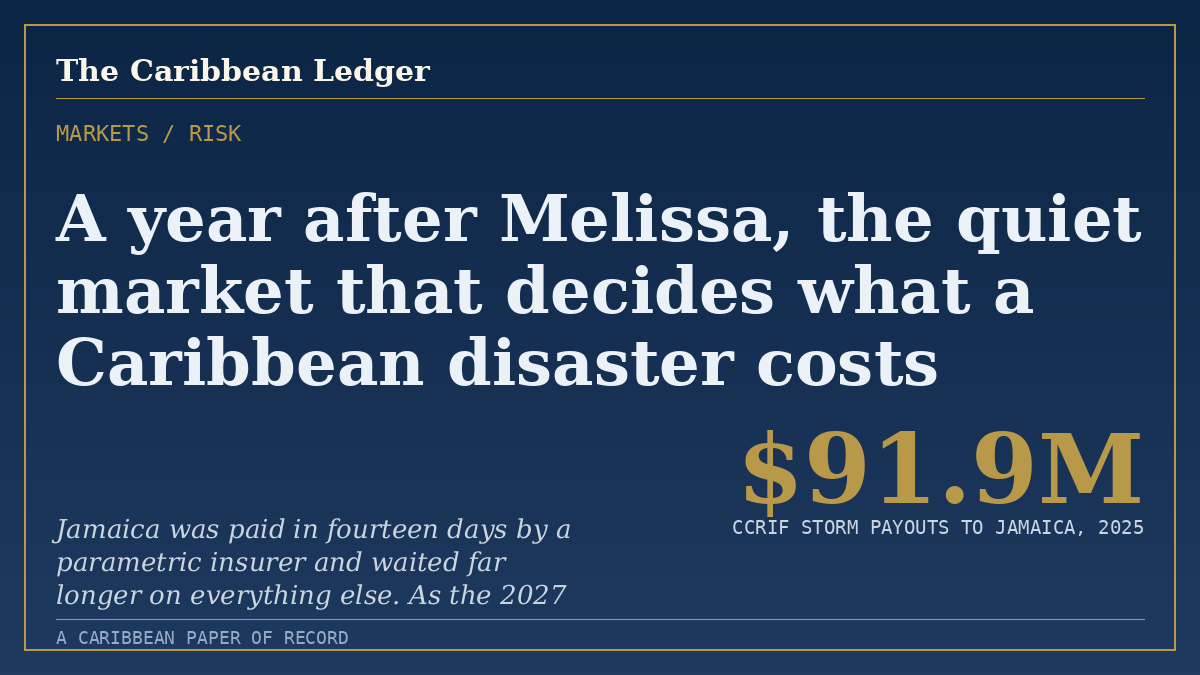
Jamaica was paid in fourteen days by a parametric insurer and waited far longer on everything else. As the 2027 season approaches, the region's risk-transfer math is the number every finance ministry should be reading.
KINGSTON. When Hurricane Melissa tore across Jamaica in late October 2025, the first money to move was not aid and it was not a bond. It was a payout triggered not by an assessor walking through the wreckage but by a formula.
The Caribbean Catastrophe Risk Insurance Facility, the regional risk pool known as CCRIF, announced a record parametric payout to Jamaica, an initial 70.8 million US dollars, reported by Insurance Journal and Reinsurance News on November 4, 2025, followed by a second payout of 21.1 million US dollars, about 3.4 billion Jamaican dollars, for roughly 91.9 million US dollars in total according to CCRIF. The money reached the government within about two weeks.
A year on, that speed is worth studying, because it is the exception that reveals the rule. Parametric insurance pays on a measured trigger, wind speed and track, or rainfall and ground shaking, rather than on a tally of actual losses. That is its genius and its limit.
The genius is liquidity when a treasury needs it most, in the first fortnight, before the diaspora remittances and the donor pledges arrive. The limit is that a formula is a proxy. It is designed to cover a slice of the fiscal shock, not to make a country or a homeowner whole.
The size of the gap became the real subject of the Melissa year. Jamaica secured a package of 6.7 billion US dollars over three years in international support for recovery and reconstruction, the IMF announced on December 1, 2025. Set that figure beside the roughly 91.9 million US dollars of parametric cover and the proportion tells you something uncomfortable: the fast money was a rounding error against the bill.
A 2026 review of the region's post-Melissa insurance data circulated by analysts at Maestro captured the asymmetry in a single line, that Jamaica was paid in fourteen days while many homeowners waited seven months. The state had a hedge. Most of the people living under the roofs did not.
This is what the industry calls the protection gap, the difference between economic losses and insured losses, and in the Caribbean it is among the widest in the world. It is not a moral failing so much as a pricing problem. Property insurance in a hurricane corridor is expensive because the reinsurers who stand behind it must hold capital against a once-in-a-generation loss that, with a warming ocean, is arriving more than once in a generation. After a major event, reinsurance renews dearer, and the cost passes down to every policy on every island, whether or not that island was hit.
The instruments to close the gap exist, and they are financial, not charitable. Catastrophe bonds let a sovereign transfer tail risk to capital markets, paying a coupon to investors who forfeit principal if a defined disaster occurs; the World Bank has arranged them for Caribbean and Pacific states, and the market has deepened as yield-seeking investors look for risk uncorrelated with equities. Contingent credit lines, the kind multilateral lenders pre-arrange so that a government can draw instantly after a shock, sit alongside parametric cover as the liquidity layer. Indemnity insurance, slower but truer to actual loss, remains the layer that protects households, and it is the one the region underbuys.
The lesson of the Melissa year is not that parametric cover failed. It performed exactly as designed, and the fourteen-day payout almost certainly prevented a deeper fiscal crisis. The lesson is that no single layer is enough, and that a Caribbean treasury which treats disaster financing as an afterthought is running an uninsured balance sheet in the most exposed real estate on earth. The right posture is the one a prudent institution takes toward any tail risk, to decide in advance, in daylight, how much of the loss it will retain, how much it will transfer to a pool, how much to the bond market, and how much it will ask its citizens to carry themselves.
There is a further twist that the Melissa year exposed. Even the fast money depends on the quality of the data behind the trigger. A parametric contract only pays what the modeled wind field says the storm delivered, and if the measurement understates the event, the payout does too.
The region's weather stations, its exposure maps and its building registries are thinner than those of the wealthy coasts the models were first built for, and that data gap quietly widens the protection gap. Investing in the measurement, unglamorous as it is, is one of the cheapest ways a Caribbean state can increase what its insurance actually pays when the wind comes.
The 2027 Atlantic season is six months away, and reinsurance is already repricing the Caribbean after a decade of costly years. The number that matters for every island budget is not the headline cost of a policy. It is the expected annual loss against the cover actually held, and the honesty with which a government has decided who pays when, not if, the next storm comes.
That calculation is unglamorous and it is never urgent until it is. It is also, after Melissa, the clearest market signal the region has.
Read more at The Caribbean Ledger ›