Tancoo's $63.4 Billion Budget Bets on $77 Oil and a Return to the Savings-Bond Window
Trinidad and Tobago's 2027 budget lifts its energy-price assumptions, raises the levy on oil and gas profits, and reopens a retail bond to ordinary savers, a package aimed as much at markets as at households.
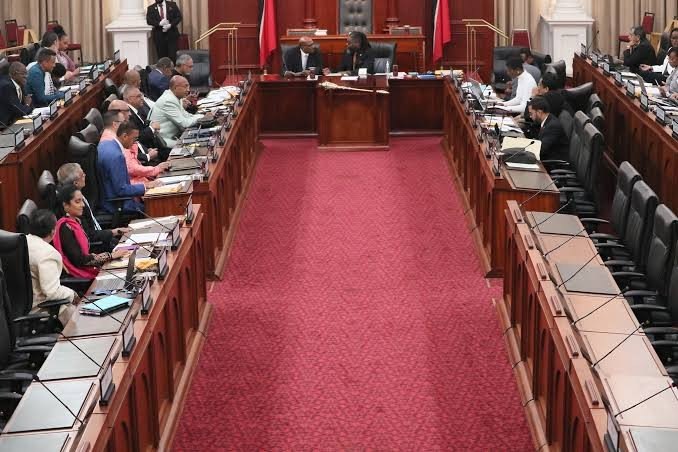
Finance Minister Davendranath Tancoo presented Trinidad and Tobago's fiscal 2027 budget in Parliament on October 12, and the numbers tell the story of a gas economy trying to hold its footing while the price of the thing it sells swings around it. Total expenditure is set at 63.368 billion Trinidad and Tobago dollars, against projected revenue of 59.729 billion, leaving a deficit of 3.639 billion, or 2.1% of output, according to the Trinidad Guardian. That gap sits comfortably inside the government's own 3% benchmark, a point the minister was keen to make.
The budget's foundation is a wager on price. Tancoo raised the oil assumption to 77 US dollars a barrel, from 73.25, and lifted the gas assumption to 5 US dollars per million British thermal units, from 4.25, the Guardian reported. Those revisions matter because they do the heavy lifting on the revenue line. Of the 59.729 billion dollars the government expects to collect, 14.355 billion is projected to come from oil and gas and 45.062 billion from the non-energy economy. In a country where the energy sector has shrunk as a share of output for the better part of a decade, the split is a reminder of how much work the rest of the economy is now being asked to do.
A heavier hand on energy profits
For investors in the sector, the headline measure is the unemployment levy. Tancoo raised it from 5% to 8% of energy companies' taxable profits, a change the Guardian estimated would raise about 155 million dollars. It is a modest sum against a 63 billion dollar budget, but the signal is what markets will weigh. A government leaning harder on energy profits at the same moment it raises its own price assumptions is betting that producers can absorb the levy out of a windfall that higher prices are expected to deliver. If Brent cooperates, the arithmetic holds. If it does not, the levy lands on thinner margins.
The budget also reaches directly into capital markets for households. Tancoo announced new government retail savings bonds, available from denominations as low as 1,000 Trinidad and Tobago dollars, a deliberate effort to widen the base of domestic lenders to the state and to give ordinary savers an instrument with a sovereign backstop. The move echoes a broader regional turn toward retail debt. St. Kitts and Nevis kept its own first retail bond open to small savers earlier this month, and the logic is the same in both capitals. Domestic savings are cheaper and stickier than foreign borrowing, and in a world of multidecade-high global interest rates, every dollar raised at home is a dollar not rolled over at a rising offshore rate.
Measures that touch the consumer
Alongside the market-facing items, the budget carried a slate of measures aimed at households and public health. Senior citizens', public assistance and disability grants will rise by 250 dollars a month from January 1, 2027. The standard rate of value-added tax will extend to non-resident digital services from March 1, 2027, a quiet but consequential broadening of the tax base as more consumption moves online. The excise on domestically produced alcohol will fall by 25%. And in a measure that mirrors moves across the region, the government will ban vaping for those under 21 and apply a 20% customs duty on vaping devices.
For debt managers, the budget's quieter achievement is its restraint. A deficit of 2.1% in a year of volatile energy prices keeps Trinidad and Tobago inside the fiscal rule it set for itself, and it does so without the one-off revenue tricks that unsettle rating agencies. The retail savings bond is part of a deliberate strategy to deepen the domestic market for government paper, and the logic is timely. The International Monetary Fund spent this week in Bangkok warning that global borrowing costs sit at multidecade highs, which makes every dollar Port of Spain raises from its own citizens cheaper than the equivalent raised abroad. The extension of value-added tax to non-resident digital services, effective March 1, 2027, works toward the same end from the revenue side, broadening a base that the migration of spending online had been quietly eroding.
The question the budget cannot answer
What Tancoo cannot legislate is the price of gas on the world market or the pace at which Trinidad and Tobago's maturing fields give up their output. The budget is honest about its dependence on an energy sector in transition, which was the framing the government itself used in the weeks before the presentation. The deficit is contained, the grants are real, and the savings-bond window is a sensible piece of debt management. But the entire structure rests on 77 dollar oil and 5 dollar gas holding through the fiscal year. In a market whipsawed by a war in its eighth month, that is the one line in the budget no finance minister controls.
Read more at The Caribbean Ledger ›