Haiti names an election date while foreign soldiers fight for its streets
Authorities have set a calendar for the first general vote in more than a decade. Whether anyone can campaign, register or count is a separate question, and the answer is being written by gangs and by troops sent from abroad.
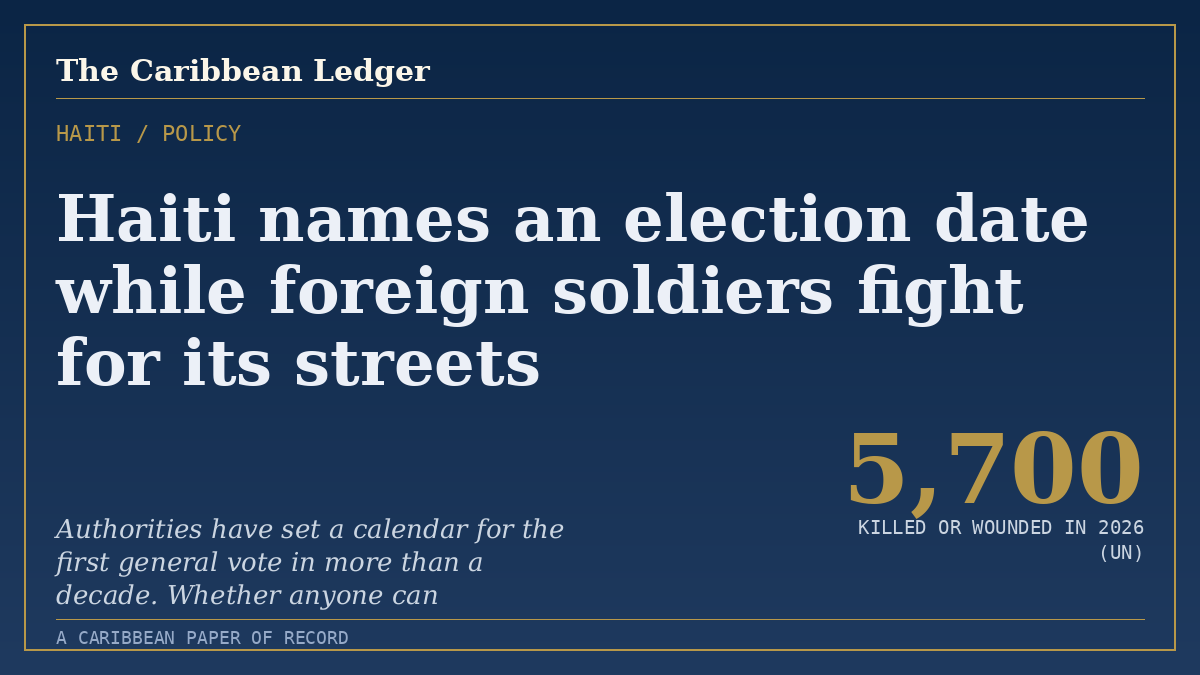
PORT-AU-PRINCE. Haiti has a date again. Authorities announced on October 30, 2026, as reported by Africanews, that the country would hold the first round of long-delayed general elections on July 18, with a runoff on October 4.
It would be the first general election in more than a decade in a country whose presidency has been vacant since Jovenel Moise was assassinated in 2021 and which is governed today by an unelected prime minister. The Provisional Electoral Council, the body charged with running the vote, is expected to publish a final list of presidential and Senate candidates by the middle of January, with voter registration closing on May 20.
A calendar is not the same as an election, and Haiti has set dates before. An earlier target of August 30, 2026, announced at the end of 2025, passed without a vote. The names already circulating as presidential hopefuls are a measure of both the country's continuity and its exhaustion: the former presidents Michel Martelly, Claude Joseph and Jocelerme Privert, the former Chamber of Deputies president Gary Bodeau, and the public prosecutor Jean Ernest Muscadin, among others.
These are not new faces. They are the same contest Haiti has been unable to hold.
The obstacle is not procedural. It is that much of the capital, and the roads that connect it to the rest of the country, are controlled by armed groups. The United Nations has reported that at least 5,700 people were killed or wounded in Haiti's gang crisis this year. An electoral council cannot register voters in neighborhoods its staff cannot safely enter, and candidates cannot campaign where ballots would have to be protected by force.
That is why the sharpest news out of Haiti in recent weeks concerned soldiers, not ballots. El Salvador deployed about 2,000 troops to Haiti after four of its soldiers, working with the United Nations-backed Gang Suppression Force, were kidnapped by armed groups when their armored vehicle came under fire and was struck by explosives. El Salvador has extended its participation in the anti-gang mission through October 2027. The mission itself is backed by several countries and international organizations, a patchwork that has struggled for funding, mandate and manpower since it replaced the earlier Kenyan-led effort.
For the rest of the Caribbean, Haiti is not a distant file. It is a CARICOM member whose collapse exports migration, disease risk and instability across the archipelago, and whose recovery would relieve pressures felt from the Bahamas to the Dominican Republic. The regional body has invested diplomatic capital in brokering and re-brokering Haiti's transitional arrangements, with limited leverage and less thanks.
Neighboring governments have carried the humanitarian weight. The Dominican Republic, which shares the island, has hardened its border and its politics around the crisis, and the Bahamas and others have absorbed the human cost of people fleeing by sea. A failed election would not stay inside Haiti's borders; neither would a successful one, which is why the region's stake in the calendar is more than sympathy.
The uncomfortable truth in the October 30 announcement is the sequencing. An election calendar has been placed ahead of the security that would make an election possible, in the hope that the promise of a vote can itself become a reason for the various armed and political actors to stand down. It is a bet that order can be summoned by a deadline. History in Haiti, and the arithmetic of a capital where gangs outnumber and often outgun the police, counsels caution.
The governing arrangements themselves have been unstable. The transitional presidential council that was meant to steer the country to elections dissolved earlier in 2026 after a troubled tenure, leaving authority with an unelected prime minister and a cabinet whose legitimacy rests on agreement among factions rather than on a ballot. The foreign security presence has been no steadier.
The Gang Suppression Force is the latest iteration of an international effort that began as a Kenyan-led mission and has struggled throughout for funding, troops and a clear mandate, even as the gangs it confronts have consolidated control over the capital and the arteries that feed it. Each reset has bought time without yet buying order.
None of that makes the attempt worthless. A credible path to a legitimate government is the one thing Haiti has lacked, and without it the foreign deployments are holding actions with no exit. The dates on the calendar, July 18 and October 4, are now the clearest marker the country has of where it intends to be.
The months between them and now will be decided less by the electoral council than by whether the Gang Suppression Force, the Salvadoran contingent and Haiti's own police can take back enough ground to let a citizen register, campaign and vote without risking their life to do it. That is the policy story. Everything else is a date.
Read more at The Caribbean Ledger ›