The Dominican Republic's deportation machine runs at a thousand a day
Two years into President Luis Abinader's mass-repatriation order, Dominican migration figures show the removals to Haiti continuing at industrial pace, even as Haiti's own crisis gives the deported almost nothing to return to.
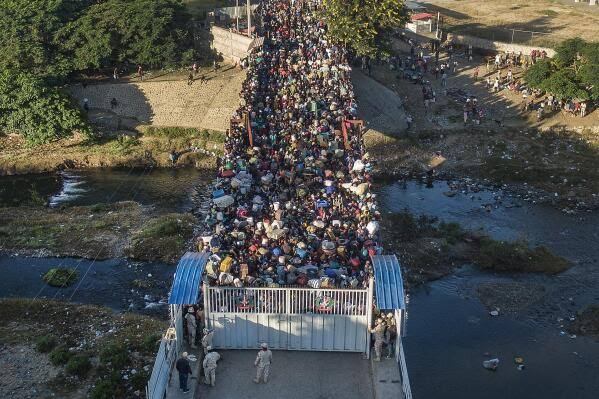
The most consequential migration policy in the Caribbean is not being argued in a parliament. It is being executed, day after day, at the border posts between the Dominican Republic and Haiti, and the numbers the Dominican government itself publishes show no sign of slowing.
Figures from the Dirección General de Migración, the Dominican migration directorate, reported by the regional outlet Rio Times on October 5, show removals continuing at roughly a thousand people a day. On October 3, the directorate said it detained 1,171 foreigners and deported 1,139. On October 4 it sent 302 Haitians across at Dajabón, one of the principal northern crossings. The directorate's tallies for the preceding days ran in the same band, 1,145 detained and 992 deported on September 29, and 1,382 detained against 1,007 deported on October 2. Rio Times, citing the directorate and Dominican press, put total deportations for January through July 2026 at 250,429, an increase of 16.2% over the same period a year earlier.
The campaign traces to an order issued in October 2024 under President Luis Abinader, who instructed the country's security council to repatriate as many as 10,000 undocumented Haitians a week. The directorate, headed by Vice Admiral Luis Rafael Lee Ballester, has become the instrument of that order. He has said publicly that more than 525,000 people have been removed since he took office. Two years on, the policy is no longer an announcement. It is a standing operation with its own daily rhythm and its own published scorecard.

Deported to a country in collapse
What gives the figures their weight is the condition of the country on the receiving end. Haiti remains gripped by gang control of much of its capital, a displacement crisis, and an interim security presence that has not restored order. People removed from the Dominican Republic are not returning to a functioning state that can absorb them. Many are returning to danger, to hunger, or to nowhere in particular, and some have lived in the Dominican Republic for years or were born there to Haitian parents, a group whose legal status has been contested in Dominican courts for more than a decade.
That is why the removals have drawn sustained criticism from humanitarian and human-rights organizations, which have raised concerns about due process at the point of detention, the separation of families, and the deportation of people with claims to Dominican residence or birthright. The Dominican government's position has been consistent and unapologetic: it argues that a small country cannot be asked to carry the cost of its neighbor's collapse, that its immigration laws are its own to enforce, and that the pace of removals reflects the scale of irregular migration it faces.
The economics complicate the moral argument on both sides. Haitian labor has long underpinned Dominican agriculture, construction and parts of the tourism sector, the industries that keep the Dominican economy among the fastest-growing in the region. Removing workers at this rate is a policy that collides with the labor needs of the very economy it is meant to protect, a tension Dominican employers have raised quietly for years. It is worth noting, too, that the figures themselves carry caveats. Rio Times, which compiled the directorate's tallies, cautioned that monthly totals vary from one source to another and are not always independently confirmed, so the daily counts are best read as the government's own account of its activity rather than an audited record.
A regional problem with no regional answer
The deportations are a Dominican policy, but the pressure behind them is regional, and no regional mechanism has formed to share it. Haiti's crisis has pushed its people outward for years, toward the Dominican Republic above all, but also toward the Bahamas, the Turks and Caicos Islands, and beyond. Each receiving territory has responded largely on its own, with its own detentions and its own removals, and without a common framework for protection, burden-sharing or managed return.
For the Dominican Republic, the politics are straightforward. Border control is popular, the order is being carried out visibly, and the published daily figures are themselves a form of message to a domestic audience. For the wider Caribbean, the harder question is what happens if Haiti's situation does not improve, and the removals continue at this pace indefinitely, returning a quarter of a million people or more each year to a country that cannot receive them. A policy measured in detentions and deportations per day is efficient at what it does. Whether it is sustainable, humane, or even effective at reducing the underlying pressure, is a question the numbers alone cannot answer.
The directorate will publish tomorrow's figures, and the day after's, and they will almost certainly look like today's. That regularity is the point, and it is also the warning. A machine that runs this smoothly tends to keep running long after the emergency that started it has been forgotten, which in this case it has not, because next door it has not ended.
Read more at The Caribbean Ledger ›