St. Kitts and Nevis keeps its first retail bond open to ordinary savers, with the window closing October 23
The EC$5 million offer pays 4.50% over two years and can be bought for as little as EC$500. It is a small sum with a larger purpose: widening who gets to lend to the state.
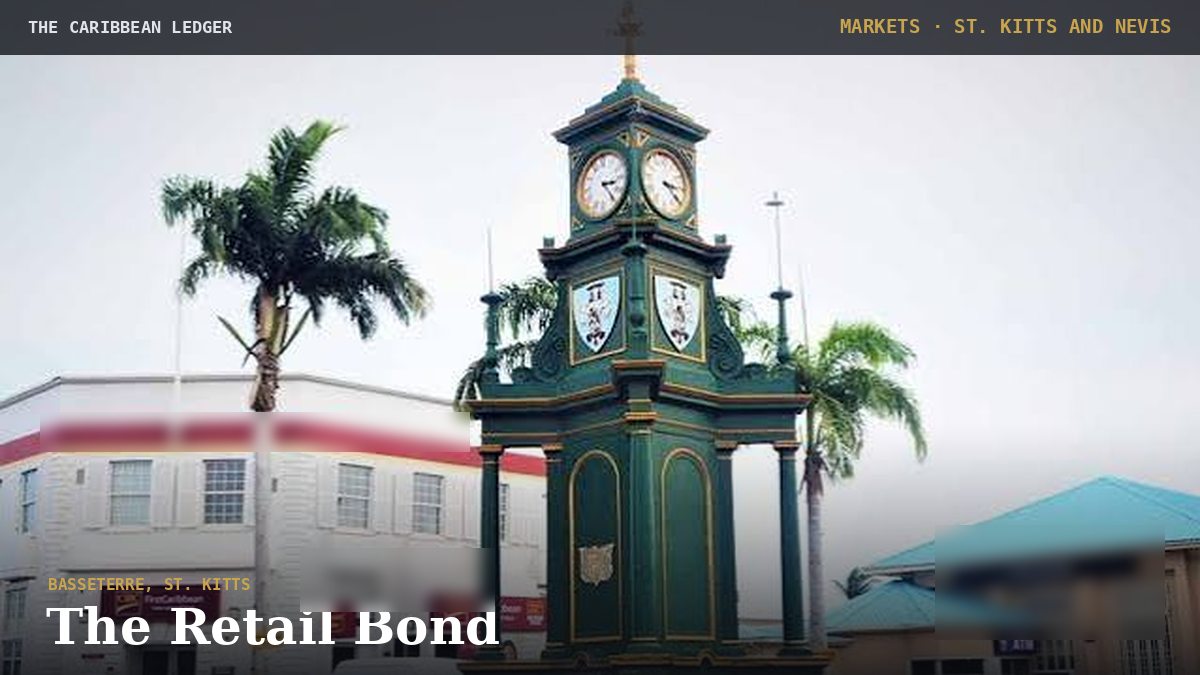
The subscription window for St. Kitts and Nevis’s first retail government bond remains open this week and is scheduled to close on October 23, giving ordinary savers a few more days to lend directly to their own government on terms designed to let almost anyone take part. The offer, which opened on September 22, was described by WINN FM and the government information service SKNIS as the first instrument of its kind the federation has brought to the retail market.
The terms are deliberately modest. The bond raises EC$5 million, pays 4.50% a year in semi-annual installments, and matures in two years. The minimum investment is EC$500, low enough for a working saver, and the maximum is EC$125,000 per investor, high enough to attract a serious individual holder while keeping the offer from being swallowed by a single institution. It trades on the Eastern Caribbean Central Bank’s Regional Government Securities Market, the shared platform on which the currency union’s governments raise money.
The significance is less about the EC$5 million, which is a small sum in the scale of a national budget, than about who is being invited to provide it. Government securities in the Eastern Caribbean have traditionally been the business of banks, insurers and other institutions. A retail bond with a EC$500 entry point is an attempt to widen that circle, to let households hold a piece of the public debt and earn a return on it rather than leaving it entirely to the financial sector. Financial Secretary Carlton Pogson and Eastern Caribbean Central Bank Governor Timothy Antoine have both framed the instrument in those terms, as a step toward deeper and more inclusive capital markets.
There is a practical case for the saver as well as the state. A 4.50% return over two years, in a currency pegged firmly to the United States dollar at EC$2.70, is a competitive rate for a low-risk instrument at a time when bank deposit rates across the union have stayed low. For the government, a retail base of lenders is a more stable and more domestically rooted source of financing than wholesale markets that can turn skittish. Money raised at home, from citizens, does not flee at the first sign of regional stress.
The timing is its own small statement. The federation is bringing retail investors into government paper at a moment when the external environment, from a crude price above US$100 to a Federal Reserve that sets the floor for dollar borrowing, is making wholesale financing more expensive across the currency union. A domestic base of small lenders is a hedge against that volatility. It also builds something less tangible, a habit of saving in instruments that pay a return, among households that have traditionally kept what they could in cash or in low-yielding deposits.
Whether the federation can build on a EC$5 million pilot will depend on how fully this first window is taken up and on whether other governments in the union follow. The Regional Government Securities Market already links the eight territories that share the Eastern Caribbean dollar, which means a successful retail model in Basseterre could be copied in the other capitals. For now, the offer is a small and quietly notable experiment in financial citizenship, and savers in St. Kitts and Nevis have until October 23 to decide whether to join it.
Read more at The Caribbean Ledger ›